Cybesecurity researchers today revealed[1]
a new malspam campaign that distributes a remote access Trojan
(RAT) by purporting to contain a sex scandal video of U.S.
President Donald Trump.
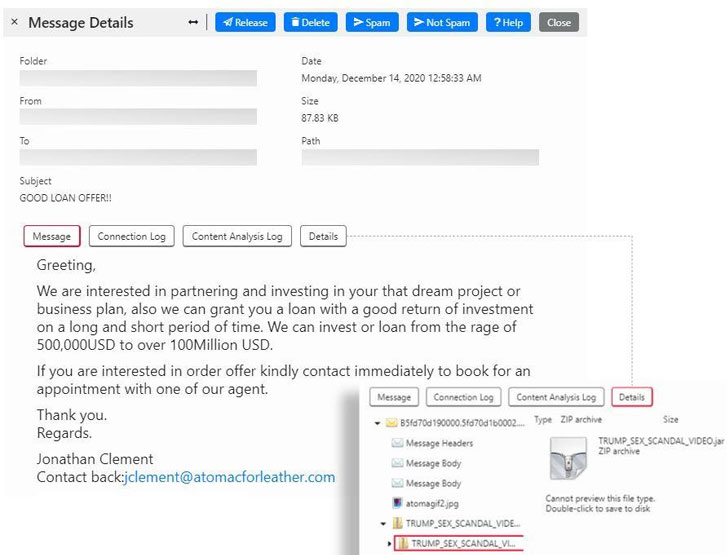
The emails, which carry with the subject line “GOOD LOAN
OFFER!!,” come attached with a Java archive (JAR) file called
“TRUMP_SEX_SCANDAL_VIDEO.jar,” which, when downloaded, installs Qua
or Quaverse RAT (QRAT[2]) onto the infiltrated
system.
“We suspect that the bad guys are attempting to ride the frenzy
brought about by the recently concluded Presidential elections
since the filename they used on the attachment is totally unrelated
to the email’s theme,” Trustwave’s Senior Security Researcher Diana
Lopera said in a write-up published today.
The latest campaign is a variant of the Windows-based QRAT
downloader Trustwave researchers discovered[3]
in August.
The infection chain starts with a spam message containing an
embedded attachment or a link pointing to a malicious zip file,
either of which retrieves a JAR file (“Spec#0034.jar”) that’s
scrambled using the Allatori[4]
Java obfuscator.
This first stage downloader sets up the Node.Js platform onto
the system and then downloads and executes a second-stage
downloader called “wizard.js” that’s responsible for achieving
persistence and fetching and running the Qnode RAT
(“qnode-win32-ia32.js”) from an attacker-controlled server.
QRAT is a typical remote access Trojan with various features
including, obtaining system information, performing file
operations, and acquiring credentials from applications such as
Google Chrome, Firefox, Thunderbird, and Microsoft Outlook.
What’s changed this time around is the inclusion of a new pop-up
alert that informs the victim that the JAR being run is a remote
access software used for penetration testing. This also means the
sample’s malicious behavior only begins to manifest once the user
clicks the “Ok, I know what I am doing.” button.

“This pop-up is a little odd and is perhaps an attempt to make
the application look legitimate, or deflect responsibility from the
original software authors,” Lopera noted.
Furthermore, the malicious code of the JAR downloader is
split-up into different randomly-numbered buffers in an attempt to
evade detection.
Other changes include an overall increase in the JAR file size
and the elimination of the second-stage downloader in favor of an
updated malware chain that immediately fetches the QRAT payload now
called “boot.js.”
For its part, the RAT has received its own share of updates,
with the code now encrypted with base64 encoding, in addition to
taking charge of persisting on the target system via a VBS
script.
“This threat has been significantly enhanced over the past few
months since we first examined it,” Topera concluded, urging
administrators to block the incoming JARs in their email security
gateways.
“While the attachment payload has some improvements over
previous versions, the email campaign itself was rather amateurish,
and we believe that the chance this threat will be delivered
successfully is higher if only the email was more
sophisticated.”