While it’s a norm for phishing campaigns that distribute
weaponized Microsoft Office documents to prompt victims to enable
macros in order to trigger the infection chain in the background,
new findings indicate that macro security warnings can be disabled
entirely without requiring any user interaction.
In yet another instance of malware authors continue to evolve
their techniques to evade detection, researchers from McAfee Labs
stumbled upon a novel tactic that “downloads and executes malicious
DLLs (ZLoader) without any malicious code present in the initial
spammed attachment macro.”
ZLoader infections[1]
propagated using this mechanism have been primarily reported in the
U.S., Canada, Spain, Japan, and Malaysia, McAfee noted. The malware
— a descendant of the infamous ZeuS banking trojan — is well known
for aggressively using macro-enabled Office documents as an initial
attack vector to steal credentials and personally identifiable
information from users of targeted financial institutions.
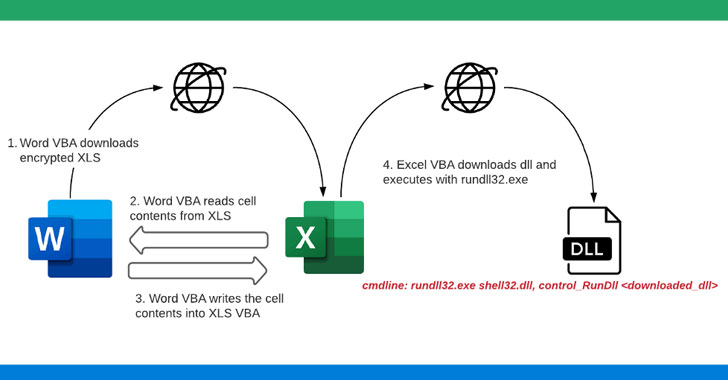
In investigating the intrusions, the researchers found that the
infection chain started with a phishing email containing a
Microsoft Word document attachment that, when opened, downloaded a
password-protected Microsoft Excel file from a remote server.
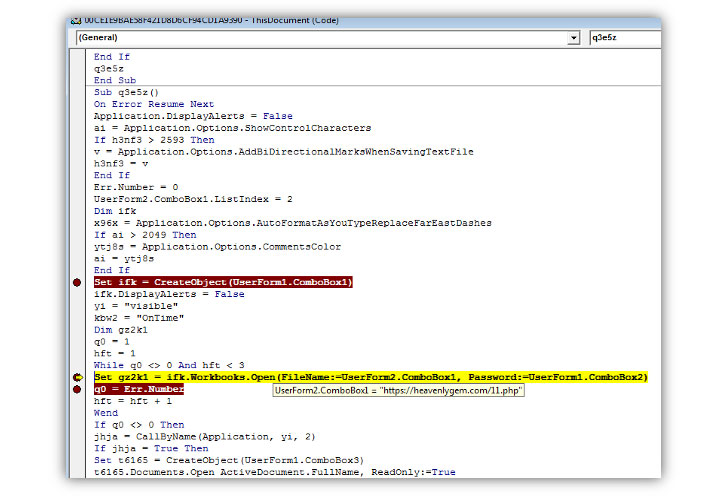
“After downloading the XLS file, the Word VBA reads the cell
contents from XLS and creates a new macro for the same XLS file and
writes the cell contents to XLS VBA macros as functions,” the
researchers said[2]. “Once the macros are
written and ready, the Word document sets the policy in the
registry to ‘Disable Excel Macro Warning’ and invokes the malicious
macro function from the Excel file. The Excel file now downloads
the Zloader payload. The Zloader payload is then executed using
rundll32.exe.”
Given the “significant security risk[3]” posed by macros, the
feature is usually disabled by default, thereby prompting threat
actors to display a convincing lure to trick victims into enabling
them. By turning off the security warning presented to the user,
the attacks are noteworthy because of the steps it takes to thwart
detection and stay under the radar.
“Malicious documents have been an entry point for most malware
families and these attacks have been evolving their infection
techniques and obfuscation, not just limiting to direct downloads
of payload from VBA, but creating agents dynamically to download
payloads,” the researchers said. “Usage of such agents in the
infection chain is not only limited to Word or Excel, but further
threats may use other living off the land tools to download its
payloads.”
References
- ^
ZLoader
infections (thehackernews.com) - ^
said
(www.mcafee.com) - ^
significant security risk
(support.microsoft.com)