Microsoft on Friday said it’s investigating an incident wherein
a driver signed by the company turned out to be a malicious Windows
rootkit that was observed communicating with command-and-control
(C2) servers located in China.
The driver, called “Netfilter[1],” is said to target
gaming environments, specifically in the East Asian country, with
the Redmond-based firm noting that “the actor’s goal is to use the
driver to spoof their geo-location to cheat the system and play
from anywhere.”
“The malware enables them to gain an advantage in games and
possibly exploit other players by compromising their accounts
through common tools like keyloggers,” Microsoft Security Response
Center (MSRC) said[2].
The rogue code signing was spotted by Karsten Hahn, a malware
analyst at German cybersecurity company G Data, who shared additional details[3]
of the rootkit, including a dropper[4], which is used to deploy
and install Netfilter on the system.
Upon successful installation, the driver was found to establish
connection with a C2 server to retrieve configuration information,
which offered a number of functionalities such as IP redirection,
among other capabilities to receive a root certificate and even
self-update the malware.
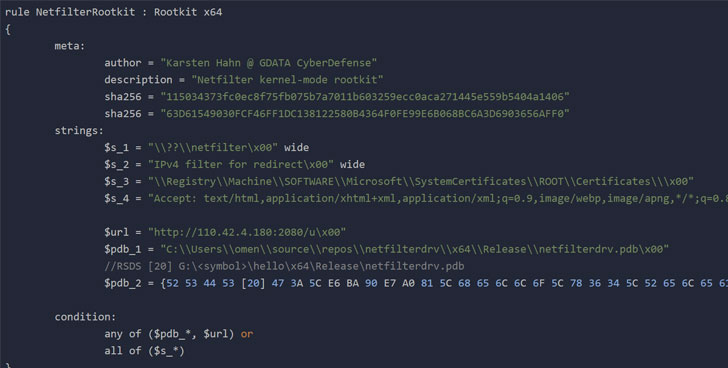
The oldest sample of Netfilter[5] detected on VirusTotal
dates back to March 17, 2021, Hahn said.
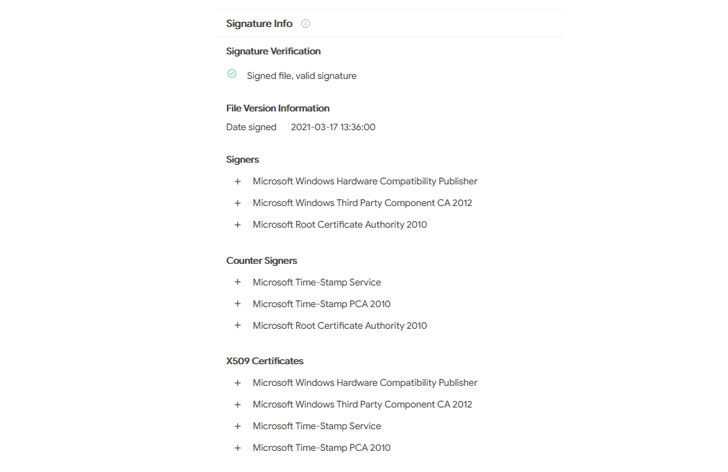
Microsoft noted that the actor submitted the driver for
certification through the Windows Hardware Compatibility Program
(WHCP[6]), and that the drivers
were built by a third-party. The company has since suspended the
account and reviewed its submissions for additional signs of
malware.
The Windows maker also stressed that the techniques employed in
the attack occur post-exploitation, which necessitates
that the adversary must have had previously gained administrative
privileges so as to be able to install the driver during system
startup or trick the user into doing it on their behalf.
Additionally, Microsoft said it intends to refine its partner
access policies as well as its validation and signing process to
enhance protections further.
“The security landscape continues to rapidly evolve as threat
actors find new and innovative methods to gain access to
environments across a wide range of vectors,” MSRC said, once again
highlighting how legitimate processes can be exploited by threat
actors to facilitate large-scale software supply chain attacks.