coronavirus crisis, cybercriminals—with no conscience and
empathy—are continuously targeting healthcare organizations,
research facilities, and other governmental organizations with
ransomware and malicious information stealers.
The new research, published by Palo Alto Networks and shared
with The Hacker News, confirmed that “the threat actors who profit
from cybercrime will go to any extent, including targeting
organizations that are in the front lines and responding to the
pandemic on a daily basis.”
While the security firm didn’t name the latest victims, it said
a Canadian government healthcare organization and a Canadian
medical research university both suffered ransomware attacks, as
criminal groups seek to exploit the crisis for financial gain.
The attacks were detected between March 24 and March 26 and were
initiated as part of the coronavirus-themed phishing campaigns that
have become widespread in recent months.
Palo Alto Networks’ disclosure comes as The U.S. Department of
Health and Human Services (HHS),
biotechnology firm 10x Genomics,
Brno University
Hospital in the Czech Republic, and Hammersmith
Medicines Research have been hit by cyberattacks in
the past few weeks.
Delivering Ransomware by Exploiting CVE-2012-0158
According to the researchers, the campaign began with malicious
emails sent from a spoofed address mimicking the World Health
Organization (noreply@who[.]int) that were sent to a number of
individuals associated with the healthcare organization that’s
actively involved in COVID-19 response efforts.
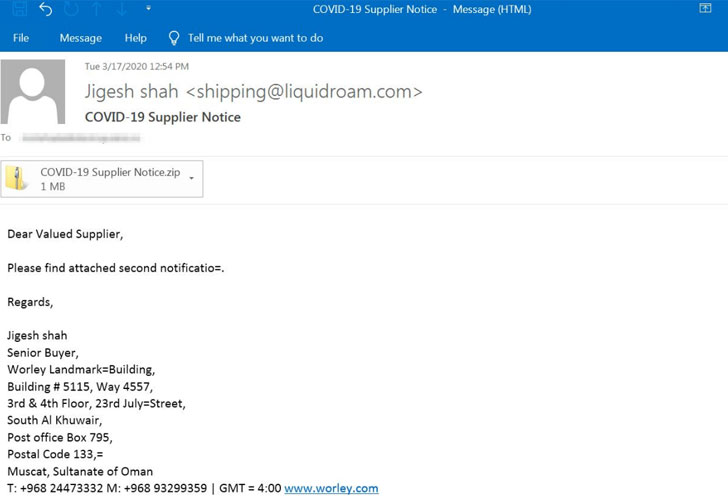
The email lures contained a rich text format (RTF) document
named “20200323-sitrep-63-covid-19.doc,” which, when opened,
attempted to deliver EDA2 ransomware by exploiting a known buffer
overflow vulnerability (CVE-2012-0158[6]) in Microsoft’s ListView
/ TreeView ActiveX controls in MSCOMCTL.OCX library.
references a specific date (March 23, 2020), the file name was not
updated over the course of the campaign to reflect current dates,”
Palo Alto Networks researchers noted.
“It is also interesting that the malware authors did not attempt
to make their lures appear legitimate in any way; it is clear from
the first page of the document that something is amiss.”
Upon execution, the ransomware binary contacts the
command-and-control (C2) server to download an image that serves as
the main ransomware infection notification on the victim’s device,
and subsequently transmits the host details to create a custom key
to encrypt the files on the system’s desktop with a “.locked20”
extension.
Aside from receiving the key, the infected host uses an HTTP
Post request to send the decryption key, encrypted using AES, to
the C2 server.
Palo Alto Networks ascertained that the ransomware strain was
EDA2 based on the code structure of the binary and the host-based
and network-based behaviors of the ransomware. EDA2 and Hidden Tear
are considered one of the first open-source
ransomware[7] that was created for
educational purposes but has since been abused by hackers to pursue
their own interests.
A Spike in Ransomware Incidents
The ransomware attacks are a consequence of an increase in other
cyberattacks related to the pandemic. They have included a rash
of phishing emails that
attempt to use the crisis to persuade people to click on links that
download malware or ransomware onto their computers.
Furthermore, Check Point Research’s Brand Phishing Report for Q1
2020 observed a jump in mobile phishing due to people spending more
time on their phones for information related to the outbreak and
for work. Attackers were found imitating popular services such as
Netflix, Airbnb, and Chase Bank to steal login credentials.
With hospitals under time constraints and pressure due to the
ongoing pandemic, hackers are counting on the organizations to pay
ransoms to recover access to critical systems and prevent
disruption to patient care.
A report released by RisKIQ[10] last week found that
ransomware attacks on medical facilities were up 35% between 2016
and 2019, with the average ransom demand being $59,000 across 127
incidents. The cybersecurity firm stated that hackers also favored
small hospitals and healthcare centers for reasons ranging from
lean security support to increased likelihood of heeding to ransom
demands.
The spike in ransomware attacks against the medical sector has
prompted Interpol[11] to issue a warning
about the threat to member countries.
“Cybercriminals are using ransomware to hold hospitals and
medical services digitally hostage, preventing them from accessing
vital files and systems until a ransom is paid,” the agency
said.
To protect the systems from such attacks, Interpol cautioned
organizations to watch out for phishing attempts, encrypt sensitive
data, and take periodic data backups, aside from storing them
offline or on a different network to thwart cybercriminals.
References
- ^
HHS
(www.reuters.com) - ^
10x Genomics
(www.bloomberg.com) - ^
Brno University Hospital
(www.novinky.cz) - ^
Hammersmith Medicines Research
(www.computerweekly.com) - ^
cyberattacks
(twitter.com) - ^
CVE-2012-0158
(nvd.nist.gov) - ^
first open-source ransomware
(blog.trendmicro.com) - ^
increase in other cyberattacks
(thehackernews.com) - ^
phishing emails
(thehackernews.com) - ^
RisKIQ
(www.riskiq.com) - ^
Interpol
(www.interpol.int)
Read more http://feedproxy.google.com/~r/TheHackersNews/~3/Hgo8AbcgGI8/ransomware-hospitals-coronavirus.html