
Two newly discovered malicious Android applications on Google
Play Store have been used to target users of Brazil’s instant
payment ecosystem in a likely attempt to lure victims into
fraudulently transferring their entire account balances into
another bank account under cybercriminals’ control.
“The attackers distributed two different variants of banking
malware, named PixStealer and MalRhino, through two
separate malicious applications […] to carry out their attacks,”
Check
Point[1] Research said in an
analysis shared with The Hacker News. “Both malicious applications
were designed to steal money of victims through user interaction
and the original PIX application.”
The two apps in question, which were uncovered in April 2021,
have since been removed from the app store.
Launched in November 2020 by the Central Bank of Brazil, the
country’s monetary authority, Pix[2]
is a state-owned payments platform that enables consumers and
companies to make money transfers from their bank accounts without
requiring debit or credit cards.
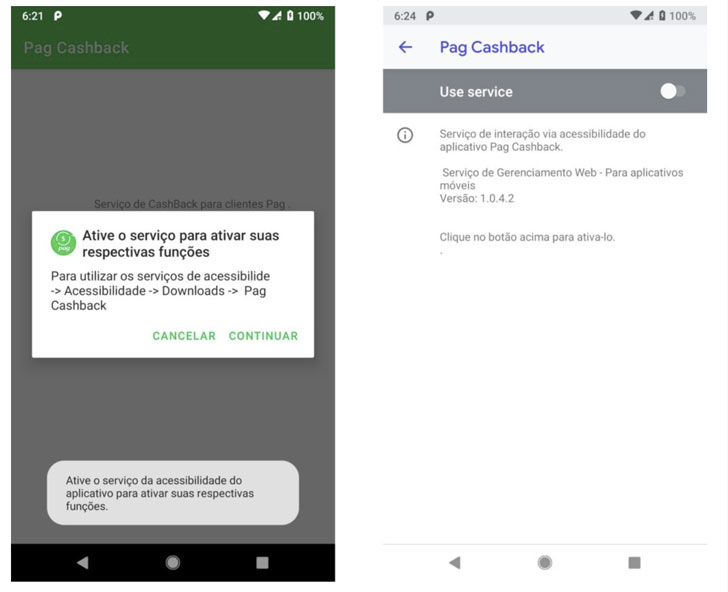
PixStealer, which was found distributed on Google Play as a fake
PagBank Cashback service app, is designed to empty a victim’s funds
to an actor-controlled account, while MalRhino — masquerading as a
mobile token app for Brazil’s Inter bank — comes with advanced
features necessary to collect the list of installed apps and
retrieve PIN for specific banks.
“When a user opens their PIX bank application, Pixstealer shows
the victim an overlay window, where the user can’t see the
attacker’s moves,” the researchers said. “Behind the overlay
window, the attacker retrieves the available amount of money and
transfers the money, often the entire account balance, to another
account.”
What unites PixStealer and MalRhino is that both the apps abuse
Android’s accessibility service to perform malicious actions on the
compromised devices, making them the latest[3]
addition[4]
to a long list[5]
of mobile malware[6]
that leverages the permission to perpetrate data theft.
Specifically, the fake overlay comes with a message
“Synchronizing your access… Do not turn off your mobile screen”
when, in reality, the malware searches for the “Transfer” button to
perform the transfer using a series of accessibility APIs.
The MalRhino variant also stands out for its use of Mozilla’s
Java-based Rhino JS framework[7]
to run JavaScript commands inside targeted banking applications,
but not before convincing the user to turn on accessibility
services.
“This technique is not commonly used on mobile malware and shows
how malicious actors are getting innovative to avoid detection and
get inside Google Play,” the researchers said. “With the increasing
abuse of the Accessibility Service by mobile banking malware, users
should be wary of enabling the relevant permissions even in the
applications distributed via known app stores such as Google
Play.”
References
- ^
Check Point
(research.checkpoint.com) - ^
Pix
(en.wikipedia.org) - ^
latest
(thehackernews.com) - ^
addition
(thehackernews.com) - ^
long
list (thehackernews.com) - ^
mobile
malware (thehackernews.com) - ^
Rhino JS
framework (en.wikipedia.org)