
sophisticated cyber-espionage campaign directed against aerospace
and military organizations in Europe and the Middle East with an
aim to spy on key employees of the targeted firms and, in some
case, even to siphon money.
The campaign, dubbed “Operation
In(ter)ception[1]” because of a reference
to “Inception” in the malware sample, took place between September
to December 2019, according to a new report cybersecurity firm ESET
shared with The Hacker News.
“The primary goal of the operation was espionage,” the
researchers told The Hacker News. “However, in one of the cases we
investigated, the attackers tried to monetize access to a victim’s
email account through a business email compromise (BEC) attack as
the final stage of the operation.”
The financial motivation behind the attacks, coupled with
similarities in targeting and development environment, have led
ESET to suspect Lazarus Group, a notorious hacking group
that’s been attributed to working on behalf of the North Korean
government to fund the country’s illicit weapon and missile
programs.
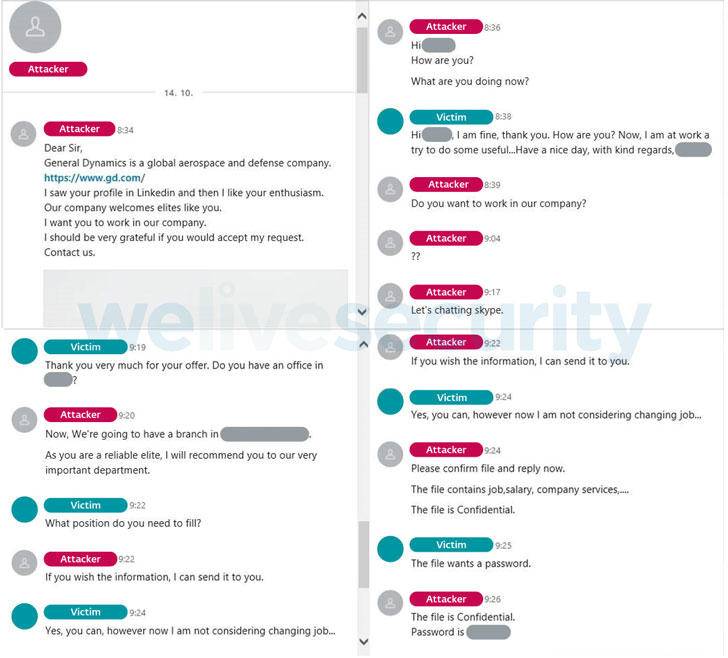
Social Engineering via LinkedIn
Stating that the campaign was highly targeted, ESET said it relied
on social engineering tricks to lure employees working for the
chosen companies with fake job offers using LinkedIn’s messaging
feature, posing as HR managers of well-known companies in the
aerospace and defense industry, including Collins Aerospace and
General Dynamics.
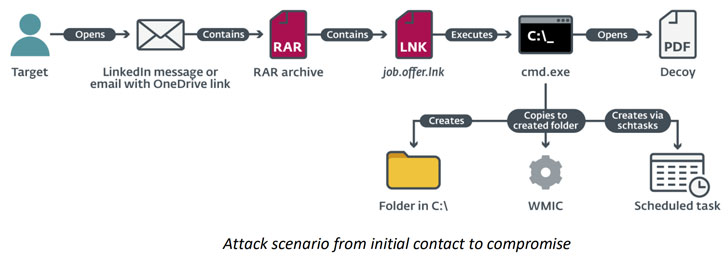
files into the communication, disguising them as documents related
to the advertised job offer,” the researchers said, based on an
investigation with two of the affected European companies.
The decoy RAR archive files, which were directly sent over the
chats or as emails sent from their fake LinkedIn personas pointing
to an OneDrive link, purported to contain a PDF document detailing
salary information of specific job positions, when in actuality, it
executed Windows’ Command Prompt utility to perform a series of
actions:
- Copy Windows Management Instrumentation command-line tool
(wmic.exe[3]) to a specific
folder - Rename it to something innocuous to evade detection (e.g.,
Intel, NVidia, Skype, OneDrive and Mozilla), and - Create scheduled tasks that execute a remote XSL script via
WMIC.
The actors behind the operation, upon gaining an initial foothold
inside the target company, went on to employ a custom malware
downloader, which in turn downloaded a previously undocumented
second-stage payload — a C++ backdoor that periodically sends
requests to an attacker-controlled server, carry out pre-defined
actions based on the received commands, and exfiltrate the
collected information as a RAR file via a modified version of
dbxcli, an
open-source command-line client for Dropbox.
In addition to using WMIC to interpret remote XSL scripts, the
adversaries also abused native Windows utilities such as “certutil”
to decode base64-encoded downloaded payloads, and “rundll32” and
“regsvr32” to run their custom malware.
Financially Motivated BEC Attacks
Besides reconnaissance, ESET researchers also found evidence of
attackers attempting to exploit the compromised accounts to extract
money from other companies.
existing email communications between the account holder and a
customer of the company to settle an outstanding invoice to a
different bank account under their control.
“As part of this ruse, the attackers registered an identical
domain name to that of the compromised company, but on a different
top-level domain, and used an email associated with this fake
domain for further communication with the targeted customer,” ESET
said.
Ultimately, the targeted customer reached out to the correct
email address of the victim about the suspicious emails, thus
foiling the attackers’ attempt.
“Our research into Operation In(ter)ception shows again how
effective spear-phishing can be for compromising a target of
interest,” the researchers concluded.
“They were highly targeted and relied on social engineering over
LinkedIn and custom, multistage malware. To operate under the
radar, the attackers frequently recompiled their malware, abused
native Windows utilities, and impersonated legitimate software and
companies.”
References
- ^
Operation In(ter)ception
(www.welivesecurity.com) - ^
Lazarus Group
(attack.mitre.org) - ^
wmic.exe
(docs.microsoft.com) - ^
dbxcli
(github.com)
Read more http://feedproxy.google.com/~r/TheHackersNews/~3/M3JLG6tkQao/military-aerospace-hacking.html