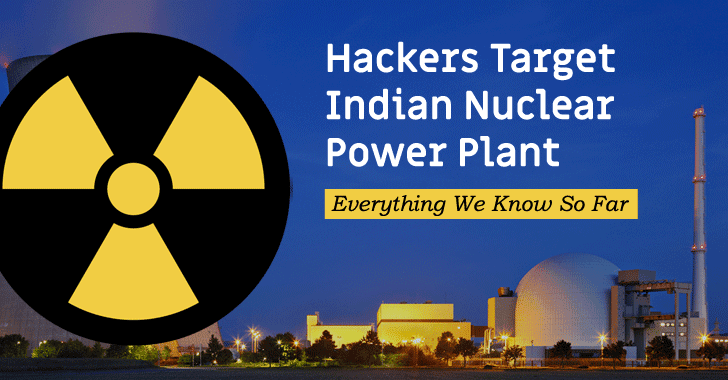
yesterday about a cyber attack on an Indian nuclear power plant.
Due to some experts commentary on social media even after lack
of information about the event and overreactions by many, the
incident received factually incorrect coverage widely suggesting a
piece of malware has compromised “mission-critical systems” at the
Kudankulam Nuclear Power Plant.
Relax! That’s not what happened. The attack merely infected a
system that was not connected to any critical controls in the
nuclear facility.
Here we have shared a timeline of the events with brief
information on everything we know so far about the cyberattack at
Kudankulam Nuclear Power Plant (KKNPP) in Tamil Nadu.
From where this news came?
The story started when Indian security researcher Pukhraj Singh
tweeted[1]
that he informed Indian authorities a few months ago about an
information-stealing malware, dubbed Dtrack, which successfully hit
“extremely mission-critical targets” at Kudankulam Nuclear Power
Plant.
According to Pukhraj, the malware managed to gain domain
controller-level access at the nuclear facility.

What is the Dtrack malware (linked to the North Korean
hackers)?
According to a previous report[2]
published by researchers at Kaspersky, Dtrack is a remote access
Trojan (RAT) intended to spy on its victims and install various
malicious modules on the targeted computers, including:
- keylogger,
- browser history stealer,
- functions that collect host IP address, information about
available networks and active connections, list of all running
processes, and also the list of all files on all available disk
volumes.
Dtrack allows remote attackers to download files to the victim’s
computer, execute malicious commands, upload data from the victim’s
computer to a remote server controlled by attackers, and more.
According to the researchers, Dtrack malware was developed by
the Lazarus Group, a hacking group believed to be working on behalf
of North Korea’s state spy agency.
How did the Indian Government respond?
Immediately after Pukhraj’s tweet, many Twitter users and Indian
opposition politicians, including Congress MP Shashi Tharoor,
demanded
an explanation[3]
from the Indian Government about the alleged cyberattack — which it
never disclosed to the public.

Corporation of India (NPCIL), a government-owned entity, on Tuesday
released an official statement, denying any cyber attack on the
control system of the nuclear power plant.
Indian Nuclear Power Plants Control are stand-alone and not
connected to outside cyber network and Internet. Any cyber-attack
on the Nuclear Power Plant Control System is not possible,” the
NPCIL statement reads.
To be honest, the statement is factually correct, except the
“not possible” part, as Pukhraj was also talking about the
compromise of the administrative IT network, not the critical
systems that control the power plant.
Indian Government later acknowledged the cyberattack,
but…
However, while primarily addressing false media reports and rumors
of Stuxnet like malware attack, the NPCIL, intentionally or
unintentionally, left an important question unanswered:
If not control systems, then which systems were actually
compromised?

released a second statement, confirming that there was indeed a
cyberattack, but it was limited only to an Internet-connected
computer used for administrative purposes, which is isolated from
any mission-critical system at the nuclear facility.
“Identification of malware in the NPCIL system is correct. The
matter was conveyed by CERT-In when it was noticed by them on
September 4, 2019,” the NPCIL statement reads.
“The investigation revealed that the infected PC belonged to a user
who was connected to the Internet-connected network. This is
isolated from the critical internal network. The networks are being
continuously monitored.”
Government has not yet attributed the attack to any group or
country.
What could attackers have achieved?
For security reasons, control processing technologies at nuclear
power plants are typically isolated from the Internet or any other
computers that are connected to the Internet or external network.
Such isolated systems are also termed as air-gapped computers
and are common in production or manufacturing environments to
maintain a gap between the administrative and operational
networks.
Compromising an Internet-connected administrative system doesn’t
allow hackers to manipulate the air-gapped control system. Still,
it certainly could allow attackers to infect other computers
connected to the same network and steal information stored in them.
If we think like a hacker who wants to sabotage a nuclear
facility, the first step would be collecting as much information
about the targeted organization as possible, including type of
devices and equipment being used in the facility, to determine the
next possible ways to jump through air gaps.
The Dtrack malware could be the first phase of a bigger
cyber-attack that, fortunately, get spotted and raised the alarm
before causing any chaos.
However, it has not yet been revealed, by researchers or the
Government, that what kind of data the malware was able to steal,
analysis of which could be helpful to shed more light on the
gravity of the incident.
The Hacker News will update the article when more information
becomes available on this incident. Stay Tuned!
References
Read more http://feedproxy.google.com/~r/TheHackersNews/~3/B5h9TuIBD74/nuclear-power-plant-cyberattack.html