
A North Korean government-backed campaign targeting
cybersecurity researchers with malware has re-emerged with new
tactics in their arsenal as part of a fresh social engineering
attack.
In an update shared on Wednesday, Google’s Threat Analysis Group
said the attackers behind the operation set up a fake security
company called SecuriElite and a slew of social media accounts
across Twitter and LinkedIn in an attempt to trick unsuspecting
researchers into visiting the company’s booby-trapped website
“where a browser exploit was waiting to be triggered.”
“The new website claims the company is an offensive security
company located in Turkey that offers pentests, software security
assessments and exploits,” TAG’s Adam Weidemann said[1]. The website is said to
have gone live on March 17.
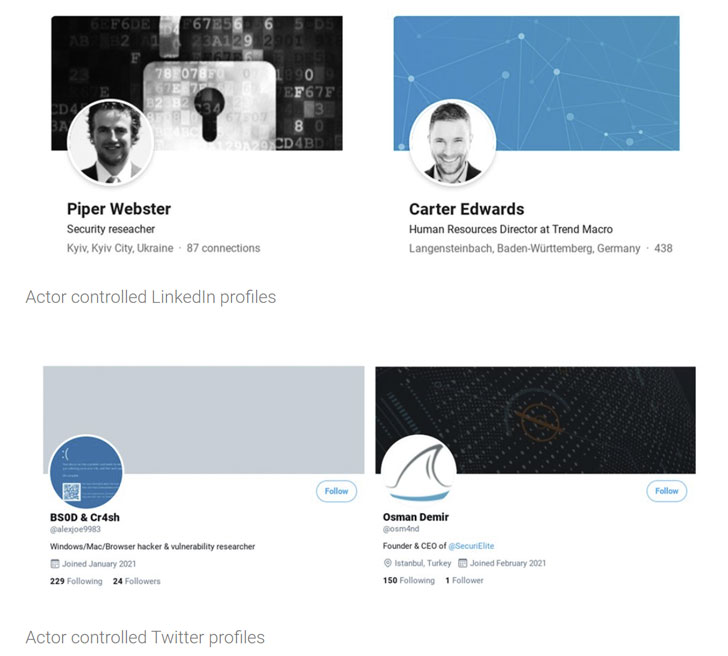
A total of eight Twitter profiles and seven LinkedIn profiles,
who claimed to be vulnerability researchers and human resources
personnel at different security firms (including Trend Macro,
inspired by Trend Micro), were created for this purpose, with a few
others posing as the chief executive officer and employees at the
fictitious company. All the accounts have since been suspended.
The campaign was initially flagged by TAG[2] in January 2021, when it
came to light that the adversary had created a research blog and
multiple profiles on various social media platforms such as
Twitter, LinkedIn, Telegram, Discord, and Keybase in a bid to
communicate with the researchers and build trust, only to deploy a
Windows backdoor that came in the form of a trojanized Visual
Studio Project.
Following the disclosure, researchers from South Korean
cybersecurity firm ENKI revealed a zero-day in Internet Explorer[3] that it said allowed the
hackers to access the devices managed by its security team with
malicious MHTML files. Microsoft later addressed the issue in its
Patch Tuesday update[4]
for March 2021.
As a precaution, Google has added the website’s URL to its
Safebrowsing blocklist service[5] to prevent accidental
visits, even though the site hasn’t been found to serve any
malicious content.
If anything, the latest development is yet another example of
attackers quickly shifting gears when their methods are discovered
and exposed publicly.
The real motive behind the attacks remains unclear as yet,
although it’s being suspected that the threat actor may be
attempting to stealthily gain a foothold on systems in order to get
hold of zero-day research, and in the process, use those unpatched
vulnerabilities to stage further attacks on vulnerable targets of
their choice.
References
- ^
said
(blog.google) - ^
initially flagged by TAG
(thehackernews.com) - ^
zero-day
in Internet Explorer (thehackernews.com) - ^
Patch
Tuesday update (thehackernews.com) - ^
Safebrowsing blocklist service
(thehackernews.com)