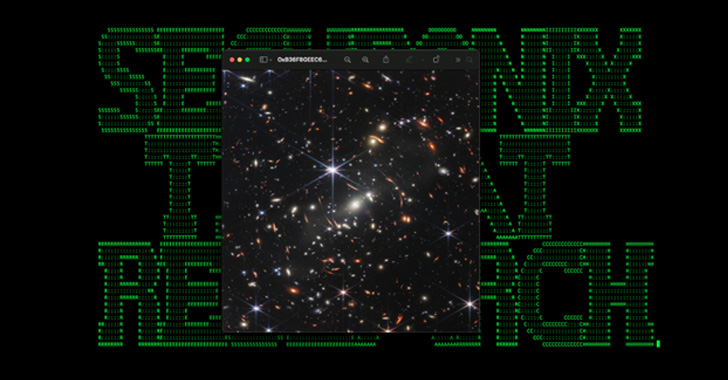
A persistent Golang-based malware campaign dubbed
GO#WEBBFUSCATOR has leveraged the deep field image taken from
NASA’s James Webb Space Telescope (JWST) as a lure to deploy
malicious payloads on infected systems.
The development, revealed by Securonix, points to the
growing adoption of Go among threat actors, given the programming
language’s cross-platform support, effectively allowing the
operators to leverage a common codebase to target different
operating systems.
Go binaries also have the added benefit of rendering analysis
and reverse engineering difficult as opposed to malware written in
other languages like C++ or C#, not to mention prolong analysis and
detection attempts.
Phishing emails containing a Microsoft Office attachment act as
the entry point for the attack chain that, when opened, retrieves
an obfuscated VBA macro, which, in turn, is auto-executed should
the recipient enable macros.
The execution of the macro results in the download of an image
file “OxB36F8GEEC634.jpg” that seemingly is an image of the
First Deep Field[1]
captured by JWST but, when inspected using a text editor, is
actually a Base64-encoded payload.
“The deobfuscated [macro] code executes [a command] which will
download a file named OxB36F8GEEC634.jpg, use certutil.exe[2]
to decode it into a binary (msdllupdate.exe) and then finally,
execute it,” Securonix researchers D. Iuzvyk, T. Peck, and O.
Kolesnikov said[3].
The binary, a Windows 64-bit executable with a size of 1.7MB, is
not only equipped to fly under the radar of antimalware engines,
but is also obscured by means of a technique called gobfuscation,
which makes use of a Golang obfuscation
tool[4] publicly available on
GitHub.
The gobfuscate library has been previously documented as used by
the actors behind ChaChi[5], a remote access trojan
employed by the operators of the PYSA[6]
(aka Mespinoza) ransomware as part of their toolset, and the
Sliver[7]
command-and-control (C2) framework.
Communication with the C2 server is facilitated through
encrypted DNS queries and responses, enabling the malware to run
commands sent by the server through the Windows Command Prompt
(cmd.exe). The C2 domains for the campaign are said to have been
registered in late May 2022.
Microsoft’s decision to block macros by default[8]
across Office apps has led many an adversary to tweak their
campaigns by switching to rogue LNK and ISO files[9]
for deploying malware. It remains to be seen if the GO#WEBBFUSCATOR
actors will embrace a similar attack method.
“Using a legitimate image to build a Golang binary with Certutil
is not very common,” the researchers said, adding, “it’s clear that
the original author of the binary designed the payload with both
some trivial counter-forensics and anti-EDR detection methodologies
in mind.”
References
- ^
First
Deep Field (www.nasa.gov) - ^
certutil.exe
(docs.microsoft.com) - ^
said
(www.securonix.com) - ^
Golang
obfuscation tool (github.com) - ^
ChaChi
(blogs.blackberry.com) - ^
PYSA
(thehackernews.com) - ^
Sliver
(thehackernews.com) - ^
block
macros by default (thehackernews.com) - ^
rogue
LNK and ISO files (www.sentinelone.com)
Read more https://thehackernews.com/2022/08/hackers-hide-malware-in-stunning-images.html