
An unidentified threat actor has been exploiting a now-patched
zero-day flaw in Internet Explorer browser to deliver a
fully-featured VBA-based remote access trojan (RAT) capable of
accessing files stored in compromised Windows systems, and
downloading and executing malicious payloads as part of an
“unusual” campaign.
The backdoor is distributed via a decoy document named
“Manifest.docx” that loads the exploit code for the vulnerability
from an embedded template, which, in turn, executes shellcode to
deploy the RAT, according to cybersecurity firm Malwarebytes, which
spotted the suspicious Word file on July 21, 2021.
The malware-laced document claims to be a “Manifesto of the
inhabitants of Crimea” calling on the citizens to oppose Russian
President Vladimir Putin and “create a unified platform called
‘People’s Resistance.'”
The Internet Explorer flaw, tracked as CVE-2021-26411, is
notable for the fact that it was abused by the North Korea-backed
Lazarus Group to target security researchers[1] working on vulnerability
research and development.
Earlier this February, South Korean cybersecurity firm ENKI
revealed[2]
the state-aligned hacking collective had made an unsuccessful
attempt at targeting its security researchers with malicious MHTML
files that, when opened, downloaded two payloads from a remote
server, one of which contained a zero-day against Internet
Explorer. Microsoft addressed the issue[3]
as part of its Patch Tuesday updates for March.
The Internet Explorer exploit is one of the two ways that’s used
to deploy the RAT, with the other method relying on a social
engineering component that involves downloading and executing a
remote macro-weaponized template containing the implant. Regardless
of the infection chain, the use of double attack vectors is likely
an attempt to increase the likelihood of finding a path into the
targeted machines.
“While both techniques rely on template injection to drop a
full-featured remote access trojan, the IE exploit (CVE-2021-26411)
previously used by the Lazarus APT is an unusual discovery,”
Malwarebytes researcher Hossein Jazi said in a report[4]
shared with The Hacker News. “The attackers may have wanted to
combine social engineering and exploit to maximize their chances of
infecting targets.”
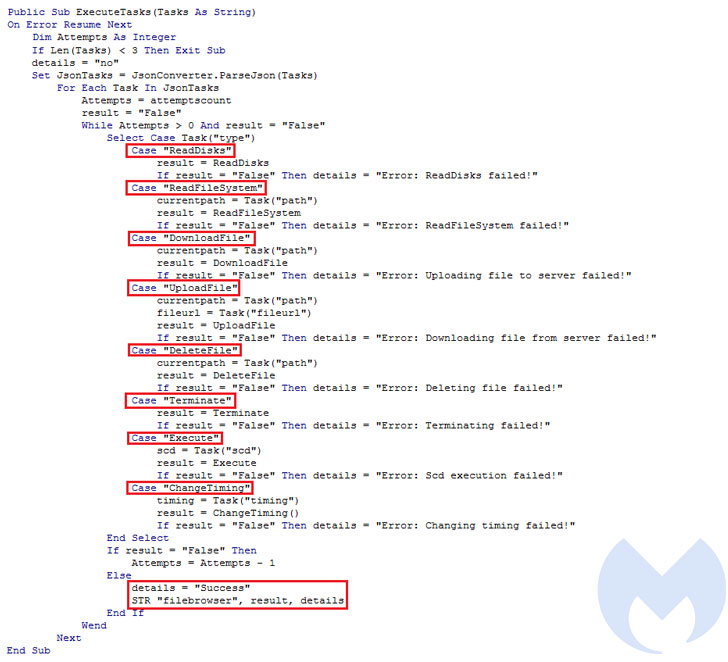
Besides collecting system metadata, the VBA RAT is orchestrated
to identify antivirus products running on the infected host and
execute commands it receives from an attacker-controlled server,
including reading, deleting, and downloading arbitrary files, and
exfiltrate the results of those commands back to the server.
Also discovered by Malwarebytes is a PHP-based panel nicknamed
“Ekipa” that’s used by the adversary to track victims and view
information about the modus operandi that led to the successful
breach, highlighting successful exploitation using the IE zero-day
and the execution of the RAT.
“As the conflict between Russia and
Ukraine[5] over Crimea continues,
cyber attacks have been increasing as well,” Jazi said. “The decoy
document contains a manifesto that shows a possible motive (Crimea)
and target (Russian and pro-Russian individuals) behind this
attack. However, it could also have been used as a false flag.”
References
- ^
target
security researchers (thehackernews.com) - ^
revealed
(enki.co.kr) - ^
addressed the issue
(thehackernews.com) - ^
report
(blog.malwarebytes.com) - ^
conflict
between Russia and Ukraine
(en.wikipedia.org)