Misconfigurations in smart contracts are being exploited by
scammers to create malicious cryptocurrency tokens with the goal of
stealing funds from unsuspecting users.
The instances of token fraud in the wild include hiding 99% fee
functions and concealing backdoor routines, researchers from
Check Point[1]
said in a report shared with The Hacker News.
Smart contracts are programs[2]
stored on the blockchain that are automatically executed when
predetermined conditions are met according to the terms of a
contract or an agreement. They allow trusted transactions and
agreements to be carried out between anonymous parties without the
need for a central authority.
By examining the Solidity[3] source code used for
implementing smart contracts, the Israeli cybersecurity company
found instances of hidden[4]
and hardcoded fees[5]
that can’t be changed, while allowing malicious actors to exert
control over “who is allowed to sell.”
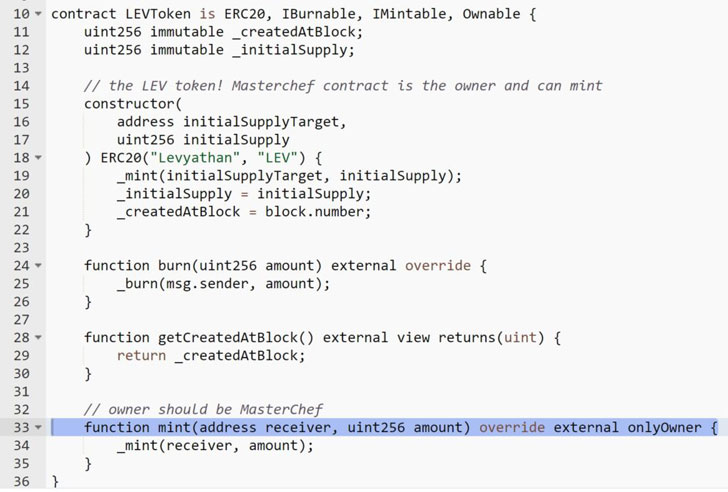
In another instance, a legitimate contract called Levyathan[6]
was hacked[7]
after its developers inadvertently uploaded the wallet’s private
key to their GitHub repository, enabling[8]
the exploiter to mint an infinite number of tokens and steal funds
from the contract in July 2021.
A rug pull is a type of scam that happens when the creators cash
out out the investors’ money and abandon the project after a huge
amount is allocated to what appears to be a legitimate crypto
project.
Lastly, poor access controls put in place by the maintainers of
the Zenon Network allowed an attacker to abuse the unprotected burn
function within the smart contract to ramp up the price of the coin
and drain funds[9]
to the tune of $814,570 in November 2021.
The findings come as cyberattack campaigns have been observed
leveraging phishing schemes built on lures surrounding
soon-to-be-released (albeit fake) crypto tokens to ultimately trick
victims into paying for it with their own cryptocurrency.
“On top of that, to engage other victims and perpetuate the
scam, the website offered a referral program for friends and
family,” Akamai researcher Or Katz said[10]. “In doing this, the
threat actors created a new trustworthy channel through which
current victims referred [to] other potential targets.”
“The implication is that crypto users will continue to fall into
these traps, and will lose their money,” Oded Vanunu, head of
products vulnerabilities research at Check Point, said. “To avoid
scam coins, I recommend crypto users to diversify their wallets,
ignore ads, and test their transactions.”
References
- ^
Check
Point (research.checkpoint.com) - ^
programs
(en.wikipedia.org) - ^
Solidity
(en.wikipedia.org) - ^
hidden
(bscscan.com) - ^
hardcoded fees
(bscscan.com) - ^
Levyathan
(bscscan.com) - ^
hacked
(levyathan-index.medium.com) - ^
enabling
(levyathan-index.medium.com) - ^
drain
funds (twitter.com) - ^
said
(www.akamai.com)
Read more https://thehackernews.com/2022/01/hackers-creating-fraudulent-crypto.html