technique to remotely inject inaudible and invisible commands into
voice-controlled devices — all just by shining a laser at the
targeted device instead of using spoken words.
Dubbed ‘Light Commands,’ the hack relies on a
vulnerability in MEMS microphones embedded in widely-used popular
voice-controllable systems that unintentionally respond to light as
if it were sound.
According to experiments done by a team of researchers from
Japanese and Michigan Universities, a remote attacker standing at a
distance of several meters away from a device can covertly trigger
the attack by simply modulating the amplitude of laser light to
produce an acoustic pressure wave.
“By modulating an electrical signal in the intensity of a light
beam, attackers can trick microphones into producing electrical
signals as if they are receiving genuine audio,” the researchers
said in their paper [PDF].
[1]
Doesn’t this sound creepy? Now read this part carefully…
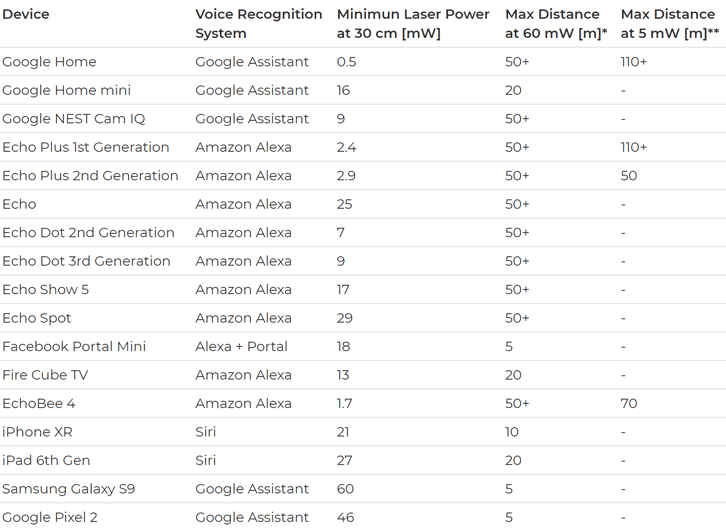
Smart voice assistants in your phones, tablets, and other smart
devices, such as Google Home and Nest Cam IQ, Amazon Alexa and
Echo, Facebook Portal, Apple Siri devices, are all vulnerable to
this new light-based signal injection attack.
“As such, any system that uses MEMS microphones and acts on this
data without additional user confirmation might be vulnerable,” the
researchers said.
as a legitimate user, the impact of such an attack can be evaluated
based on the level of access your voice assistants have over other
connected devices or services.
Therefore, with the light commands attack, the attackers can
also hijack any digital smart systems attached to the targeted
voice-controlled assistants, for example:
- Control smart home switches,
- Open smart garage doors,
- Make online purchases,
- Remotely unlock and start certain vehicles,
- Open smart locks by stealthily brute-forcing the user’s PIN
number.
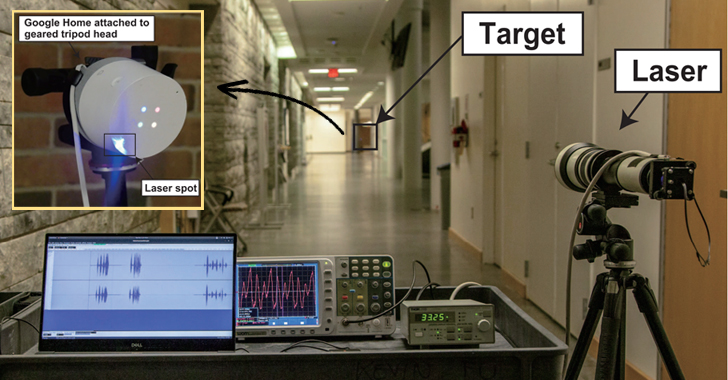
As shown in the video demonstration listed below: In one of their
experiments, researchers simply injected “OK Google, open the
garage door” command to a Google Home by shooting a laser beam at
Google Home that was connected to it and successfully opened a
garage door.
In a second experiment, the researchers successfully issued the
same command, but this time from a separate building, about 230
feet away from the targeted Google Home device through a glass
window.
Besides longer-range devices, researchers were also able to test
their attacks against a variety of smartphone devices that use
voice assistants, including iPhone XR, Samsung Galaxy S9, and
Google Pixel 2, but they work only at short distances.
According to the researchers, these attacks can be mounted
“easily and cheaply,” using a simple laser pointer (under $20), a
laser driver ($339), and a sound amplifier ($28). For their set up,
they also used a telephoto lens ($199.95) to focus the laser for
long-range attacks.
How can you protect yourself against the light vulnerability in
real-life? The best and common solution is to keep your voice
assistant of the line of sight from outside and avoid giving it
access to things that you don’t want someone else to access.
University of Electro-Communications and Mr. Fu, Daniel Genkin,
Sara Rampazzi, and Benjamin Cyr from the University of
Michigan—also released their findings in a paper [PDF] on Monday.
Genkin was also one of the researchers who discovered two major
microprocessor vulnerabilities, known as Meltdown and
Spectre[3], last year.
References
Read more http://feedproxy.google.com/~r/TheHackersNews/~3/qfTKEDAHKrY/hacking-voice-assistant-laser.html