Feb 01, 2023Ravie Lakshmanan
Microsoft on Tuesday said it took steps to disable fake
Microsoft Partner Network (MPN) accounts that were used for
creating malicious OAuth[1]
applications as part of a malicious campaign designed to breach
organizations’ cloud environments and steal email.
“The applications created by these fraudulent actors were then
used in a consent phishing campaign, which tricked users into
granting permissions to the fraudulent apps,” the tech giant
said[2]. “This phishing campaign
targeted a subset of customers primarily based in the U.K. and
Ireland.”
Consent phishing is a social engineering attack[3] wherein users are
tricked into granting permissions to malicious cloud applications,
which can then be weaponized to gain access to legitimate cloud
services and sensitive user data.
The Windows maker said it became aware of the campaign on
December 15, 2022. It has since alerted affected customers via
email, with the company noting that the threat actors abused the
consent to exfiltrate mailboxes.
On top of that, Microsoft said it implemented additional
security measures to improve the vetting process associated with
the Microsoft Cloud Partner Program[4] (formerly MPN) and
minimize the potential for fraud in the future.
The disclosure coincides with a report released[5]
by Proofpoint about how threat actors have successfully exploited
Microsoft’s “verified publisher[6]” status to infiltrate
the cloud environments of organizations.
What’s notable about the campaign is that by mimicking popular
brands, it was also successful at fooling Microsoft in order to
gain the blue verified badge. “The actor used fraudulent partner
accounts to add a verified publisher to OAuth app registrations
they created in Azure AD,” the company explained.
These attacks, which were first observed on December 6, 2022,
employed lookalike versions of legitimate apps like Zoom to deceive
targets into authorizing access and facilitate data theft. Targets
included financial, marketing, managers, and senior executives.
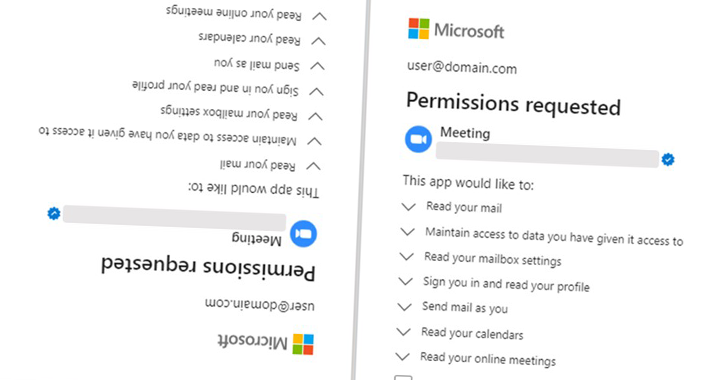
Proofpoint noted the malicious OAuth apps had “far-reaching
delegated permissions” such as reading emails, adjusting mailbox
settings, and gaining access to files and other data connected to
the user’s account.
It also said that unlike a previous campaign[7]
that compromised existing Microsoft verified publishers to take
advantage of OAuth app privileges, the latest attacks are designed
to impersonate legitimate publishers to become verified and
distribute the rogue apps.
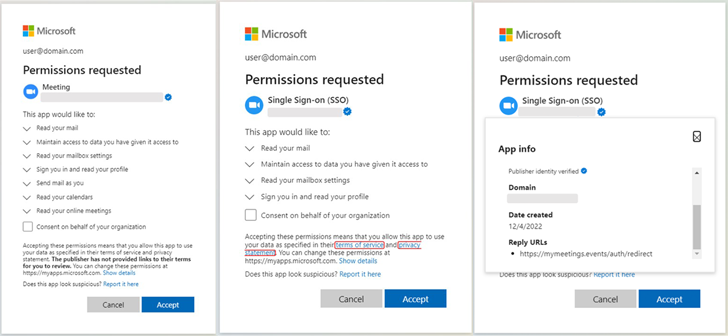
Two of the apps in question were named “Single Sign-on (SSO),”
while the third app was called “Meeting” in an attempt to
masquerade as video conferencing software. All three apps, created
by three different publishers, targeted the same companies and
leveraged the same attacker-controlled infrastructure.
“The potential impact to organizations includes compromised user
accounts, data exfiltration, brand abuse of impersonated
organizations, business email compromise (BEC) fraud, and mailbox
abuse,” the enterprise security firm said.
The campaign is said to have come to an end on December 27,
2022, after Proofpoint informed Microsoft of the attack on December
20 and the apps were disabled.
The findings demonstrate the sophistication that has gone into
mounting the attack, not to mention bypass Microsoft’s security
protections and misuse the trust users place in enterprise vendors
and service providers.
This is not the first time bogus OAuth apps have been used to
target Microsoft’s cloud services. In January 2022, Proofpoint
detailed another threat activity dubbed OiVaVoii[8]
that targeted high-level executives to seize control of their
accounts.
Then in September 2022, Microsoft revealed[9]
that it dismantled an attack that made use of rogue OAuth
applications deployed on compromised cloud tenants to ultimately
seize control of Exchange servers and distribute spam.
Found this article interesting? Follow us on Twitter [10] and LinkedIn[11] to read more exclusive
content we post.
References
- ^
OAuth
(en.wikipedia.org) - ^
said
(msrc-blog.microsoft.com) - ^
social
engineering attack (learn.microsoft.com) - ^
Microsoft Cloud Partner Program
(partner.microsoft.com) - ^
released
(www.proofpoint.com) - ^
verified
publisher (learn.microsoft.com) - ^
previous
campaign (www.proofpoint.com) - ^
OiVaVoii
(www.proofpoint.com) - ^
revealed
(thehackernews.com) - ^
Twitter
(twitter.com) - ^
LinkedIn
(www.linkedin.com)
Read more https://thehackernews.com/2023/02/hackers-abused-microsofts-verified.html