Dec 26, 2022Ravie Lakshmanan
Cybersecurity researchers have exposed a wide variety of
techniques adopted by an advanced malware downloader called
GuLoader to evade security software.
“New shellcode anti-analysis technique attempts to thwart
researchers and hostile environments by scanning entire process
memory for any virtual machine (VM)-related strings,” CrowdStrike
researchers Sarang Sonawane and Donato Onofri said[1]
in a technical write-up published last week.
GuLoader, also called CloudEyE[2], is a Visual Basic
Script (VBS) downloader that’s used to distribute remote access
trojans on infected machines. It was first detected in the wild in
2019.
In November 2021, a JavaScript malware strain dubbed
RATDispenser emerged[3]
as a conduit for dropping GuLoader by means of a Base64-encoded
VBScript dropper.
A recent GuLoader sample unearthed by CrowdStrike exhibits a
three-stage process wherein the VBScript is designed to deliver a
next-stage that performs anti-analysis checks before injecting
shellcode embedded within the VBScript into memory.
The shellcode, besides incorporating the same anti-analysis
methods, downloads a final payload of the attacker’s choice from a
remote server and executes it on the compromised host.
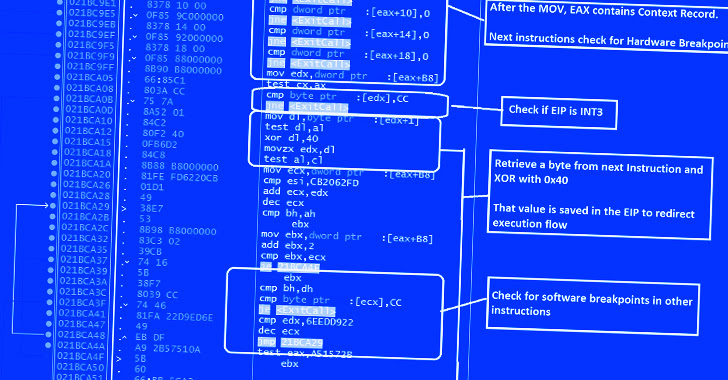
“The shellcode employs several anti-analysis and anti-debugging
tricks at every step of execution, throwing an error message if the
shellcode detects any known analysis of debugging mechanisms,” the
researchers pointed out.
This includes anti-debugging and anti-disassembling checks to
detect the presence of a remote debugger and breakpoints, and if
found, terminate the shellcode. The shellcode also features scans
for virtualization software.
An added capability is what the cybersecurity company calls a
“redundant code injection mechanism” to avoid NTDLL.dll[4]
hooks implemented by endpoint detection and response (EDR)
solutions.
NTDLL.dll API hooking[5]
is a technique[6]
used[7]
by anti-malware engines to detect and flag suspicious processes on
Windows by monitoring the APIs that are known to be abused by
threat actors.
In a nutshell, the method involves using assembly instructions
to invoke the necessary windows API function to allocate memory
(i.e., NtAllocateVirtualMemory[8]) and inject arbitrary
shellcode into memory via process hollowing[9].
The findings from CrowdStrike also come as cybersecurity firm
Cymulate demonstrated an EDR bypass technique known as Blindside[10] that allows for running
arbitrary code by using hardware breakpoints to create a “process
with only the NTDLL in a stand-alone, unhooked state.”
“GuLoader remains a dangerous threat that’s been constantly
evolving with new methods to evade detection,” the researchers
concluded.
Found this article interesting? Follow us on Twitter [11] and LinkedIn[12] to read more exclusive
content we post.
References
- ^
said
(www.crowdstrike.com) - ^
CloudEyE
(malpedia.caad.fkie.fraunhofer.de) - ^
emerged
(thehackernews.com) - ^
NTDLL.dll
(learn.microsoft.com) - ^
hooking
(learn.microsoft.com) - ^
technique
(www.mdsec.co.uk) - ^
used
(cymulate.com) - ^
NtAllocateVirtualMemory
(learn.microsoft.com) - ^
process
hollowing (attack.mitre.org) - ^
Blindside
(cymulate.com) - ^
Twitter
(twitter.com) - ^
LinkedIn
(www.linkedin.com)
Read more https://thehackernews.com/2022/12/guloader-malware-utilizing-new.html