Jan 29, 2023Ravie Lakshmanan

The threat actors associated with the Gootkit malware have made
“notable changes” to their toolset, adding new components and
obfuscations to their infection chains.
Google-owned Mandiant is monitoring[1]
the activity cluster under the moniker UNC2565,
noting that the usage of the malware is “exclusive to this
group.”
Gootkit[2], also called Gootloader,
is spread through compromised websites that victims are tricked
into visiting when searching for business-related documents like
agreements and contracts via a technique called search engine
optimization (SEO) poisoning.
The purported documents take the form of ZIP archives that
harbor the JavaScript malware, which, when launched, paves the way
for additional payloads such as Cobalt Strike Beacon[3], FONELAUNCH, and
SNOWCONE.
FONELAUNCH is a .NET-based loader designed to load an encoded
payload into memory, and SNOWCONE is a downloader that’s tasked
with retrieving next-stage payloads, typically IcedID[4], via HTTP.
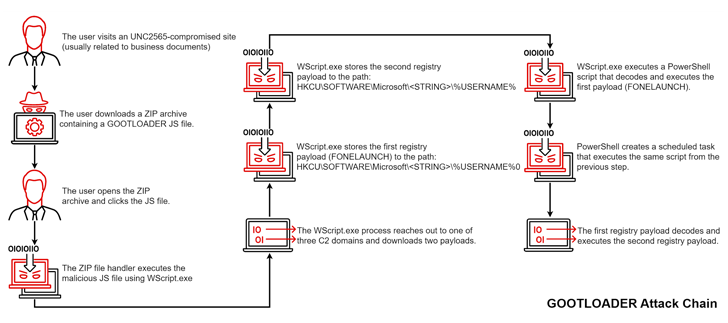
While the overarching goals of Gootkit have remained unchanged,
the attack sequence in itself has received significant updates,
wherein the JavaScript file within the ZIP archive is trojanized
and contains another obfuscated JavaScript file that consequently
proceeds to execute the malware.
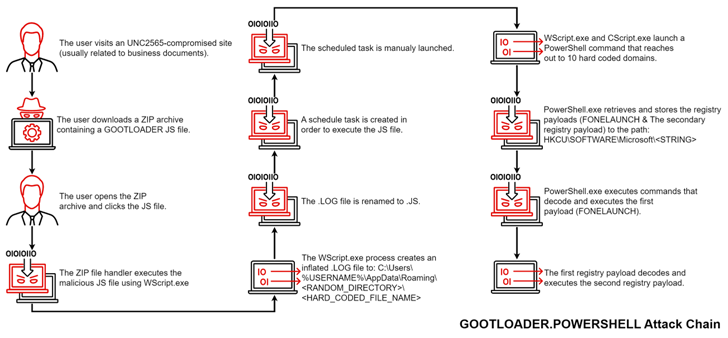
The new variant, which was spotted by the threat intelligence
firm in November 2022, is being tracked as GOOTLOADER.POWERSHELL.
It’s worth noting that the revamped infection chain was also
documented[5]
by Trend Micro earlier this month, detailing Gootkit attacks
targeting the Australian healthcare sector.
What’s more, the malware authors are said to have taken three
different approaches to obscure Gootkit, including concealing the
code within altered versions of legitimate JavaScript libraries
such as jQuery, Chroma.js, and Underscore.js, in an attempt to
escape detection.
It’s not just Gootkit, as three different flavors of FONELAUNCH
– FONELAUNCH.FAX, FONELAUNCH.PHONE, and FONELAUNCH.DIALTONE – have
been put to use by UNC2565 since May 2021 to execute DLLs, .NET
binaries, and PE files, indicating that the malware arsenal is
being continuously maintained and updated.
“These changes are illustrative of UNC2565’s active development
and growth in capabilities,” Mandiant researchers Govand Sinjari
and Andy Morales said.
Found this article interesting? Follow us on Twitter [6]
and LinkedIn[7]
to read more exclusive content we post.
References
- ^
monitoring
(www.mandiant.com) - ^
Gootkit
(thehackernews.com) - ^
Cobalt
Strike Beacon (thehackernews.com) - ^
IcedID
(thehackernews.com) - ^
documented
(thehackernews.com) - ^
Twitter
(twitter.com) - ^
LinkedIn
(www.linkedin.com)
Read more https://thehackernews.com/2023/01/gootkit-malware-continues-to-evolve.html