
Your iPhone can be hacked just by visiting an innocent-looking
website, confirms a terrifying report Google researchers released
earlier today.
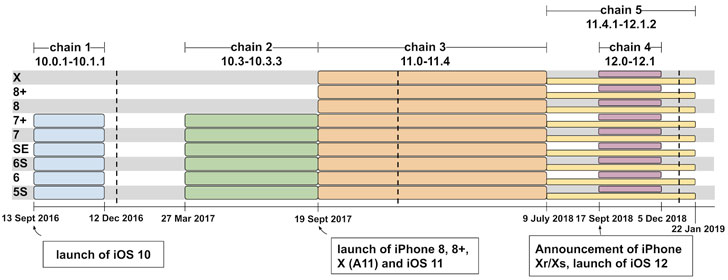
The story goes back to a widespread iPhone hacking campaign that
cybersecurity researchers from Google’s Project Zero discovered
earlier this year in the wild, involving at least five unique
iPhone exploit chains capable of remotely jailbreaking an iPhone
and implanting spyware on it.
Those iOS exploit chains were found exploiting a total of 14
separate vulnerabilities in Apple’s iOS mobile operating system—of
which 7 flaws resided in Safari web browser, 5 in the iOS kernel
and 2 separate sandbox escape issues—targeting devices with almost
every version in that time-frame from iOS 10 through to the latest
version of iOS 12.
According to a deep-dive blog post
published by Project Zero researcher Ian Beer, only two of the 14
security vulnerabilities were zero-days, CVE-2019-7287 and
CVE-2019-7286, and unpatched at the time of discovery—and
surprisingly, the campaign remained undetected for at least two
years.
then-zero-day vulnerabilities were not available at that time,
The Hacker News
warned about both the flaws in February after Apple released
iOS version 12.1.4 to address them.
“We reported these issues to Apple with a 7-day deadline on 1 Feb
2019, which resulted in the out-of-band release of iOS 12.1.4 on 7
Feb 2019. We also shared the complete details with Apple, which
were disclosed publicly on 7 Feb 2019,” Beer says.
out through a small collection of hacked websites with thousands of
visitors per week, targeting every iOS user landing on those
websites without discrimination.
“Simply visiting the hacked site was enough for the exploit
server to attack your device, and if it was successful, install a
monitoring implant,” Beer says.
Once an iPhone user visited one of the hacked websites through
the vulnerable Safari web browser, it triggered WebKit exploits for
each exploit chain in an attempt to gain an initial foothold onto
the user’s iOS device and stage the privilege escalation exploits
to further gain root access to the device, which is the highest
level of access.
The iPhone exploits were used to deploy an implant primarily
designed to steal files like iMessages, photos, and live GPS
location data of users, and upload them to an external server every
60 seconds.
“There is no visual indicator on the device that the implant is
running. There’s no way for a user on iOS to view a process
listing, so the implant binary makes no attempt to hide its
execution from the system,” Beers explains.
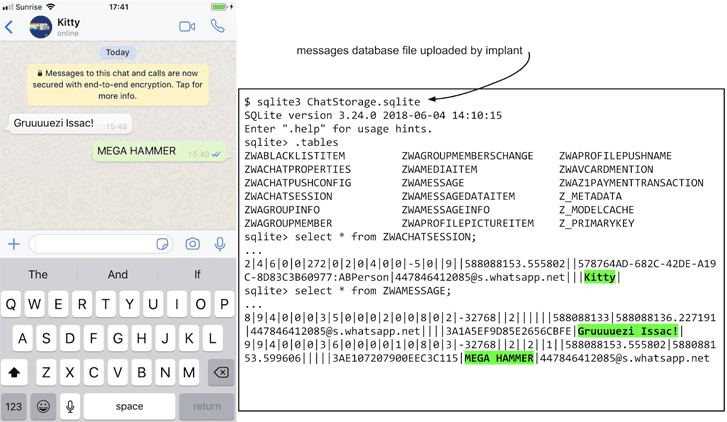
device used by popular end-to-end encryption apps like Whatsapp,
Telegram, and iMessage to store data, including private chats in
the plaintext.
keychain data containing credentials, authentication tokens, and
certificates used on and by the device.
“The keychain also contains the long-lived tokens used by services
such as Google’s iOS Single-Sign-On to enable Google apps to access
the user’s account. These will be uploaded to the attackers and can
then be used to maintain access to the user’s Google account, even
once the implant is no longer running,” Beers says.
iPhone upon rebooting thereby leaving no trace of itself, visiting
the hacked site again would reinstall the implant.
Alternatively, as Beer explains, the attackers may “nevertheless be
able to maintain persistent access to various accounts and services
by using the stolen authentication tokens from the keychain, even
after they lose access to the device.”
Takeaway: Since Apple already patched the majority of
vulnerabilities exploited by the uncovered iPhone exploits, users
are always recommended to keep their devices up-to-date to avoid
becoming victims of such attack chains.
References
- ^
blog post
(googleprojectzero.blogspot.com) - ^
The Hacker News warned
(thehackernews.com)
Read more http://feedproxy.google.com/~r/TheHackersNews/~3/xKHjXxhN5kA/hacking-iphone-ios-exploits.html