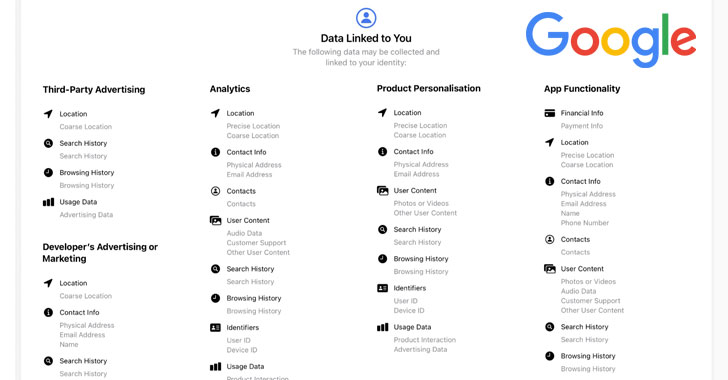
Privacy-focused search engine DuckDuckGo called out rival Google
for “spying” on users after the search giant updated its flagship
app to spell out the exact kinds of information it collects for
personalization and marketing purposes.
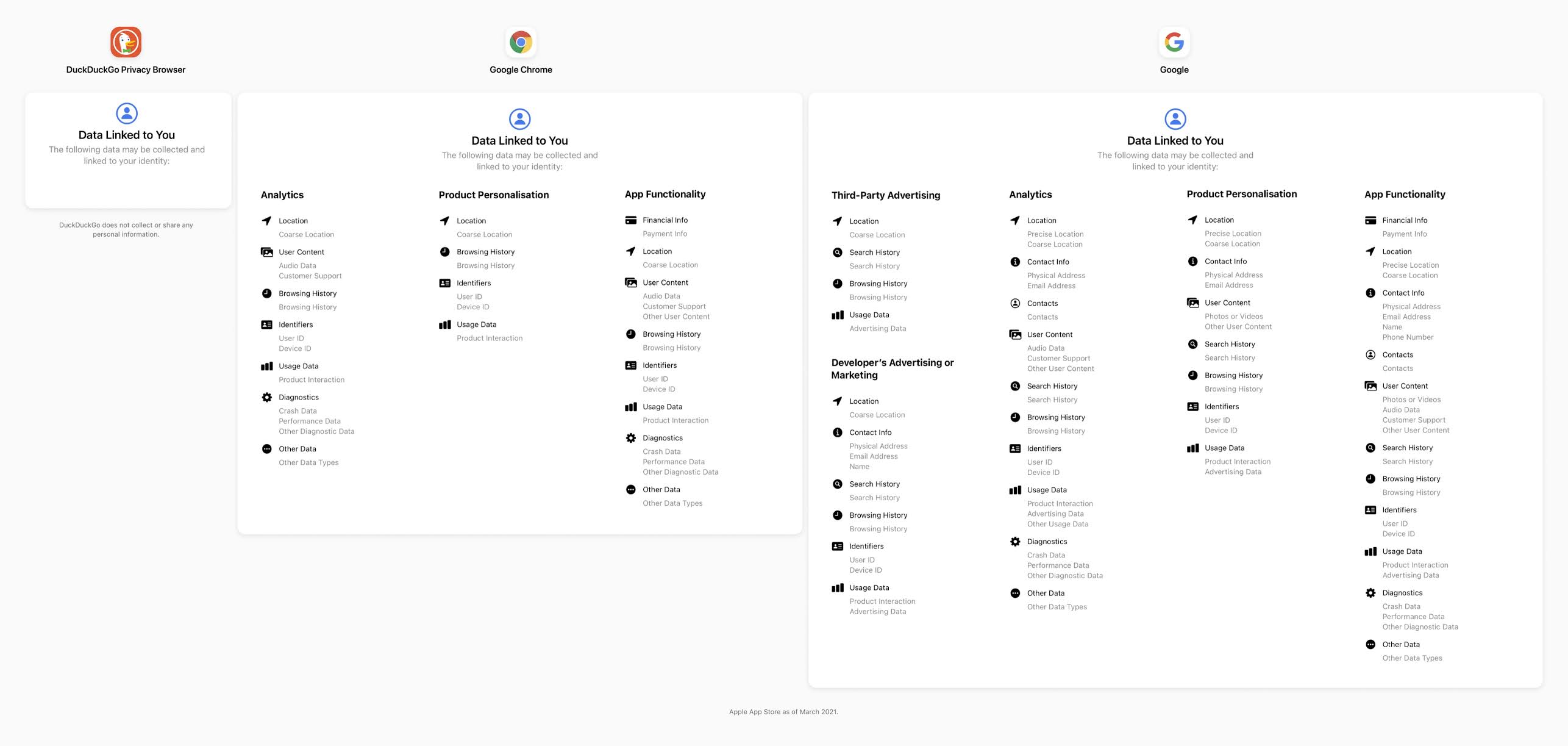
“After months of stalling, Google finally revealed how much
personal data they collect in Chrome and the Google app. No wonder
they wanted to hide it,” the company said[1]
in a tweet. “Spying on users has nothing to do with building a
great web browser or search engine.”
The “privacy nutrition labels[2]” are part of a new
policy that went into effect[3]
on December 8, 2020, mandating app developers to disclose their
data collection practices and help users understand how their
personal information is put to use.
The insinuation from DuckDuckGo comes as Google has been
steadily adding app privacy labels to its iOS apps over the course
of the last several weeks in accordance with Apple’s App Store
rules, but not before a three-month-long delay that caused most of
its apps to go without being updated, lending credence to theories
that the company had halted iOS app updates as a consequence of
Apple’s enforcement.
An analysis of app data collection practices by cloud storage
company pCloud released[4]
earlier this month found that 52% of apps share user data with
third-parties, with 80% of apps using the collected data to “market
their own products in the app” and deliver ads on other
platforms.
For its part, Apple updated its privacy website last week with a
new “Labels[5]” section that highlights
the privacy labels for all of Apple’s apps together in one place,
making it easier for users to learn about how Apple apps handle
their personal data.
App Tracking Transparency Explained
In addition, an upcoming privacy update to iOS 14.5 will also
require apps to ask for users’ consent before tracking them across
other apps and websites using the device’s advertising identifier
(also called IDFA) as part of a new framework dubbed App Tracking
Transparency (ATT[6]).
The IDFA (or Identifier for Advertisers) — created by Apple in
2012 — has been traditionally used by companies and marketers to
keep tabs on individuals between different apps in order to serve
tailored ads and monitor how their ad campaigns performed.
For example, imagine scrolling through your Instagram feed, and
you see an ad for a smartphone. You don’t tap the ad, but instead,
you go on Google, search for the same smartphone you saw on
Instagram, and buy them.
Once this purchase is made, the retailer records the IDFA of the
user who bought the phone and shared it with Facebook, which can
then determine whether the ID corresponds to the user who saw an ad
for the smartphone.
 |
| Click to see full version |
With the new changes, it’s no longer possible for apps and
third-party partners to accurately measure the effectiveness of
their ads without asking explicit permissions from users to opt-in
to being tracked using the identifier as they hop from one app to
the other, a move that has riled up Facebook[7]
and others that sell mobile ads who heavily rely on this identifier
to help target ads to users.
Put differently, while companies can still track users through
their own services on a first-party basis, they cannot share that
information with third-parties without users’ permission.
In what could be a sign of things to come, an analysis by mobile
advertising firm AppsFlyer found[8]
that after several third-party developers integrated Apple’s ATT
into their apps, 99% of users chose not to allow tracking.
“Technology does not need vast troves of personal data, stitched
together across dozens of websites and apps, in order to succeed.
Advertising existed and thrived for decades without it,” Apple CEO
Tim Cook explained the change in a January 28 speech at the
Computers, Privacy and Data Protection (CPDP) conference. “If a
business is built on misleading users, on data exploitation, on
choices that are no choices at all, then it does not deserve our
praise. It deserves reform.”
The development comes as tech giants including Apple, Google,
Amazon, and Facebook have come under heightened regulatory and
privacy scrutiny in the U.S. and Europe for having amassed immense
market power and for their collection of personal information,
leading to the formation of new data protection laws aimed at
safeguarding user privacy.
On Wednesday, France’s competition regulator rejected[9]
calls from advertising companies and publishers to block ATT on
antitrust grounds, stating that the privacy initiative “does not
appear to reflect an abuse of a dominant position on the part of
Apple,” but added it would continue to investigate the changes to
ensure that “Apple has not applied less restrictive rules” for its
own apps, signaling how measures designed to protect user privacy
can be at odds with regulating online competition.
It’s worth noting that Google has separately announced plans[10] to stop supporting
third-party cookies in its Chrome browser by early 2022 while
emphasizing that it would not build alternate identifiers or tools
to track users across the web.
Advertisers Test New Tool to Circumvent ATT
But that hasn’t stopped advertisers from trying workarounds to
sidestep iOS privacy protections, setting them once again on a
collision course with Apple.
According to the Financial Times[11], the Chinese
Advertising Association (CAA) has developed an identifier called
the China Anonymization ID (or CAID) that’s aimed at bypassing the
new Apple privacy rules and allow companies to continue tracking
users without having to rely on IDFA.
“CAID has the characteristics of anonymity and decentralization,
does not collect private data, only transmits the encrypted result,
and the encrypted result is irreversible, which can effectively
protect the privacy and data security of the end user; the
decentralized design allows developers to be more flexible Access
to meet business needs,” a Guangzhou-based ad-tech firm called
TrackingIO explained[12] in a now-removed
write-up.
“Because CAID does not depend on Apple IDFA and can generate
device identification ID independently of IDFA, it can be used as
an alternative to device identification in iOS 14 and a
supplementary solution when IDFA is not available,” it added.
While CAID is yet to be formally implemented, the tool is said
to be presently under testing by some of China’s largest technology
companies, including ByteDance and Tencent, with “several foreign
advertising companies have already applied on behalf of their
Chinese divisions,” per the report.
It remains to be seen if Apple will green-light this proposal
from the CAA, which is said to be “currently actively
communicating” with the Cupertino-based company, with the report
claiming that “Apple is aware of the tool and seems to have so far
turned a blind eye to its use.”
“The App Store terms and guidelines apply equally to all
developers around the world, including Apple,” the iPhone maker
told FT. “We believe strongly that users should be asked for their
permission before being tracked. Apps that are found to disregard
the user’s choice will be rejected.”
References
- ^
said
(twitter.com) - ^
privacy
nutrition labels (developer.apple.com) - ^
went
into effect (developer.apple.com) - ^
released
(blog.pcloud.com) - ^
Labels
(www.apple.com) - ^
ATT
(developer.apple.com) - ^
riled up
Facebook (www.eff.org) - ^
found
(www.appsflyer.com) - ^
rejected
(www.autoritedelaconcurrence.fr) - ^
announced plans
(thehackernews.com) - ^
Financial Times
(www.ft.com) - ^
explained
(web.archive.org)