government surveillance, Google, Apple and Mozilla finally today
came forward and blocked Kazakhstan’s government-issued root CA
certificate within their respective web browsing software.
Starting today, Chrome, Safari and Firefox users in Kazakhstan
will see an error message stating that the certificate should not
be trusted when attempting to access a website that responds with a
government-issued certificate.
As The Hacker News reported last
month, all major Kazakh Internet Service Providers (ISPs) are
forcing their customers into installing a government-issued root
certificate on their devices in order to regain access to their
Internet services.
[1]
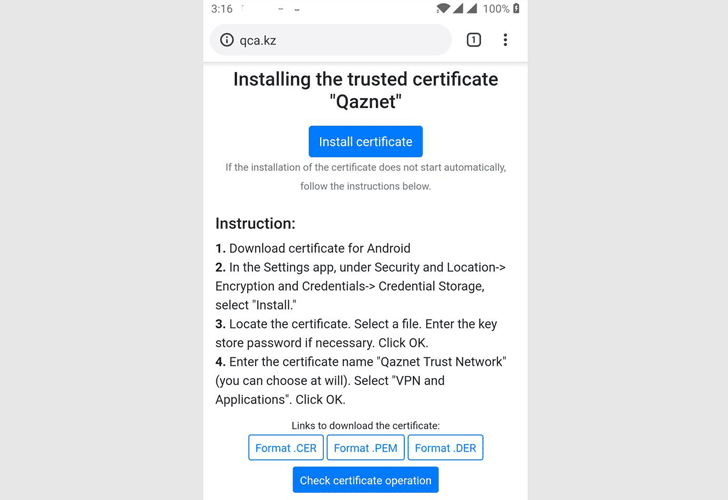
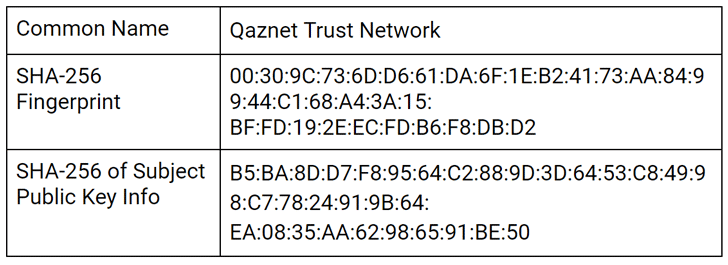
The root certificate in question, labeled as “trusted
certificate” or “national security certificate,” if installed,
allows ISPs to intercept, monitor, and decrypt users’ encrypted
HTTPS and TLS connections, helping the government spy on its 18
million people and censor content.
to decrypt and read anything a user visiting popular
sites—Facebook, Twitter, and Google, among others—types or posts,
including intercepting their account information and passwords.
“When a user in Kazakhstan installs the root certificate provided
by their ISP, they are choosing to trust a CA that doesn’t have to
follow any rules and can issue a certificate for any website to
anyone,” Mozilla[3] explained in a blog post
published today.
“This enables the interception and decryption of network
communications between Firefox and the website, sometimes referred
to as a Monster-in-the-Middle (MITM) attack.”
allow the government to surveil its citizens’ online activities,
but also leaves them at risk of social engineering attacks as an
opportunity for hackers to trick users into installing a malicious
root cert from unofficial websites and sources.
After facing worldwide criticism, the Kazakh government described the
initial roll-out of the certificate as a test for monitoring cyber
threats and then abandoned its plans to intercept citizens’
internet traffic.
“We will never tolerate any attempt, by any organization—government
or otherwise—to compromise Chrome users’ data. We have implemented
protections from this specific issue, and will always take action
to secure our users around the world,” said Parisa Tabriz, Senior
Engineering Director, Chrome.
“No action is needed by users to be protected. In addition, the
certificate will be added to a blocklist in the Chromium source
code and thus should be included in other Chromium-based browsers
in due course,” Google
said[5].
intercepted the internet traffic of its citizens.
In 2015, the government attempted to have a root certificate
included in Mozilla’s trusted root store program, but the company
denied the request as soon as it was discovered that the Kazakhstan
government was intending to use that certificate to intercept user
data.
Both Google and Mozilla are encouraging you to remove the
Kazakhstan government root certificate from your devices if you
have already installed it and to change your passwords for each of
your online accounts immediately.
References
- ^
reported last month
(thehackernews.com) - ^
trusted certificate
(thehackernews.com) - ^
Mozilla
(blog.mozilla.org) - ^
described
(www.reuters.com) - ^
Google said
(security.googleblog.com)
Read more http://feedproxy.google.com/~r/TheHackersNews/~3/xYGDTbF4jt0/kazakhstan-root-certificate.html