In January 2019, a critical flaw[1]
was reported in Apple’s FaceTime group chats feature that made it
possible for users to initiate a FaceTime video call and eavesdrop
on targets by adding their own number as a third person in a group
chat even before the person on the other end accepted the incoming
call.
The vulnerability was deemed so severe that the iPhone maker
removed the FaceTime group chats feature altogether before the
issue was resolved in a subsequent iOS update.
Since then, a number of similar shortcomings have been
discovered in multiple video chat apps such as Signal, JioChat,
Mocha, Google Duo, and Facebook Messenger — all thanks to the work
of Google Project Zero researcher Natalie Silvanovich.
“While [the Group FaceTime] bug was soon fixed, the fact that
such a serious and easy to reach vulnerability had occurred due to
a logic bug in a calling state machine — an attack scenario I had
never seen considered on any platform — made me wonder whether
other state machines had similar vulnerabilities as well,”
Silvanovich wrote[2]
in a Tuesday deep-dive of her work.
How Signaling in WebRTC Works?
Although a majority of the messaging apps today rely on WebRTC
for communication, the connections themselves are created by
exchanging call set-up information using Session Description
Protocol (SDP[3]) between peers in what’s
called signaling, which typically works by sending an SDP offer
from the caller’s end, to which the callee responds with an SDP
answer.
Put differently, when a user starts a WebRTC call to another
user, a session description called an “offer” is created containing
all the information necessary setting up a connection — the kind of
media being sent, its format, the transfer protocol used, and the
endpoint’s IP address and port, among others. The recipient then
responds with an “answer,” including a description of its
endpoint.
The entire process is a state machine[4], which indicates “where
in the process of signaling the exchange of offer and answer the
connection currently is.”
Also included optionally as part of the offer/answer exchange is
the ability of the two peers to trade SDP candidates[5]
to each other so as to negotiate the actual connection between
them. It details the methods that can be used to communicate,
regardless of the network topology — a WebRTC framework called
Interactive Connectivity Establishment (ICE[6]).
Once the two peers agree upon a mutually-compatible candidate,
that candidate’s SDP is used by each peer to construct and open a
connection, through which media then begins to flow.
In this way, both devices share with one another the information
needed in order to exchange audio or video over the peer-to-peer
connection. But before this relay can happen, the captured media
data has to be attached to the connection using a feature called
tracks.
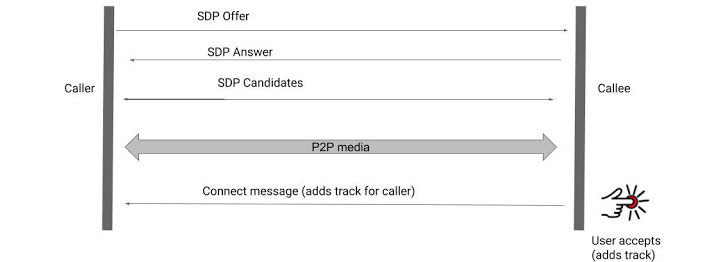
While it’s expected that callee consent is ensured ahead of
audio or video transmission and that no data is shared until the
receiver has interacted with the application to answer the call
(i.e., before adding any tracks to the connection), Silvanovich
observed behavior to the contrary.
Multiple Messaging Apps Affected
Not only did the flaws in the apps allow calls to be connected
without interaction from the callee, but they also potentially
permitted the caller to force a callee device to transmit audio or
video data.
- Signal[7]
(fixed in September 2019) – A audio call flaw in Signal’s Android
app made it possible for the caller to hear the callee’s
surroundings due to the fact that the app didn’t check if the
device receiving the connect message from the callee was the caller
device.
- JioChat[8] (fixed in July 2020) and
Mocha[9]
(fixed in August 2020) – Adding candidates to the offers created by
Reliance JioChat and Viettel’s Mocha Android apps that allowed a
caller to force the target device to send audio (and video) without
a user’s consent. The flaws stemmed from the fact that the
peer-to-peer connection had been set up even before the callee
answered the call, thus increasing the “remote attack surface of
WebRTC.”
- Facebook
Messenger[10] (fixed in November
2020) – A vulnerability[11] that could have granted
an attacker who is logged into the app to simultaneously initiate a
call and send a specially crafted message to a target who is signed
in to both the app as well as another Messenger client such as the
web browser, and begin receiving audio from the callee device.
- Google Duo[12] (fixed in December
2020) – A race condition between disabling the video and setting up
the connection that, in some situations, could cause the callee to
leak video packets from unanswered calls.
Other messaging apps like Telegram and Viber were found to have
none of the above flaws, although Silvanovich noted that
significant reverse engineering challenges when analyzing Viber
made the investigation “less rigorous” than the others.
“The majority of calling state machines I investigated had logic
vulnerabilities that allowed audio or video content to be
transmitted from the callee to the caller without the callee’s
consent,” Silvanovich concluded. “This is clearly an area that is
often overlooked when securing WebRTC applications.”
“The majority of the bugs did not appear to be due to developer
misunderstanding of WebRTC features. Instead, they were due to
errors in how the state machines are implemented. That said, a lack
of awareness of these types of issues was likely a factor,” she
added.
“It is also concerning to note that I did not look at any group
calling features of these applications, and all the vulnerabilities
reported were found in peer-to-peer calls. This is an area for
future work that could reveal additional problems.”
References
- ^
critical
flaw (thehackernews.com) - ^
wrote
(googleprojectzero.blogspot.com) - ^
SDP
(en.wikipedia.org) - ^
state
machine (developer.mozilla.org) - ^
SDP
candidates (developer.mozilla.org) - ^
ICE
(developer.mozilla.org) - ^
Signal
(bugs.chromium.org) - ^
JioChat
(bugs.chromium.org) - ^
Mocha
(bugs.chromium.org) - ^
Facebook Messenger
(bugs.chromium.org) - ^
vulnerability
(thehackernews.com) - ^
Google
Duo (bugs.chromium.org)