
Google’s Threat Analysis Group (TAG) on Thursday disclosed it
had acted to block as many as 36 malicious domains operated by
hack-for-hire groups from India, Russia, and the U.A.E.
In a manner analogous to the surveillanceware ecosystem[1], hack-for-hire firms
equip their clients with capabilities to enable targeted attacks
aimed at corporates as well as activists, journalists, politicians,
and other high-risk users.
Where the two stand apart is that while customers purchase the
spyware from commercial vendors and then deploy it themselves, the
operators behind hack-for-hire attacks are known to conduct the
intrusions on their clients’ behalf in order to obscure their
role.
“The hack-for-hire landscape is fluid, both in how the attackers
organize themselves and in the wide range of targets they pursue in
a single campaign at the behest of disparate clients,” Shane
Huntley, director of Google TAG, said[2]
in a report.
“Some hack-for-hire attackers openly advertise their products
and services to anyone willing to pay, while others operate more
discreetly selling to a limited audience.”
A recent campaign mounted by an Indian hack-for-hire operator is
said to have targeted an IT company in Cyprus, an education
institution in Nigeria, a fintech company in the Balkans, and a
shopping company in Israel, indicating the breadth of victims.
The Indian outfit, which Google TAG said it’s been tracking
since 2012, has been linked to a string of credential phishing
attacks with the goal of harvesting login information associated
with government agencies, Amazon Web Services (AWS), and Gmail
accounts.
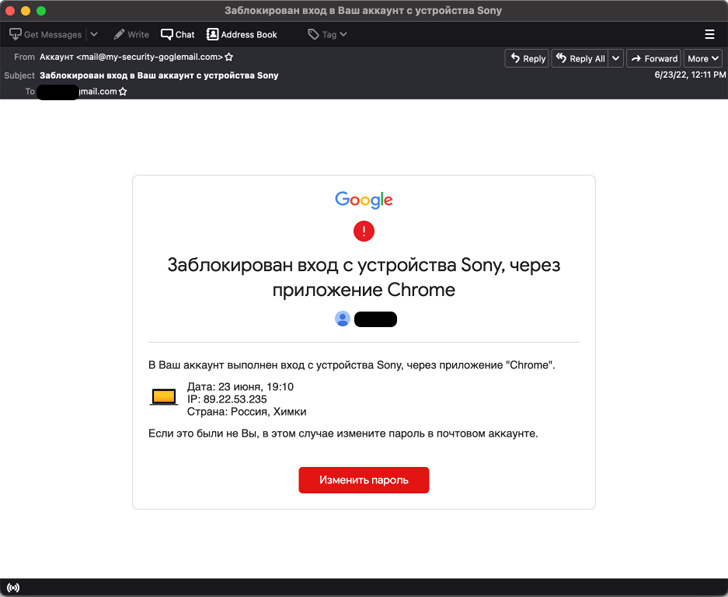
The campaign involves sending spear-phishing emails containing a
rogue link that, when clicked, launches an attacker-controlled
phishing page designed to siphon credentials entered by
unsuspecting users. Targets included government, healthcare, and
telecom sectors in Saudi Arabia, the United Arab Emirates, and
Bahrain.
Google TAG attributed the Indian hack-for-hire actors to a firm
called Rebsec, which, according to its dormant Twitter
account[3], is short for “Rebellion
Securities[4]” and is based in the
city of Amritsar. The company’s website[5], down for “maintenance”
as of writing, also claims to offer corporate espionage
services.
A similar set of credential theft attacks targeting journalists,
European politicians, and non-profits has been linked to a Russian
actor dubbed Void Balaur[6], a cyber mercenary group
first documented by Trend Micro in November 2021.
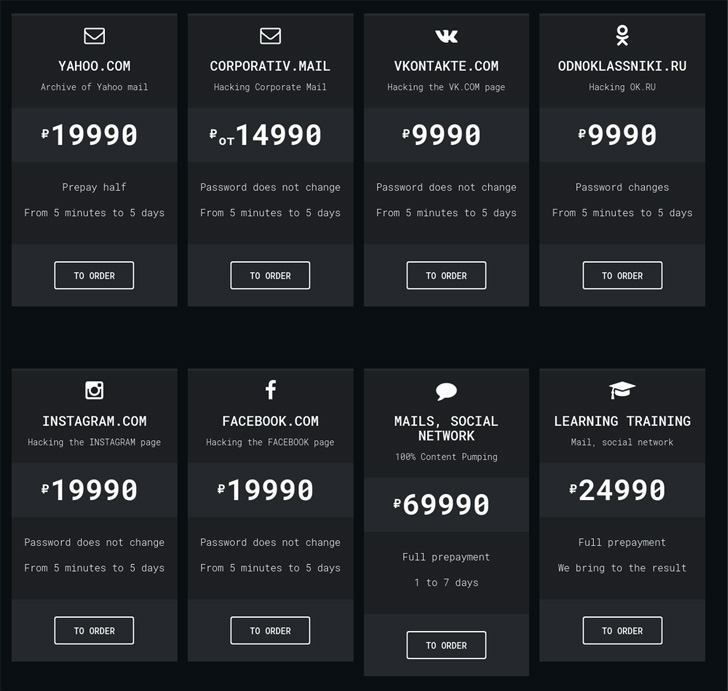
Over the past five years, the collective is believed to have
singled out accounts at major webmail providers like Gmail,
Hotmail, and Yahoo! and regional webmail providers like abv.bg,
mail.ru, inbox.lv, and UKR.net.
Lastly, TAG also detailed the activities of a group based in the
U.A.E. and has connections to the original developers of a remote
access trojan called njRAT[7]
(aka H-Worm[8]
or Houdini[9]).
The phishing attacks, as previously uncovered by Amnesty International[10] in 2018, entail using
password reset lures to steal credentials from targets in
government, education, and political organizations in the Middle
East and North Africa.
Following the account compromise, the threat actor maintains
persistence by granting an OAuth token to a legitimate email
application like Thunderbird, generating an App Password[11] to access the account
via IMAP, or linking the victim’s Gmail account to an
adversary-owned account on a third-party mail provider.
The findings come a week after Google TAG revealed details of an
Italian spyware company named RCS Lab, whose “Hermit[12]” hacking tool was used
to target Android and iOS users in Italy and Kazakhstan.
References
- ^
surveillanceware ecosystem
(thehackernews.com) - ^
said
(blog.google) - ^
Twitter
account (twitter.com) - ^
Rebellion Securities
(about.me) - ^
website
(web.archive.org) - ^
Void
Balaur (thehackernews.com) - ^
njRAT
(malpedia.caad.fkie.fraunhofer.de) - ^
H-Worm
(www.zscaler.com) - ^
Houdini
(blog.morphisec.com) - ^
Amnesty International
(www.amnesty.org) - ^
App
Password (support.google.com) - ^
Hermit
(thehackernews.com)
Read more https://thehackernews.com/2022/06/google-blocks-dozens-of-malicious.html