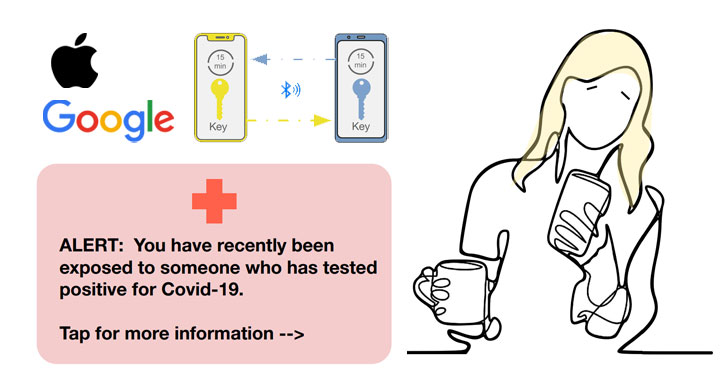
Google have
joined forces to develop an interoperable contract-tracing tool
that will help individuals determine if they have come in contact
with someone infected with COVID-19.
As part of this new initiative, the companies are expected to
release an API that public agencies can integrate into their apps.
The next iteration will be a built-in system-level platform that
uses Bluetooth low energy (BLE) beacons to allow for contact
tracing on an opt-in basis.
The APIs are expected to be available mid-May for Android and
iOS, with the broader contact tracing system set to roll out “in
the coming months.”
“Privacy, transparency, and consent are of utmost importance in
this effort, and we look forward to building this functionality in
consultation with interested stakeholders,” the companies said.
The rare collaboration comes as governments worldwide are
increasingly turning to technology such as phone tracking and
facial recognition to battle the virus and contain the coronavirus
outbreak.
Apple has also launched a new web page
announcing the feature, which details the preliminary Bluetooth
specifications, cryptography specifications, and the framework API,
the contact tracing system, will be based on.
Zero Use of Location Data
Unlike existing apps developed by different countries that use
real-time location tracking to enforce quarantine rules, the
proposed system doesn’t involve tracking user locations or other
identifying data.
Instead, it leverages BLE beacons to identify if an individual
has been around other people who have tested positive COVID-19,
thus ensuring that personal privacy is not compromised.
provide their explicit consent for it to work. This also means that
for it to be effective, millions of people would need to opt-in,
necessitating that Apple and Google build adequate privacy
safeguards before it’s rolled out to the masses.
According to a white
paper[4] released by Google,
here’s how such a system might work:
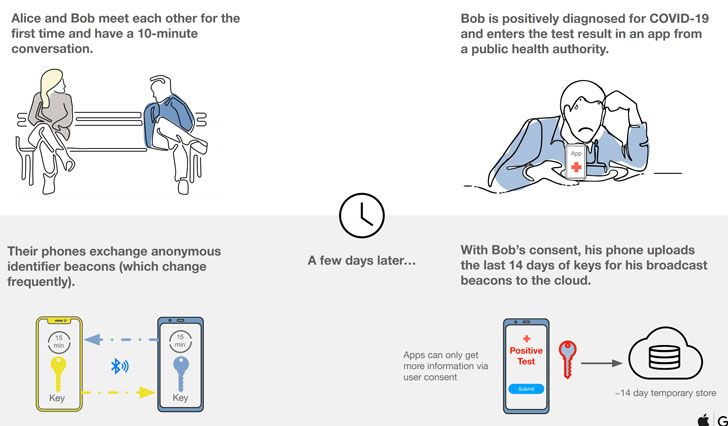
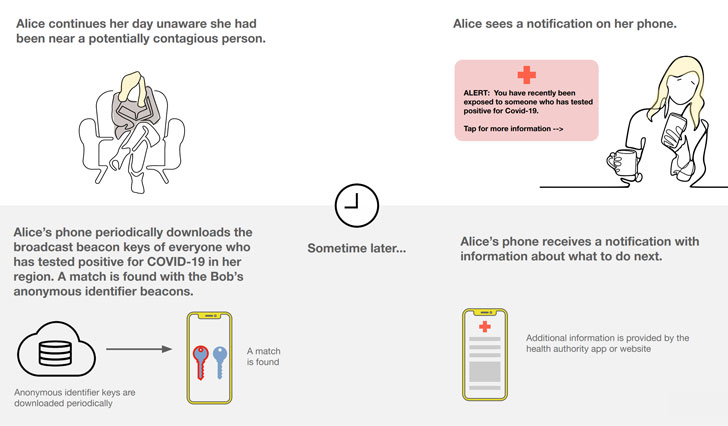
- When two people come in close contact for a certain period of
time (say 10 minutes or more), their phones will exchange anonymous
identifier beacons. The identifiers rotate every 15 minutes and
have no personally identifiable information. - If one of the two is positively diagnosed for COVID-19, that
infected person can enter the test result into an app from a public
health authority that has integrated the aforementioned API. - Then, the infected person can consent to upload the last 14
days of his or her broadcast beacons to the system. - Any other person who has been in close proximity to the
individual tested positive will then be alerted if there exists a
beacon on the device that matches the broadcast beacons of everyone
who has tested positive for COVID-19 in the region. - The app then provides the individual with information about the
next steps.
“This model places less trust in a central authority, but it
creates new risks
to users who share their infection status that must be
mitigated or accepted,” the Electronic Frontier Foundation (EFF)
said about the
proposal.
“Full transparency about how the apps and the APIs operate,
including open source code, is necessary for people to understand,
and give their informed consent to the risks,” it added.
Apple and Google’s system is along the lines of TraceTogether, an
app developed by Singapore government officials to enable contact
tracing via Bluetooth.
[7]
The app, now open-sourced, uses Bluetooth Relative
Signal Strength Indicator (RSSI) readings between devices to
determine the proximity and duration of an encounter between two
individuals. The records of encounters are stored in their
respective phones for 21 days.
Apps like COVID-Watch[9] and MIT’s Private Kit: Safe Paths[10], likewise, rely on a
mix of GPS and Bluetooth data to track people who’ve crossed paths
with another over a rolling period of 14 days.
institutions has proposed a decentralized system for
Bluetooth-based COVID-19 contacts tracing, dubbed “Decentralized
Privacy-Preserving Proximity Tracing” (DP-PPT), that
aims to “minimize privacy and security risks for individuals and
communities, and guarantee the highest level of data protection.”
Privacy Concerns With Pandemic Surveillance
The need to single out infected individuals and maintain
quarantines has led governments across the world to enact tough
surveillance measures. So far, over 28
countries have adopted a mix of smartphone tracking, electronic
tracking wristbands, and even require citizens to send a picture of
themselves at home within 20 minutes or face a fine.
In response to privacy concerns raised by the European Data
Protection Supervisor[13], the European Union
said it would adopt a “pan-European
approach[14]” to using mobile apps
to track the spread of the coronavirus and include a common scheme
for using anonymous, aggregated data to trace people who come into
contact with those infected and to monitor those under
quarantine.
Earlier this week, the American Civil Liberties Union (ACLU) raised
concerns about tracking users with aggregated phone data, arguing
that any system would need to be limited in scope and avoid any
potential for invasions of privacy and abuse.
[15]
Although countries like South Korea have been able to minimize the
outbreak through an extensive contact tracing program, it also
raises questions about consent, such as whether users can opt-out
before such data is collected and stored — not to mention the
potential danger of turning a blind eye to its privacy risks.
Specifically, how long will the data collection go on, and when
will it be deleted? It’s also crucial to ensure that the gathered
anonymized data cannot be reverse-engineered to track people.
Cybersecurity expert Bruce Schneier said that any data
collection and digital monitoring initiative “must be scientifically
justified and deemed necessary[16] by public health
experts for the purpose of containment. And that data processing
must be proportionate to the
need[17].”
Urging the need to protect civil liberties during the crisis,
the EFF
said[18] bypassing certain
privacy protections is warranted, but warned that “any
extraordinary measures used to manage a specific crisis must not
become permanent fixtures in the landscape of government intrusions
into daily life.”
Put differently, these programs shouldn’t pave the way for
government overreach or draconian monitoring systems that will
continue to live on even after the current outbreak has died down.
Including strong privacy guarantees are the right means to make
sure that emergency measures don’t become the new normal.
No doubt, it’s a slippery slope. In the race to stem its spread
and control the situation, mobilizing a pandemic surveillance
apparatus to help contain the outbreak requires an adequate balance
between transparency, meeting public health needs, and civil
rights.
References
- ^
Apple
(www.apple.com) - ^
Google
(blog.google) - ^
new
web page (www.apple.com) - ^
white paper
(www.blog.google) - ^
creates new risks to users
(arxiv.org) - ^
said
(www.eff.org) - ^
TraceTogether
(www.tracetogether.gov.sg) - ^
Bluetooth Relative Signal Strength
Indicator (tracetogether.zendesk.com) - ^
COVID-Watch
(www.covid-watch.org) - ^
Private Kit: Safe Paths
(safepaths.mit.edu) - ^
DP-PPT
(github.com) - ^
over 28 countries
(onezero.medium.com) - ^
European Data Protection
Supervisor (edps.europa.eu) - ^
pan-European approach
(www.reuters.com) - ^
ACLU
(www.aclu.org) - ^
scientifically justified and deemed
necessary (www.schneier.com) - ^
proportionate to the need
(necessaryandproportionate.org) - ^
EFF said
(www.eff.org)
Read more http://feedproxy.google.com/~r/TheHackersNews/~3/HURY0mDRCSM/iphone-android-coronavirus-tracing.html