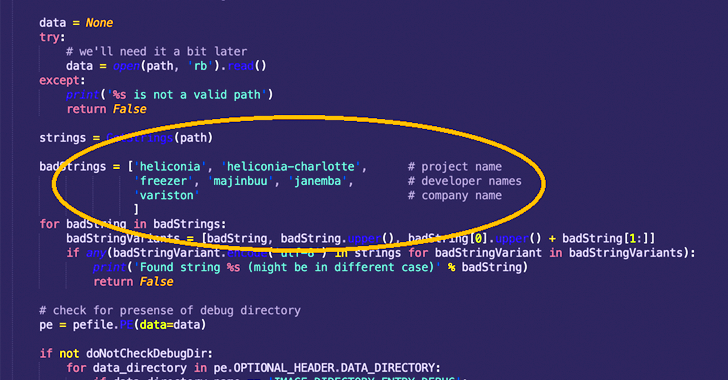
A Barcelona-based surveillanceware vendor named Variston IT is
said to have surreptitiously planted spyware on targeted devices by
exploiting several zero-day flaws in Google Chrome, Mozilla
Firefox, and Windows, some of which date back to December 2018.
“Their Heliconia framework exploits n-day vulnerabilities in
Chrome, Firefox, and Microsoft Defender, and provides all the tools
necessary to deploy a payload to a target device,” Google Threat
Analysis Group (TAG) researchers Clement Lecigne and Benoit Sevens
said[1]
in a write-up.
Variston, which has a bare-bones website[2], claims to “offer tailor
made Information Security Solutions to our customers,” “design
custom security patches for any kind of proprietary system,” and
support the “the discovery of digital information by [law
enforcement agencies],” among other services.
The vulnerabilities, which have been patched by Google,
Microsoft, and Mozilla in 2021 and early 2022, are believed to have
been utilized as zero-days to help customers install malware of
their choice on the targeted systems.
Heliconia comprises a trio of components, namely Noise, Soft,
and Files, each of which are responsible for deploying exploits
against bugs in Chrome, Windows, and Firefox, respectively.
Noise is designed to take advantage of a security flaw[3]
in the Chrome V8 engine JavaScript engine that was patched in
August 2021 as well as an unknown sandbox escape method called
“chrome-sbx-gen” to enable the final payload (aka “agent”) to be
installed on targeted devices.
However, the attack banks on the prerequisite that the victim
accesses a booby-trapped webpage to trigger the first-stage
exploit.
Heliconia Noise can be additionally configured by the purchaser
using a JSON file to set different parameters like the maximum
number of times to serve the exploits, an expiration date for the
servers, redirect URLs for non-target visitors, and rules
specifying when a visitor should be considered a valid target.
Soft is a web framework that’s engineered to deliver a decoy PDF
document featuring an exploit for CVE-2021-42298[4], a remote code execution
flaw impacting Microsoft Defender that was fixed by Redmond in
November 2021. The infection chain, in this case, entailed the user
visiting a malicious URL, which then served the weaponized PDF
file.
The Files package – the third framework – contains a Firefox
exploit chain for Windows and Linux that leverages a use-after-free
flaw in the browser that was reported in March 2022 (CVE-2022-26485[5]). However, it’s
suspected that the bug was likely abused since at least 2019.
Google TAG said it became aware of the Heliconia attack
framework after receiving an anonymous submission to its Chrome bug
reporting program. It further noted that there’s no current
evidence of exploitation, either indicating the toolset has been
put to rest or evolved further.
The development arrives more than five months after the tech
giant’s cybersecurity division linked a previously unattributed
Android mobile spyware, dubbed Hermit, to Italian software outfit,
RCS Lab[6].
“The growth of the spyware industry puts users at risk and makes
the Internet less safe, and while surveillance technology may be
legal under national or international laws, they are often used in
harmful ways to conduct digital espionage against a range of
groups,” the researchers said.
Found this article interesting? Follow us on Twitter [7]
and LinkedIn[8]
to read more exclusive content we post.
References
- ^
said
(blog.google) - ^
bare-bones website
(variston.net) - ^
security
flaw (bugs.chromium.org) - ^
CVE-2021-42298
(thehackernews.com) - ^
CVE-2022-26485
(thehackernews.com) - ^
RCS
Lab (thehackernews.com) - ^
Twitter
(twitter.com) - ^
LinkedIn
(www.linkedin.com)
Read more http://thehackernews.com/2022/12/google-accuses-spanish-spyware-vendor.html