Mar 01, 2023Ravie Lakshmanan
Google has announced the general availability of client-side
encryption (CSE) for Gmail and Calendar, months after piloting the feature[1]
in late 2022.
The data privacy controls enable “even more organizations to
become arbiters of their own data and the sole party deciding who
has access to it,” Google’s Ganesh Chilakapati and Andy Wen
said[2].
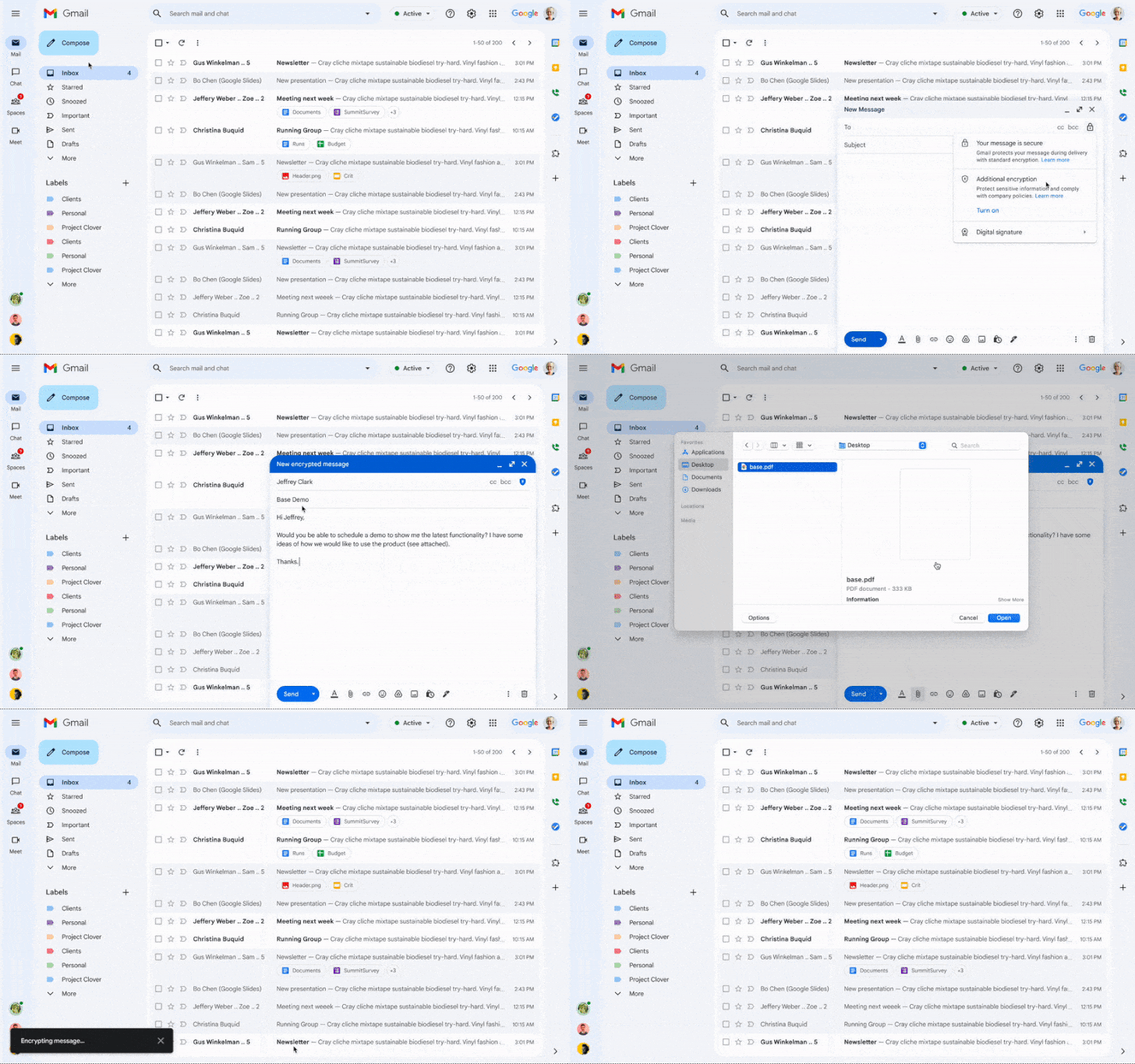
To that end, users can send and receive emails or create meeting
events within their organizations or to other external parties in a
manner that’s encrypted “before it reaches Google servers.”
The company is also making available a decrypter tool[3]
in beta for Windows to decrypt client-side encrypted files and
emails exported via its Data Export tool or Google Vault. macOS and
Linux versions of the decrypter are expected to be released in the
future.
The development follows the rollout of CSE[4]
to other products such as Google Drive, Docs, Slides, Sheets, and
Meet.
The solution, the tech behemoth said, is aimed at reducing the
“burden of compliance” for enterprises and public sector
organizations, ensuring that no third-party, including Google, can
access confidential data.
The feature is globally available to Workspace Enterprise Plus,
Education Standard, and Education Plus customers. It does not
extend to personal Google Accounts.
It once again bears repeating that client-side encryption is
different from end-to-end encryption (E2EE), as Google Workspace
users with super administrator privileges can toggle the setting
on/off and have control over the encryption keys created.
It’s also different from Pretty Good Privacy (PGP[5]), which also provides
the benefits of CSE via public-key cryptography[6]
but requires users to exchange keys with each party first before
sending an email. To add to the complexity, it passes the burden of
creating and managing the keys[7] to the users.
The integration of CSE to Gmail is the newest addition after
Google launched a confidential mode[8]
to help protect sensitive information from unauthorized access when
sending messages and attachments.
Found this article interesting? Follow us on Twitter [9]
and LinkedIn[10] to read more exclusive
content we post.
References
- ^
piloting
the feature (thehackernews.com) - ^
said
(workspace.google.com) - ^
decrypter tool
(support.google.com) - ^
rollout
of CSE (support.google.com) - ^
PGP
(en.wikipedia.org) - ^
public-key cryptography
(en.wikipedia.org) - ^
creating
and managing the keys (www.varonis.com) - ^
confidential mode
(support.google.com) - ^
Twitter
(twitter.com) - ^
LinkedIn
(www.linkedin.com)
Read more https://thehackernews.com/2023/03/gmail-and-google-calendar-now-support.html