
Code-hosting platform GitHub Friday officially announced a
series of updates to the site’s policies[1]
that delve into how the company deals with malware and exploit code
uploaded to its service.
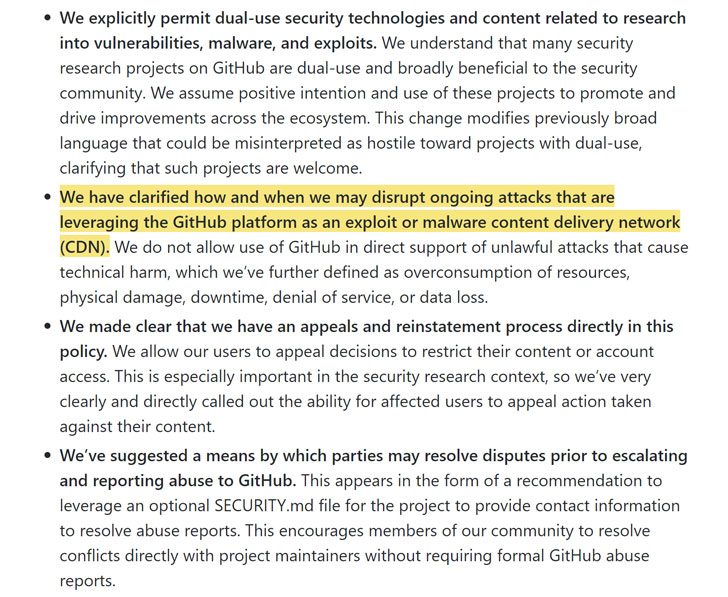
“We explicitly permit dual-use security technologies and content
related to research into vulnerabilities, malware, and exploits,”
the Microsoft-owned company said[2]. “We understand that
many security research projects on GitHub are dual-use and broadly
beneficial to the security community. We assume positive intention
and use of these projects to promote and drive improvements across
the ecosystem.”
Stating that it will not allow the use of GitHub in direct
support of unlawful attacks or malware campaigns that cause
technical harm, the company said it may take steps to disrupt
ongoing attacks that leverage the platform as an exploit or a
malware content delivery network (CDN).
To that end, users are refrained from uploading, posting,
hosting, or transmitting any content that could be used to deliver
malicious executables or abuse GitHub as an attack infrastructure,
say, by organizing denial-of-service (DoS) attacks or managing
command-and-control (C2) servers.
“Technical harms means overconsumption of resources, physical
damage, downtime, denial of service, or data loss, with no implicit
or explicit dual-use purpose prior to the abuse occurring,” GitHub
said.
In scenarios where there is an active, widespread abuse of
dual-use content, the company said it might restrict access to such
content by putting it behind authentication barriers, and as a
“last resort,” disable access or remove it altogether when other
restriction measures are not feasible. GitHub also noted that it
would contact relevant project owners about the controls put in
place where possible.
The changes come into effect after the company, in late April,
began soliciting feedback[3]
on its policy around security research, malware, and exploits on
the platform under a clearer set of terms that would remove the
ambiguity surrounding “actively harmful content” and “at-rest code”
in support of security research.
By not taking down exploits unless the repository or code in
question is incorporated directly into an active campaign, the
revision to GitHub’s policies is also a direct result of widespread
criticism that followed in the aftermath of a proof-of-concept[4]
(PoC) exploit code that was removed from the platform in March
2021.
The code, uploaded by a security researcher, concerned a set of
security flaws known as ProxyLogon[5]
that Microsoft disclosed were being abused by Chinese
state-sponsored hacking groups to breach Exchange servers
worldwide. GitHub at the time said it removed the PoC in accordance
with its acceptable use policies, citing it included code “for a
recently disclosed vulnerability that is being actively
exploited.”
References
- ^
site’s
policies (docs.github.com) - ^
said
(github.blog) - ^
soliciting feedback
(github.blog) - ^
proof-of-concept
(thehackernews.com) - ^
ProxyLogon
(thehackernews.com)