ongoing malware campaign that has already hijacked over 100,000
home routers and modified their DNS settings to hack users with
malicious web pages—especially if they visit banking sites—and
steal their login credentials.
Dubbed GhostDNS, the campaign has many similarities with
the infamous DNSChanger
malware that works by changing DNS server settings on an
infected device, allowing attackers to route the users’ internet
traffic through malicious servers and steal sensitive data.
[1]
According to a new report from cybersecurity firm Qihoo
360’s NetLab, just like the regular DNSChanger campaign, GhostDNS
scans for the IP addresses for routers that use weak or no password
at all, accesses the routers’ settings, and then changes the
router’s default DNS address to the one controlled by the
attackers.
GhostDNS System: List of Modules and Sub-Modules
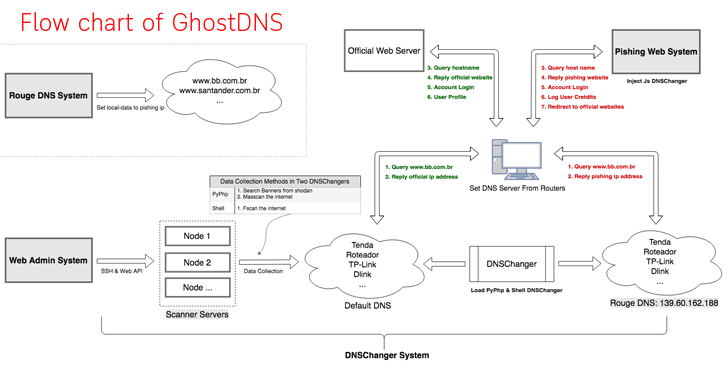
1) DNSChanger Module: This is the main module of GhostDNS
designed to exploit targeted routers based upon collected
information.
DNSChanger Module is comprised of three sub-modules, which the
researchers dubbed, Shell DNSChanger, Js DNSChanger, and PyPhp
DNSChanger.
a.) Shell DNSChanger—Written in the Shell programming language,
this sub-module combines 25 Shell scripts that can brute-force the
passwords on routers or firmware packages from 21 different
manufacturers.
b.) Js DNSChanger—Mainly written in JavaScript, this sub-module
includes 10 attack scripts designed to infect 6 routers or firmware
packages.
“Its functional structure is mainly divided into scanners, payload
generators, and attack programs. The Js DNSChanger program is
usually injected into phishing websites, so it works together with
the Phishing Web System,” the researchers say.
c.) PyPhp DNSChanger—Written in both Python and PHP, this
submodule contains 69 attack scripts against 47 different
routers/firmware and has been found deployed on over 100 servers,
most of which on Google Cloud, and includes functionalities like
Web API, Scanner and Attack module.
This sub-module is the core module of DNSChanger that allows
attackers to scan the Internet to find vulnerable routers.
2) Web Admin module: Though researchers do not have too
much information about this module yet, it seems to be an admin
panel for attackers secured with a login page.
3) Rogue DNS module: This module is responsible for
resolving targeted domain names from the attacker-controlled web
servers, which mainly involves banking and cloud hosting services,
along with a domain that belongs to a security company named
Avira.
“We have no access to the Rouge DNS server, so we can’t say for
sure how many DNS names have been hijacked, but by querying both
Alexa Top1M and our DNSMon’s Top1M domains against the rogue DNS
server (139.60.162.188), we were able to find a total of 52 domains
being hijacked,” NetLab researchers say.
gets resolved through the rogue DNS module, Phishing web module
aims to server the right fake version for that specific website.
GhostDNS Malware Targeting Brazilian Users Primarily
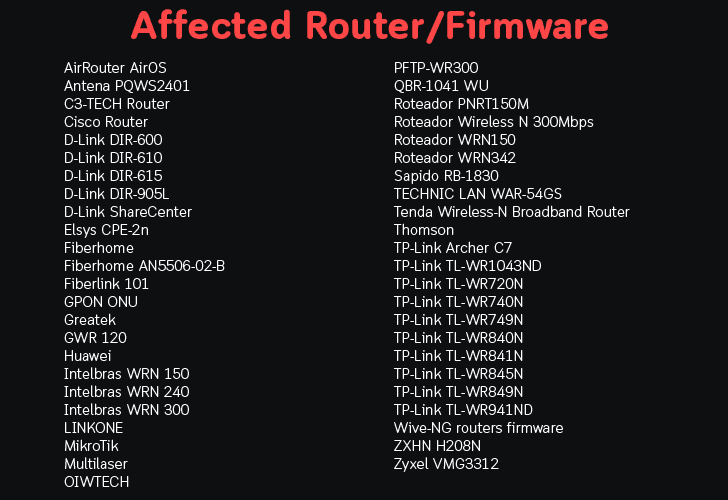
GhostDNS campaign compromised more than 100,000 routers, of which
87.8 percent of devices (which equals to 87,800) are located in
Brazil only, which means Brazil is the primary target for GhostDNS
attackers.
Also Read: VPNFilter Router
Malware Adds 7 New Network Exploitation Modules
“Currently the campaign mainly focuses on Brazil, we have
counted 100k+ infected router IP addresses (87.8% located in
Brazil), and 70+ router/firmware have been involved, and 50+ domain
names such as some big banks in brazil , even Netflix, Citibank.br
have been hijacked to steal the corresponding website login
credentials,” the researchers say.
Since the GhostDNS campaign is highly scaled, utilizes different
attack vector and adopts automated attack process, it poses a real
threat to users. Therefore, users are advised to protect
themselves.
How to Protect Your Home Router from Hackers
In order to avoid yourself from being a victim to such attacks, you
are recommended to ensure that your router is running the latest
version of the firmware and set a strong password for the router
web portal.
You can also consider disabling remote administration, changing
its default local IP address, and hardcoding a trusted DNS
server[4] into your router or the
operating system.
NetLab researchers also recommended the router vendors to
increase the complexity of router default password and enhance the
system security update mechanism for their products.
References
- ^
DNSChanger malware
(thehackernews.com) - ^
report
(blog.netlab.360.com) - ^
VPNFilter Router Malware Adds 7 New
Network Exploitation Modules
(thehackernews.com) - ^
trusted DNS server
(thehackernews.com)
Read more http://feedproxy.google.com/~r/TheHackersNews/~3/eRvRty7thdo/ghostdns-botnet-router-hacking.html
