
A regional court in the German city of Munich has ordered a
website operator to pay €100 in damages for transferring a user’s
personal data — i.e., IP address — to Google via the search giant’s
Fonts library without the individual’s consent.
The unauthorized disclosure of the plaintiff’s IP address by the
unnamed website to Google constitutes a contravention of the user’s
privacy rights, the court said, adding the website operator could
theoretically combine the gathered information with other
third-party data to identify the “persons behind the IP
address.”
The violation amounts to the “plaintiff’s loss of control over a
personal data to Google,” the ruling read[1].
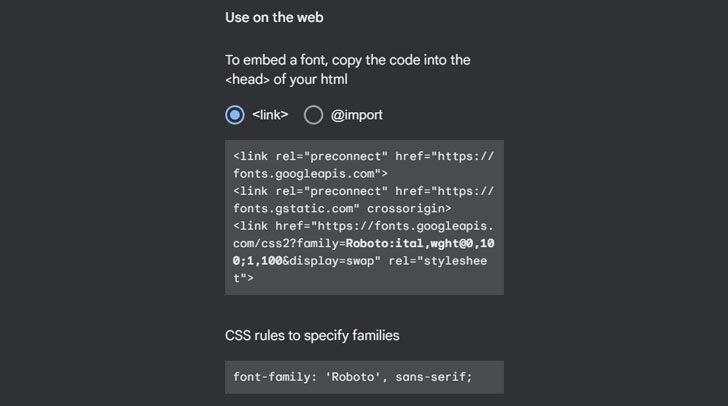
Google Fonts is a font embedding service[2]
library from Google, allowing developers to add fonts to their
Android apps and websites simply by referencing a stylesheet. As of
January 2022, Google Fonts is a repository for 1,358 font
families.
Under the European Union’s General Data Protection Regulation
(GDPR), data points such as IP addresses, advertising IDs, and
cookies are counted as personal identifiable information (PII),
making it mandatory for businesses operating in the country to seek
users’ explicit permission before processing such information.
In addition, the court noted that “Google Fonts can also be used
by the defendant without a connection to a Google server is
established and the IP address of the website user is transmitted
to Google,” effectively requiring websites to host the fonts
locally.
Aside from ordering the website to stop disclosing the IP
address by embedding the font library, the court also urged the
company running the website to share with the affected party
information about the kind of personal data that it stores and is
being processed.
The decision comes weeks after the Austrian Data Protection
Authority (DSB) ruled[3]
that the use of Google Analytics by a health-focused website called
NetDoktor violates[4]
the GDPR regulation by exporting visitors’ data to Google servers
in the U.S., thereby opening the door for potential surveillance by
the U.S. intelligence services.
References
- ^
ruling
read (rewis.io) - ^
font embedding service
(fonts.google.com) - ^
ruled (noyb.eu) - ^
violates
(www.wired.com)
Read more https://thehackernews.com/2022/01/german-court-rules-websites-embedding.html