digital businesses, yet traditional networking and cybersecurity
architectures are far from meeting the demands of the digital
business.
Gartner’s “The Future of
Network Security Is in the Cloud[1]” report spells out the
potential for the transformation of networking and security in the
cloud, built upon a new networking and security model. That model
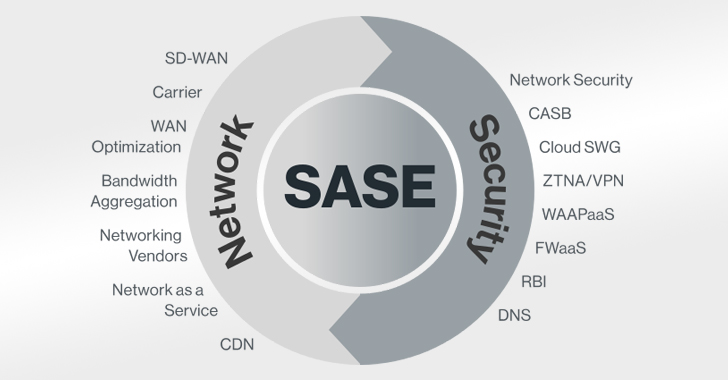
is called Secure Access Service
Edge (SASE)[2], a term coined by
Gartner’s leading security analysts Neil MacDonald, Lawrence Orans,
and Joe Skorupa.
Gartner claims that SASE has the potential to invert the
established networking and security service stack from one based in
the data center into a design that shifts the focal point of
identity to the user and the endpoint device.
SASE addresses the numerous problems that have been discovered
with traditional cybersecurity methods used in the cloud. Many of
those problems have roots with the ideology that network security
architectures must be placed at the center of connectivity in the
data center.
Those legacy applications of network security cannot efficiently
support newer networking ideologies and use cases, such as the
shift to dynamic services, software as a service (SaaS)
applications, and the growing trend of enterprises needed to work
with distributed data.
Traditional network and network security architectures were
designed for an era where the enterprise data center was the
physical center of access requirements for users and devices. A
model that worked relatively well until the push for digital
transformation drove new requirements.
With enterprises embracing digital business processes, along
with edge computing, cloud services, and hybrid networks, it became
evident that traditional networking and security architectures were
beginning to fail on multiple fronts.
The overall complexity of traditional architecture introduced
problems such as latency, networking blind spots, excessive
management overhead, and the need for constant reconfiguration as
services changed. The SASE model eliminates those problems by
reducing networking complexity and shifting the security process to
where it can do the most good, the network edge.
As an emerging, disruptive technology, Gartner has doubled down
on the importance of SASE, as evidenced by Gartner’s “Hype Cycle for
Enterprise Networking, 2019[3]” report, which presents
SASE as so strategic that the technology earned the label
“transformational.” The report also establishes sample vendors and
the critical elements of SASE.
What Exactly is SASE?
As defined by Gartner, the SASE category consists of four main
characteristics:
- Identity-driven: User and resource identity, not simply
an IP address, determine the networking experience and level of
access rights. Quality of service, route selection, applying
risk-driven security controls — all are driven by the identity
associated with every network connection. This approach reduces
operational overhead by letting companies develop one set of
networking and security policies for users regardless of device or
location. - Cloud-native architecture: The SASE architecture
leverages key cloud capabilities, including elasticity,
adaptability, self-healing, and self-maintenance, to provide a
platform that amortizes costs across customers for maximum
efficiencies, easily adapts to emerging business requirements and
is available anywhere. - Supports all edges: SASE creates one network for all
company resources—data centers, branch offices, cloud resources,
and mobile users. For example, SD-WAN appliances support physical
edges while mobile clients and clientless browser access connect
users on the go. - Globally distributed: To ensure the full networking and
security capabilities are available everywhere and deliver the best
possible experience to all edges, the SASE cloud must be globally
distributed. As such, Gartner noted, they must expand their
footprint to deliver a low-latency service to enterprise
edges.
Ultimately, the goal of a SASE architecture is one of making
secure cloud enablement easier to accomplish. SASE provides a
design philosophy that eliminates the traditional methods of
stitching together SD-WAN[4] devices, firewalls, IPS
appliances, and numerous other networking and security solutions.
Instead, SASE replaces that mish-mash of difficult to manage
technology with a secure, global SD-WAN service.
Available SASE Services
Gartner acknowledges that the SASE market is in flux, with no one
vendor offering the entire SASE portfolio of capabilities. Some
vendors, such as ZScaler, offer firewall as a service but lack
the SD-WAN capabilities (and other security capabilities) required
by SASE. Other vendors offer security as an appliance but not in a
cloud-native, global network.
About the closest to a functioning SASE service that I’ve seen
is from Cato Networks. Cato Networks provides a global private
backbone (50+ points of presence (PoPs) at last count). The PoPs
run Cato’s own cloud-native architecture that converges networking
and network security. The Cato software is a single-pass,
cloud-based architecture. All network optimizations, security
inspection, and policy enforcement are done with rich context
before forwarding traffic onto its destination.

establishing encrypted tunnels to the nearest Cato PoP. The
platform connects locations via Cato’s SD-WAN device, the Cato
Socket; mobile users via Cato’s client- and clientless access; and
cloud resources via Cato’s “agentless” integration. Even
third-party devices can be connected by establishing an IPsec
tunnel to the nearest Cato PoP.
Identity and access are unified into an easily managed paradigm.
That paradigm allows enterprises to focus on security policies,
instead of security and networking components, while also
supporting the move to a global, distributed architecture, which
securely connects all network edges.
SASE: It’s a Lot More than Security Done Right
SASE is much more than a security framework and a new model of
networking that flattens the access stack into an easily managed
fabric of connectivity with security at its core. That makes a SASE
Cloud much leaner since all functions are converged together.
SASE processes traffic faster with less latency while
incorporating more context than other networking and security
methods. As a software-defined platform, SASE can quickly adapt to
change, such as scale or agility driven reconfigurations. SASE also
introduces additional network protections, such as the concepts of
business continuity, load distribution, and improved uptime.
You can learn more about SASE, by joining to a Gartner-featured
webinar, hosted by Cato Networks. In this webinar Gartner
analyst Neil MacDonald, one of the creators of the SASE
category will cover:
- What is SASE and why is it emerging today
- What does SASE mean for networking and network security
products - What are the building blocks of a true SASE architecture
- The use cases and capabilities that are part of SASE
References
- ^
The Future of Network Security Is in
the Cloud (www.gartner.com) - ^
Secure Access Service Edge (SASE)
(www.catonetworks.com) - ^
Hype Cycle for Enterprise Networking,
2019 (www.catonetworks.com) - ^
SD-WAN
(www.catonetworks.com) - ^
Click here to register
(go.catonetworks.com)
Read more http://feedproxy.google.com/~r/TheHackersNews/~3/qN5fYdqIxv4/network-security-sase.html