
An ongoing malware campaign has been found exploiting recently
disclosed vulnerabilities in Linux devices to co-opt the systems
into an IRC botnet[1]
for launching distributed denial-of-service (DDoS) attacks and
mining Monero cryptocurrency.
The attacks involve a new malware variant called
“FreakOut” that leverages newly patched flaws in
TerraMaster, Laminas Project (formerly Zend Framework), and Liferay
Portal, according to Check Point Research’s new analysis published[2]
today and shared with The Hacker News.
Attributing the malware to be the work of a long-time cybercrime
hacker — who goes by the aliases Fl0urite and Freak on HackForums
and Pastebin as early as 2015 — the researchers said the flaws —
CVE-2020-28188[3], CVE-2021-3007[4], and CVE-2020-7961[5]
— were weaponized to inject and execute malicious commands in the
server.
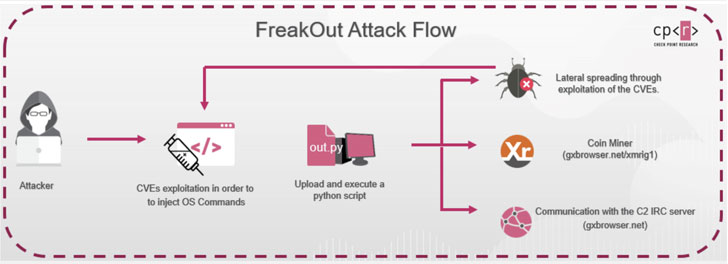
Regardless of the vulnerabilities exploited, the end goal of the
attacker appears to be to download and execute a Python script
named “out.py” using Python 2, which reached end-of-life[6]
last year — implying that the threat actor is banking on the
possibility that that victim devices have this deprecated version
installed.
“The malware, downloaded from the site hxxp://gxbrowser[.]net,
is an obfuscated Python script which contains polymorphic code,
with the obfuscation changing each time the script is downloaded,”
the researchers said, adding the first attack attempting to
download the file was observed on January 8.
And indeed, three days later, cybersecurity firm F5 Labs
warned[7]
of a series of attacks targeting NAS devices from TerraMaster
(CVE-2020-28188) and Liferay CMS (CVE-2020-7961) in an attempt to
spread N3Cr0m0rPh IRC bot and Monero cryptocurrency miner.
An IRC Botnet is a collection of machines infected with malware
that can be controlled remotely via an IRC channel to execute
malicious commands.
In FreakOut’s case, the compromised devices are configured to
communicate with a hardcoded command-and-control (C2) server from
where they receive command messages to execute.
The malware also comes with extensive capabilities that allow it
to perform various tasks, including port scanning, information
gathering, creation and sending of data packets, network sniffing,
and DDoS and flooding.
Furthermore, the hosts can be commandeered as a part of a botnet
operation for crypto-mining, spreading laterally across the
network, and launching attacks on outside targets while
masquerading as the victim company.
With hundreds of devices already infected within days of
launching the attack, the researchers warn, FreakOut will ratchet
up to higher levels in the near future.
For its part, TerraMaster[8]
is expected to patch the vulnerability in version 4.2.07. In the
meantime, it’s recommended that users upgrade to Liferay Portal[9]
7.2 CE GA2 (7.2.1) or later and laminas-http 2.14.2[10] to mitigate the risk
associated with the flaws.
“What we have identified is a live and ongoing cyber attack
campaign targeting specific Linux users,” said Adi Ikan, head of
network cybersecurity Research at Check Point. “The attacker behind
this campaign is very experienced in cybercrime and highly
dangerous.”
“The fact that some of the vulnerabilities exploited were just
published, provides us all a good example for highlighting the
significance of securing your network on an ongoing basis with the
latest patches and updates.”
References
- ^
IRC
botnet (en.wikipedia.org) - ^
published
(blog.checkpoint.com) - ^
CVE-2020-28188
(nvd.nist.gov) - ^
CVE-2021-3007
(nvd.nist.gov) - ^
CVE-2020-7961
(nvd.nist.gov) - ^
reached
end-of-life (www.python.org) - ^
warned
(twitter.com) - ^
TerraMaster
(www.ihteam.net) - ^
Liferay
Portal (sourceforge.net) - ^
laminas-http 2.14.2
(github.com)
Read more http://feedproxy.google.com/~r/TheHackersNews/~3/XiqkA-hTYq4/freakout-ongoing-botnet-attack.html