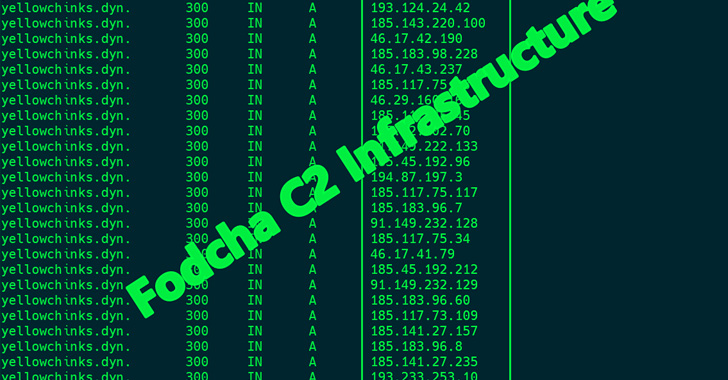
The threat actor behind the Fodcha distributed
denial-of-service (DDoS) botnet has resurfaced with new
capabilities, researchers reveal.
This includes changes to its communication protocol and the
ability to extort cryptocurrency payments in exchange for stopping
the DDoS attack against a target, Qihoo 360’s Network Security
Research Lab said[1]
in a report published last week.
Fodcha first came to light[2]
earlier this April, with the malware propagating through known
vulnerabilities in Android and IoT devices as well as weak Telnet
or SSH passwords.
The cybersecurity company said that Fodcha has evolved into a
large-scale botnet with over 60,000 active nodes and 40
command-and-control (C2) domains that can “easily generate more
than 1 Tbps traffic.”
Peak activity is said to have occurred on October 11, 2022, when
the malware targeted 1,396 devices in a single day.
The top countries singled out by the botnet since late June 2022
comprises China, the U.S., Singapore, Japan, Russia, Germany,
France, the U.K., Canada, and the Netherlands.
Some of the prominent targets range from healthcare
organizations and law enforcement agencies to a well-known cloud
service provider that was assaulted with traffic exceeding 1
Tbps.

Fodcha’s evolution has also been accompanied by new stealth
features that encrypt communications with the C2 server and
embed ransom demands[3], making it a more potent
threat.
“Fodcha reuses a lot of Mirai’s attack code, and supports a
total of 17 attack methods,” the cybersecurity company noted.
The findings come as new research from Lumen Black Lotus Labs
pointed out[4]
the growing abuse of the Connectionless Lightweight Directory
Access Protocol (CLDAP[5]) to magnify the scale of
DDoS attacks.
To that end, as many as 12,142 open CLDAP reflectors have been
identified, most of which are distributed in the U.S. and Brazil,
and to a lesser extent in Germany, India, and Mexico.
In one instance, a CLDAP service associated with an unnamed
regional retail business in North America has been observed
directing “problematic amounts of traffic” towards a wide range of
targets for more than nine months, emitting up to 7.8 Gbps of CLDAP
traffic.
References
- ^
said
(blog.netlab.360.com) - ^
first
came to light (thehackernews.com) - ^
embed
ransom demands (thehackernews.com) - ^
pointed
out (blog.lumen.com) - ^
CLDAP
(www.akamai.com)
Read more https://thehackernews.com/2022/10/fodcha-ddos-botnet-resurfaces-with-new.html