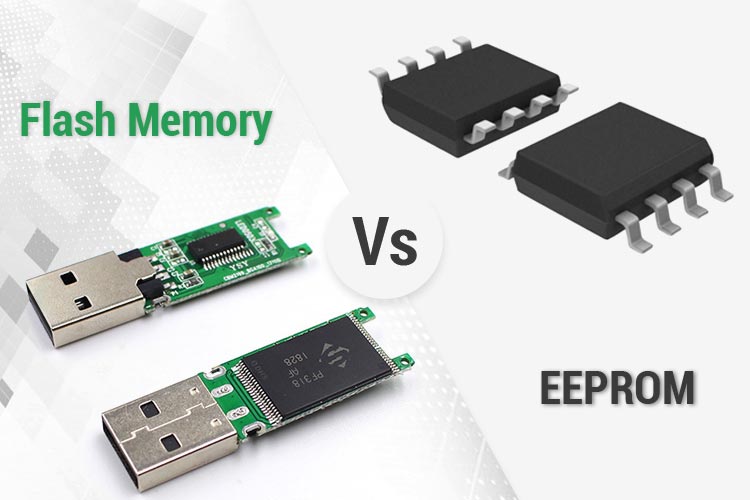
Flash memory is a type of electronically-erasable programmable read-only memory (EEPROM), but it can also be a standalone memory storage device such as USB drive.
It is a non-volatile memory chip used for storage and for transferring data between a PC and other digital devices. It is often found in USB flash drives, MP3 players, digital cameras and solid-state drives.
Toshiba developed flash memory in the early 1980s and introduced it to the market in 1984.
Flash memory incorporates the use of floating-gate transistors to store data.
EEPROM is a type of data memory device that uses an electronic device to erase or write digital data. It has per byte erase-and-write capabilities, which makes it slow. Flash memory is a distinct type of EEPROM, which is programmed and erased in large blocks. Nonetheless, the trend seems to be of using AND flash for devices that only support large-block erasure. Flash memory has many features. It is a lot cheaper than EEPROM and does not require batteries for solid-state storage such as static RAM.
To sum it up,
- Flash is just one type of EEPROM.
- Flash uses NAND-type memory, while EEPROM uses NOR type.
- Flash is block-wise erasable, while EEPROM is byte-wise erasable.
- Flash is constantly rewritten, while other EEPROMs are seldom rewritten.
- Flash is used when large amounts are needed, while EEPROM is used when only small amounts are needed.