
An exhaustive analysis of FIN7 has unmasked the
cybercrime syndicate’s organizational hierarchy, alongside
unraveling its role as an affiliate for mounting ransomware
attacks.
It has also exposed deeper associations between the group and
the larger threat ecosystem comprising the now-defunct ransomware
DarkSide[1], REvil[2], and LockBit[3]
families.
The highly active threat group, also known as Carbanak, is
known[4]
for employing an extensive arsenal of tools and tactics to expand
its “cybercrime horizons,” including adding ransomware to its
playbook and setting up fake security companies to lure researchers
into conducting ransomware attacks under the guise of penetration
testing.
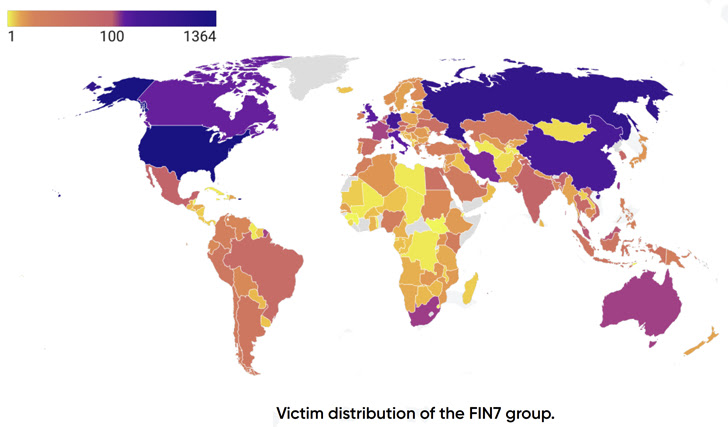
More than 8,147 victims have been compromised by the financially
motivated adversary across the world, with a majority of the
entities located in the U.S. Other prominent countries include
China, Germany, Canada, Italy, and the U.K.
FIN7’s intrusion techniques, over the years, have further
diversified beyond traditional social engineering to include
infected USB drives, software supply chain compromise, and the use
of stolen credentials purchased from underground markets.
“Nowadays, its initial approach is to carefully pick high-value
companies from the pool of already compromised enterprise systems
and force them to pay large ransoms to restore their data or seek
unique ways to monetize the data and remote access,” PRODAFT
said[5]
in a report shared with The Hacker News.
According to the Swiss cybersecurity company, the
Russian-speaking hacking crew has also been observed to weaponize
several flaws in Microsoft Exchange such as CVE-2020-0688[6], CVE-2021-42321[7], ProxyLogon, and ProxyShell[8]
to obtain a foothold into target environments.
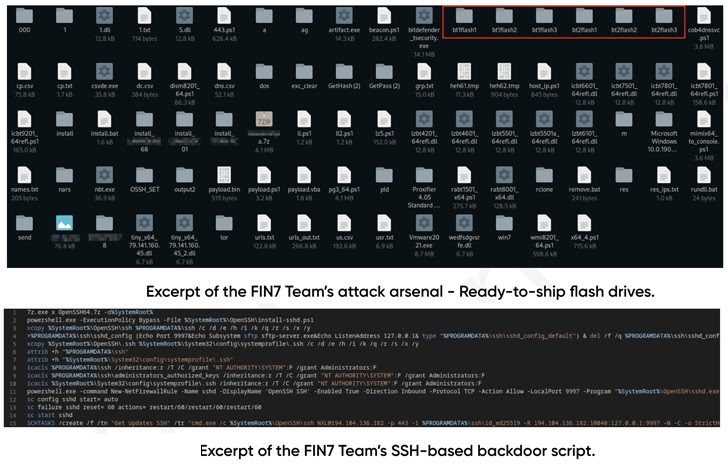
The use of double extortion tactics[9] notwithstanding, attacks
mounted by the group have deployed SSH backdoors on the compromised
systems, even in scenarios where the victim has already paid a
ransom.
The idea is to resell access to other ransomware outfits and
re-target the victims as part of its illicit money-making scheme,
underscoring its attempts to minimize efforts and maximize profits,
not to mention prioritize companies based on their annual revenues,
founded dates, and the number of employees.
This “demonstrates a particular type of feasibility study
considered a unique behavior among cybercrime groups,” the
researchers said.
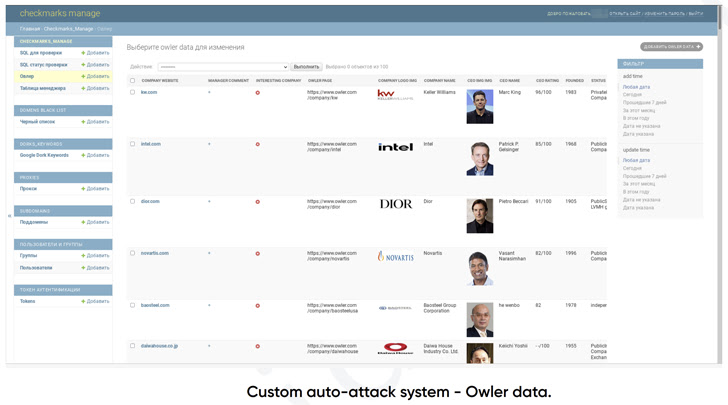
Put differently, the modus operandi of FIN7 boils down to this:
It utilizes services like Dun & Bradstreet (DNB[10]), Crunchbase, Owler,
and Zoominfo to shortlist firms and organizations with the highest
revenue. It also uses other website analytics platforms like MuStat
and Similarweb to monitor traffic to the victims’ sites.
Initial access is then obtained through one of the many
intrusion vectors, followed by exfiltrating data, encrypting files,
and eventually determining the ransom amount based on the company’s
revenue.
These infection sequences are also designed to load remote
access trojans such as Carbanak[11], Lizar[12] (aka Tirion), and
IceBot[13], the latter of which
was first documented by Recorded Future-owned Gemini Advisory in
January 2022.
Other tools developed and delivered by FIN7 encompass a module
dubbed Checkmarks that’s orchestrated to automate mass scans for
vulnerable Microsoft Exchange servers and other public-facing web
applications as well as Cobalt
Strike[14] for
post-exploitation.
In yet another indication that criminal groups function like traditional
companies[15], FIN7 follows a team
structure consisting of top-level management, developers,
pentesters, affiliates, and marketing teams, each of whom are
tasked with individual responsibilities.
While two members named Alex and Rash are the chief players
behind the operation, a third managerial member named Sergey-Oleg
is responsible for delegating duties to the group’s other
associates and overseeing their execution.
However, an examination of the group’s Jabber conversation
history has revealed that operators in administrator positions
engage in coercion and blackmail to intimidate team members into
working more and issue ultimatums to “hurt their family members in
case of resigning or escaping from responsibilities.”
The findings come more than a month after cybersecurity company
SentinelOne identified[16] potential links between
FIN7 and the Black Basta ransomware operation.
“FIN7 has established itself as an extraordinarily versatile and
well-known APT group that targets enterprise companies,” PRODAFT
concluded. “Their signature move is to thoroughly research the
companies based on their revenue, employee count, headquarters and
website information to pinpoint the most profitable targets.”
“Although they have internal issues related to the unequal
distribution of obtained monetary resources and somewhat
questionable practices towards their members, they have managed to
establish a strong presence in the cybercrime sphere.”
Found this article interesting? Follow us on Twitter [17] and LinkedIn[18] to read more exclusive
content we post.
References
- ^
DarkSide
(thehackernews.com) - ^
REvil
(thehackernews.com) - ^
LockBit
(thehackernews.com) - ^
known
(thehackernews.com) - ^
said
(www.prodaft.com) - ^
CVE-2020-0688
(thehackernews.com) - ^
CVE-2021-42321
(thehackernews.com) - ^
ProxyLogon, and ProxyShell
(thehackernews.com) - ^
double
extortion tactics (thehackernews.com) - ^
DNB
(www.dnb.com) - ^
Carbanak
(thehackernews.com) - ^
Lizar
(thehackernews.com) - ^
IceBot
(www.recordedfuture.com) - ^
Cobalt Strike
(thehackernews.com) - ^
function like traditional
companies (thehackernews.com) - ^
identified
(thehackernews.com) - ^
Twitter
(twitter.com) - ^
LinkedIn
(www.linkedin.com)
Read more https://thehackernews.com/2022/12/fin7-cybercrime-syndicate-emerges-as.html