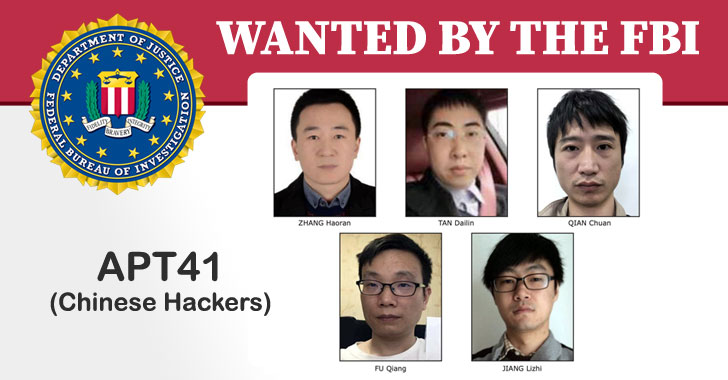
alleged members of a Chinese state-sponsored hacking group and 2
Malaysian hackers that are responsible for hacking than 100
companies throughout the world.
Named as APT41 and also known as ‘Barium,’ ‘Winnti, ‘Wicked
Panda,’ and ‘Wicked Spider,’ the cyber-espionage group has been
operating since at least 2012 and is not just involved in strategic
intelligence collection from valuable targets in many sectors, but
also behind financially motivated attacks against online gaming
industry.
According to a press
release[1] published by the U.S.
Justice Department, two of the five Chinese hackers—Zhang Haoran
(张浩然) and Tan Dailin (谭戴林)—were charged back in August 2019, and
the other three of them—Jiang Lizhi (蒋立志), Qian Chuan (钱川) and Fu
Qiang (付强)—and two Malaysian co-conspirators were in separate
indictments[2]
in August 2020.
The later indicted three Chinese hackers are associated with a
network security company Chengdu 404 Network Technology, operated
as a front by the People’s Republic of China.
“FU has been working closely with JIANG since at least 2008, and
worked with JIANG at multiple internet and video game related
companies. FU has been working with QIAN and JIANG together since
at least 2013. Before joining CHENGDU 404, FU described himself as
a skilled programmer and developer,” the court documents
say.
specializes in software supply-chain attacks, where hackers steal
proprietary “source code, software code signing certificates,
customer account data, and valuable business information,” and
distribute digitally signed malicious versions of the software to
infect systems at targeted organizations.
According to the court documents, in some cases where the
targeted systems didn’t have any valuable information, defendants
also used ransomware and crypto-jacking malware to monetize their
efforts.
The targeted industries include “software development companies,
computer hardware manufacturers, telecommunications providers,
social media companies, video game companies, non-profit
organizations, universities, think tanks, and foreign governments,
as well as pro-democracy politicians and activists in Hong
Kong.”
“The defendants also compromised foreign government computer
networks in India and Vietnam, and targeted, but did not
compromise, government computer networks in the United Kingdom,”
the press release says.
The 2 Malaysian hackers—Wong Ong Hua and Ling Yang Ching—were
arrested by Malaysian authorities in Sitiawan on September 14,
2020, and are being extradited to the United States. The FBI
confirmed[4] that all 5 Chinese
nationals remain at large.
“In addition to arresting warrants for all of the charged
defendants, in September 2020, the U.S. District Court for the
District of Columbia issued seizure warrants that resulted in the
recent seizure of hundreds of accounts, servers, domain names, and
command-and-control (C2) ‘dead drop’ web pages used by the
defendants to conduct their computer intrusion offenses,” the DoJ
said.
“The actions by Microsoft [other than Google, Facebook, and Verizon
Media] were a significant part of the overall effort to deny the
defendants continued access to hacking infrastructure, tools,
accounts, and command and control domain names.”
The targeted companies were located in the United States and
worldwide, including in Australia, Brazil, Chile, Hong Kong, India,
Indonesia, Japan, Malaysia, Pakistan, Singapore, South Korea,
Taiwan, Thailand, and Vietnam.
Zhang and Tan have been charged with 25 counts of computer fraud
and money laundering, which carry a maximum sentence of 20 years in
prison.
Jiang, Qian, and Fu are also facing similar charges with nine
counts that carry a maximum sentence of 20 years in prison.
The indictment against Wong and Ling charges the defendants with
23 counts of similar charges, but since they are also involved in
false registration of domain names, it would increase the maximum
sentence of imprisonment for money laundering to 27 years.
References
- ^
press release
(www.justice.gov) - ^
indictments
(www.justice.gov) - ^
reports
(www.fireeye.com) - ^
confirmed
(twitter.com)
Read more http://feedproxy.google.com/~r/TheHackersNews/~3/6steMmbPRmE/apt41-hackers-wanted-by-fbi.html