Mar 17, 2023Ravie Lakshmanan

An Android voice phishing (aka vishing) malware campaign known
as FakeCalls has reared its head once again to
target South Korean users under the guise of over 20 popular
financial apps.
“FakeCalls malware possesses the functionality of a Swiss army
knife, able not only to conduct its primary aim but also to extract
private data from the victim’s device,” cybersecurity firm Check
Point said[1].
FakeCalls was previously documented[2]
by Kaspersky in April 2022, describing the malware’s capabilities
to imitate phone conversations with a bank customer support
agent.
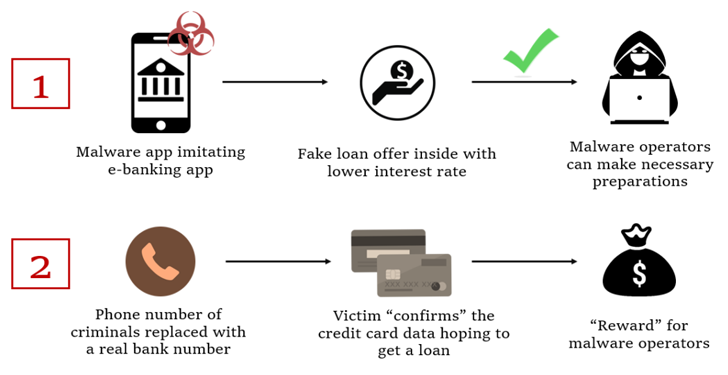
In the observed attacks, users who install the rogue banking app
are enticed into calling the financial institution by offering a
fake low-interest loan.
At the point where the phone call actually happens, a
pre-recorded audio with instructions from the real bank is played.
At the same time, malware also conceals the phone number with the
bank’s real number to give the impression that a conversation is
happening with an actual bank employee on the other end.
The ultimate goal of the campaign to get the victim’s credit
card information, which the threat actors claim is required to
qualify for the non-existent loan.
The malicious app also requests for intrusive permissions so as
to harvest sensitive data, including live audio and video streams,
from the compromised device, which are then exfiltrated to a remote
server.
The latest FakeCalls samples further implement various
techniques to stay under the radar. One of the methods involves
adding a large number of files inside nested directories to the
APK’s asset folder, causing the length of the file name and path to
breach the 300-character limit.
“The malware developers took special care with the technical
aspects of their creation as well as implementing several unique
and effective anti-analysis techniques,” Check Point said. “In
addition, they devised mechanisms for disguised resolution of the
command-and-control servers behind the operations.”
While the attack exclusively focuses on South Korea, the
cybersecurity company has warned that the same tactics can be
repurposed to target other regions across the world.
The findings also come as Cyble shed light on two Android
banking trojans dubbed Nexus and GoatRAT that can harvest valuable
data[3] and carry out financial
fraud.
Nexus[4], a rebranded version of
SOVA[5], also incorporates a
ransomware module that encrypts the stored files and can abuse
Android’s accessibility services to extract seed phrases from
cryptocurrency wallets.
WEBINAR
Discover the Hidden Dangers of Third-Party SaaS Apps
Are you aware of the risks associated with third-party app
access to your company’s SaaS apps? Join our webinar to learn about
the types of permissions being granted and how to minimize
risk.
In contrast, GoatRAT[7]
is designed to target Brazilian banks and joins the likes of
BrasDex[8]
and PixPirate[9]
to commit fraudulent money transfer over the PIX payments platform
while displaying a fake overlay window to hide the activity.
The development is part of a growing trend[10] where threat actors
have unleashed increasingly sophisticated banking malware to
automate the whole process of unauthorized money transfers on
infected devices.
Cybersecurity company Kaspersky said[11] it detected 196,476 new
mobile banking trojans and 10,543 new mobile ransomware trojans in
2022, with China, Syria, Iran, Yemen, and Iraq emerging as the top
countries attacked by mobile malware, including adware.
Spain, Saudi Arabia, Australia, Turkey, China, Switzerland,
Japan, Colombia, Italy, and India lead the list of top countries
infected by mobile financial threats.
“Despite the decline in overall malware installers, the
continued growth of mobile banking Trojans is a clear indication
that cybercriminals are focusing on financial gain,” Kaspersky
researcher Tatyana Shishkova said[12].
Found this article interesting? Follow us on Twitter [13] and LinkedIn[14] to read more exclusive
content we post.
References
- ^
said
(research.checkpoint.com) - ^
previously documented
(www.kaspersky.com) - ^
harvest valuable data
(today.ucsd.edu) - ^
Nexus
(blog.cyble.com) - ^
SOVA
(thehackernews.com) - ^
RESERVE YOUR SEAT
(thn.news) - ^
GoatRAT
(blog.cyble.com) - ^
BrasDex
(thehackernews.com) - ^
PixPirate
(thehackernews.com) - ^
growing trend
(thehackernews.com) - ^
said
(securelist.com) - ^
said
(www.kaspersky.com) - ^
Twitter
(twitter.com) - ^
LinkedIn
(www.linkedin.com)
Read more https://thehackernews.com/2023/03/fakecalls-vishing-malware-targets-south.html