
Facebook has patched a bug in its widely installed Messenger app
for Android that could have allowed a remote attacker to call
unsuspecting targets and listen to them before even they picked up
the audio call.
The flaw was discovered and reported to Facebook by Natalie Silvanovich[1]
of Google’s Project Zero bug-hunting team last month on October 6
with a 90-day deadline, and impacts version 284.0.0.16.119 (and
before) of Facebook Messenger for Android.
In a nutshell, the vulnerability could have granted an attacker
who is logged into the app to simultaneously initiate a call and
send a specially crafted message to a target who is signed in to
both the app as well as another Messenger client such as the web
browser.
“It would then trigger a scenario where, while the device is
ringing, the caller would begin receiving audio either until the
person being called answers or the call times out,” Facebook’s
Security Engineering Manager Dan Gurfinkel said[2].
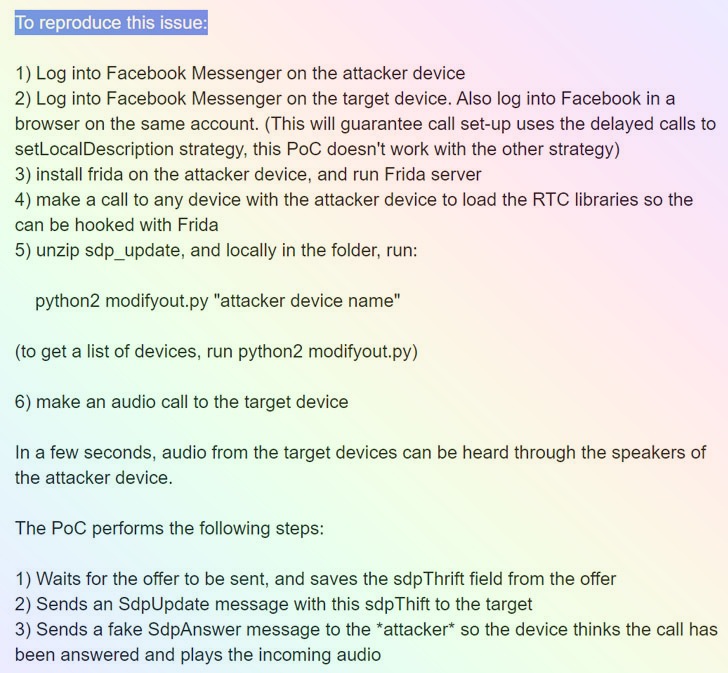
According to a technical write-up[3]
by Silvanovich, the flaw resides in WebRTC’s Session Description
Protocol (SDP[4]) — which defines a
standardized format for the exchange of streaming media between two
endpoints — allowing an attacker to send a special type of message
known as “SdpUpdate” that would cause the call to connect to the
callee’s device before being answered.
Audio and video calls via WebRTC typically does not transmit
audio until the recipient has clicked the accept button, but if
this “SdpUpdate” message is sent to the other end device while it
is ringing, “it will cause it to start transmitting audio
immediately, which could allow an attacker to monitor the callee’s
surroundings.”
In some ways, the vulnerability bears similarity to a
privacy-eroding flaw that was reported in Apple’s FaceTime group chats[5] feature last year that
made it possible for users to initiate a FaceTime video call and
eavesdrop on targets by adding their own number as a third person
in a group chat even before the person on the other end accepted
the incoming call.
The gaffe was deemed so severe that Apple pulled the plug on
FaceTime group chats altogether before it addressed the issue in a
subsequent iOS update.
But unlike the FaceTime bug, exploiting the issue isn’t that
easy. The caller would have to already have the permissions to call
a specific person — in other words, the caller and the callee would
have to be Facebook friends to pull this off.
What’s more, the attack also necessitates that the bad actor
uses reverse engineering tools like Frida to manipulate their own
Messenger application to force it to send the custom “SdpUpdate”
message.
Silvanovich was awarded a $60,000 bug bounty for reporting the
issue, one among Facebook’s three highest bug bounties to date,
which the Google researcher said she was donating[6]
to a non-profit named GiveWell.
This not the first time Silvanovich has found critical flaws in
messaging apps, who has previously unearthed a number of issues[7] in WhatApp, iMessage,
WeChat, Signal, and Reliance JioChat, some of which[8]
have found[9]
the “callee device to send audio without user interaction.”
References
- ^
Natalie
Silvanovich (twitter.com) - ^
said
(about.fb.com) - ^
technical write-up
(bugs.chromium.org) - ^
SDP
(en.wikipedia.org) - ^
Apple’s
FaceTime group chats (thehackernews.com) - ^
she was
donating (twitter.com) - ^
unearthed a number of issues
(bugs.chromium.org) - ^
which
(bugs.chromium.org) - ^
found
(bugs.chromium.org)