
Cybersecurity researchers on Tuesday released new findings that
reveal a year-long mobile espionage campaign against the Kurdish
ethnic group to deploy two Android backdoors that masquerade as
legitimate apps.
Active since at least March 2020, the attacks leveraged as many
as six dedicated Facebook profiles that claimed to provide news,
two of which were aimed at Android users while the other four
shared pro-Kurd content, only to share spying apps on Facebook
public groups. All six profiles have since been taken down.
“It targeted the Kurdish ethnic group through at least 28
malicious Facebook posts that would lead potential victims to
download Android 888 RAT or SpyNote,” ESET researcher Lukas
Stefanko said[1]. “Most of the malicious
Facebook posts led to downloads of the commercial, multi-platform
888 RAT, which has been available on the black market since
2018.”
The Slovakian cybersecurity firm attributed the attacks to a
group it refers to as BladeHawk.
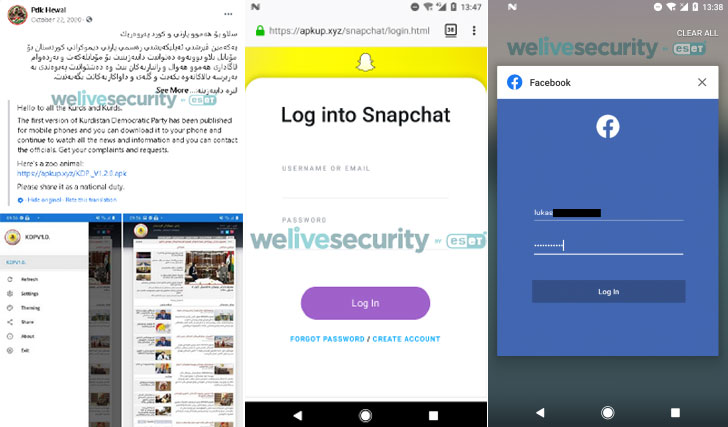
In one instance, the operators shared a Facebook post urging
users to download a “new snapchat” app that’s designed to capture
Snapchat credentials via a phishing website. A total of 28 rogue
Facebook posts have been identified as part of the latest
operation, complete with fake app descriptions and links to
download the Android app, from which 17 unique APK samples were
obtained. The spying apps were downloaded 1,481 times from July 20,
2020, until June 28, 2021.
888 RAT, originally conceived as a Windows remote access trojan
(RAT) costing $80, has since developed new capabilities for the
malicious software to target Android and Linux systems at an added
cost of $150 (Pro) and $200 (Extreme), respectively.
The commercial RAT runs the typical spyware gamut in that it’s
equipped to run 42 commands received from its command-and-control
(C&C) server. Some of its prominent functions include the
ability to steal and delete files from a device, take screenshots,
amass device location, swipe Facebook credentials, get a list of
installed apps, gather user photos, take photos, record surrounding
audio and phone calls, make calls, steal SMS messages and contact
lists, and send text messages.
According to ESET, India, Ukraine, and the U.K. account for the
most infections over the three-year period starting from August 18,
2018, with Romania, The Netherlands, Pakistan, Iraq, Russia,
Ethiopia, and Mexico rounding off the top 10 spots.
The espionage activity has been linked directly to two other
incidents that came to light in 2020, counting a public disclosure[2]
from Chinese cybersecurity services company QiAnXin that detailed a
BladeHawk attack with the same modus operandi, with overlaps in the
use of C&C servers, 888 RAT, and the reliance on Facebook for
distributing malware.
Additionally, the Android 888 RAT has been connected to two more
organized campaigns — one that involved spyware[3]
disguised as TikTok and an information-gathering operation[4] undertaken by the
Kasablanca Group.
References
- ^
said
(www.welivesecurity.com) - ^
public
disclosure (ti.qianxin.com) - ^
spyware
(www.zscaler.com) - ^
information-gathering operation
(thehackernews.com)