Researchers on Tuesday revealed details of a new banking trojan
targeting corporate users in Brazil at least since 2019 across
various sectors such as engineering, healthcare, retail,
manufacturing, finance, transportation, and government.
Dubbed “Janeleiro[1]” by Slovak cybersecurity
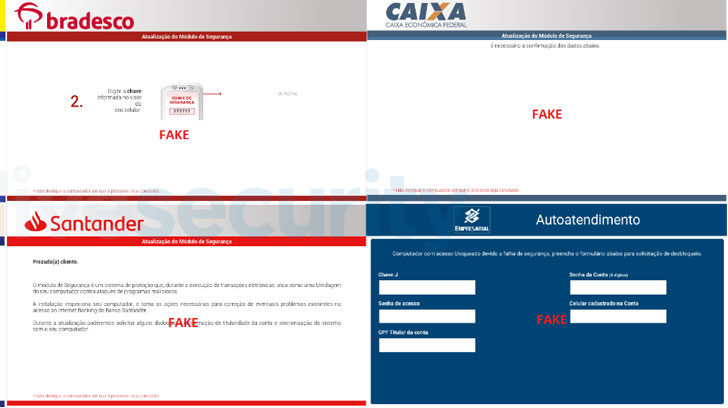
firm ESET, the malware aims to disguise its true intent via
lookalike pop-up windows that are designed to resemble the websites
of some of the biggest banks in the country, including Itaú
Unibanco, Santander, Banco do Brasil, Caixa Econômica Federal, and
Banco Bradesco.
“These pop-ups contain fake forms, aiming to trick the malware’s
victims into entering their banking credentials and personal
information that the malware captures and exfiltrates to its
[command-and-control] servers,” ESET researchers Facundo Muñoz and
Matías Porolli said in a write-up.
This modus operandi is not new to banking trojans. In August
2020, ESET uncovered a Latin American (LATAM) banking trojan called
Mekotio[2]
that displayed similar fake pop-up windows to its victims in an
attempt to entice them into divulging sensitive information.
But Janeleiro stands out for a number of reasons. One, the
malware is written in Visual Basic .NET, which the researchers say
is a “big deviation” from the Delphi programming language that’s
usually preferred by the threat actors in the region. It also
doesn’t rely on custom encryption algorithms or additional layers
of obfuscation and even reuses code taken from NjRAT, a rarity
among LATAM banking trojans.
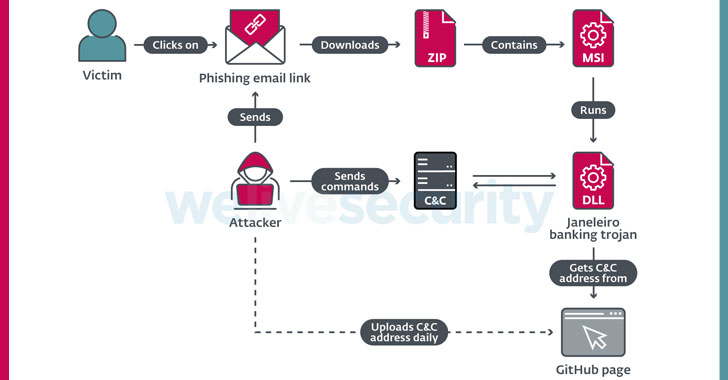
The attack commences with a phishing email that purports to be
an unpaid invoice, which contains a link that, when clicked,
downloads a ZIP file. The archive comes with an MSI installer that
loads the main trojan DLL, which subsequently fetches the IP
addresses of the command-and-control (C2) servers from a GitHub
page apparently created by the malware authors. The last link in
the infection chain involves waiting for commands from the C2
server.
Thus in the event, a user visits the website of a banking entity
of interest, Janeleiro connects to the C2 server and dynamically
displays the fraudulent pop-up windows, and captures the keystrokes
and other information entered in the fake forms.
ESET said it discovered four versions of Janeleiro between
September 2019 to March 2021.
This is not the first time banking trojans have been spotted in
the wild that have singled out Brazilian users. Last year,
Kaspersky detailed at least four malware families[3]
— Guildma, Javali, Melcoz, and Grandoreiro — which were found to
target financial institutions in Brazil, Latin America, and
Europe.
Then earlier this January, ESET revealed a new Delphi-based
banking trojan named “Vadokrist[4]” that was found to
target Brazil exclusively while sharing similarities with other
malware families like Amavaldo, Casbaneiro, Grandoreiro, and
Mekotio.
“Janeleiro follows the unique blueprint for the core
implementation of the fake pop-up windows as many LATAM banking
trojans, this does not seem to be a coincidence or inspiration:
this actor employs and distributes Janeleiro sharing the same
infrastructure as some of the most prominent of these active
malware families,” the researchers concluded.
References
Read more http://feedproxy.google.com/~r/TheHackersNews/~3/9zERzM6xf90/experts-uncover-new-banking-trojan.html