
As many as 75 apps on Google Play and 10 on Apple App Store have
been discovered engaging in ad fraud as part of an ongoing campaign
that commenced in 2019.
The latest iteration, dubbed Scylla by Online
fraud-prevention firm HUMAN Security, follows similar attack waves
in August 2019 and late 2020 that go by the codename Poseidon and
Charybdis, respectively.
Prior to their removal from the app storefronts, the apps had
been collectively installed more than 13 million times.
The original Poseidon operation comprised over 40 Android apps
that were designed to display ads out of context or hidden from the
view of the device user.
Charybdis, on the other hand, was an improvement over the former
by making use of code obfuscation tactics to target advertising
platforms.
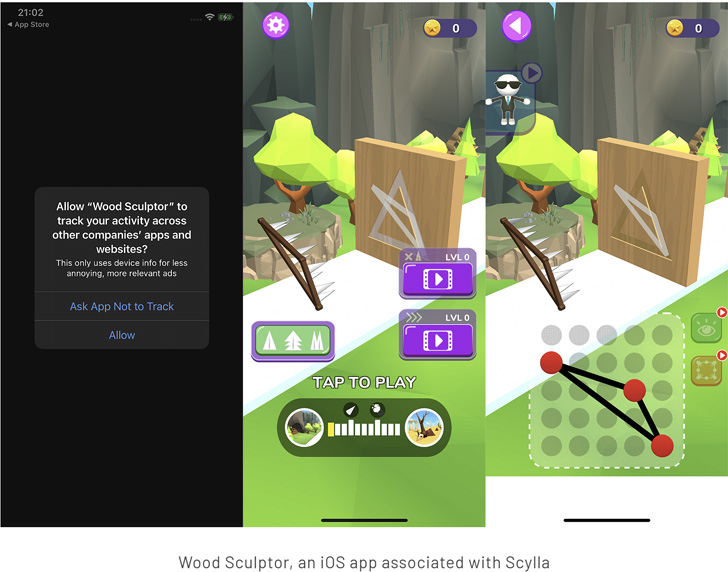
Scylla presents the latest adaption of the scheme in that it
expands beyond Android to make a foray into the iOS ecosystem for
the first time, alongside relying on additional layers of code
roundabout using the Allatori tool[1].
These apps, once installed, are engineered to commit different
kinds of ad fraud, marking a significant step up in sophistication
from previous variants.
These include spoofing popular apps such as streaming services
to trick advertising SDKs into placing ads, serving out-of-context
and “hidden” ads via off-screen WebViews, and generating fraudulent
ad clicks to profit off ads.
“In layman’s terms, the threat actors code their apps to pretend
to be other apps for advertising purposes, often because the app
they’re pretending to be is worth more to an advertiser than the
app would be by itself,” the company said[2].
As always, users are advised to scrutinize apps prior to
downloading them, and avoid third-party app stores on the web that
could harbor malicious applications.
References
- ^
Allatori tool
(allatori.com) - ^
said
(www.humansecurity.com)
Read more https://thehackernews.com/2022/09/experts-uncover-85-apps-with-13-million.html