Mar 02, 2023Ravie Lakshmanan

A malicious Python package uploaded to the Python Package Index
(PyPI) has been found to contain a fully-featured information
stealer and remote access trojan.
The package, named colourfool, was identified
by Kroll’s Cyber Threat Intelligence team, with the company calling
the malware Colour-Blind.
“The ‘Colour-Blind’ malware points to the democratization of
cybercrime that could lead to an intensified threat landscape, as
multiple variants can be spawned from code sourced from others,”
Kroll researchers Dave Truman and George Glass said[1]
in a report shared with The Hacker News.
colourfool, like other rogue Python modules[2] discovered in recent
months, conceals its malicious code in the setup script, which
points to a ZIP archive payload hosted on Discord.
The file contains a Python script (code.py) that comes with
different modules designed to log keystrokes, steal cookies, and
even disable security software.
The malware, besides performing defense evasion checks to
determine if it’s being executed in a sandbox, establishes
persistence by means of a Visual Basic script and uses
transfer[.]sh for data exfiltration.
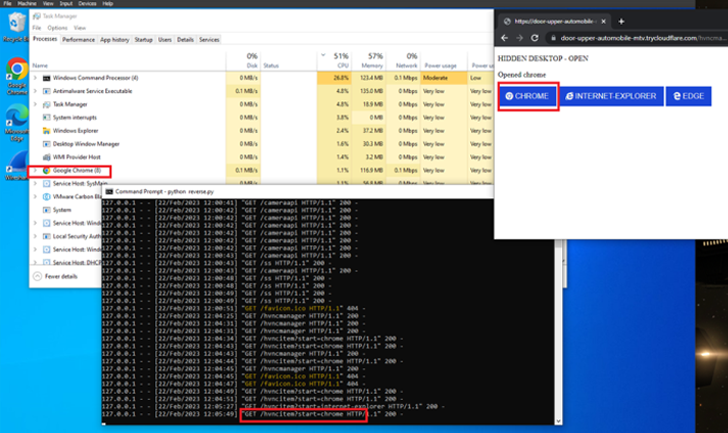
“As a method of remote control, the malware starts a Flask web
application, which it makes accessible to the internet via
Cloudflare’s reverse tunnel utility ‘cloudflared,’ bypassing any
inbound firewall rules,” the researchers said.
The use of Cloudflare tunnels mirrors another campaign[3]
that was disclosed by Phylum last month which made use of six
fraudulent packages to distribute a stealer-cum-RAT dubbed
poweRAT.
The trojan is feature rich and is capable of gathering
passwords, terminating applications, taking screenshots, logging
keystrokes, opening arbitrary web pages on a browser, executing
commands, capturing crypto wallet data, and even snooping on
victims via the web camera.
The findings come as threat actors are leveraging the source
code associated with W4SP stealer[4]
to spawn copycat versions that are distributed[5]
via Python packages like ratebypass, imagesolverpy, and 3m-promo-gen-api[6].
What’s more, Phylum discovered[7]
three more packages – called pycolured, pycolurate, and colurful –
that have been used to deliver a Go-based remote access trojan
referred to as Spark[8].
Adding to the attacks targeting PyPI, the software supply chain
security firm also revealed details[9]
of a massive attack campaign wherein unknown threat actors
published as many as 1,138 packages to deploy a Rust executable,
which is then used to drop additional malware binaries.
“The risk/reward proposition for attackers is well worth the
relatively minuscule time and effort, if they can land a whale with
a fat crypto wallet,” the Phylum research team said[10].
“And the loss of a few bitcoin pales in comparison to the
potential damage of the loss of a developer’s SSH keys in a large
enterprise such as a corporation or government.”
Found this article interesting? Follow us on Twitter [11] and LinkedIn[12] to read more exclusive
content we post.
References
- ^
said
(www.kroll.com) - ^
other
rogue Python modules (thehackernews.com) - ^
another
campaign (thehackernews.com) - ^
W4SP
stealer (thehackernews.com) - ^
distributed
(blog.sonatype.com) - ^
3m-promo-gen-api
(thehackernews.com) - ^
discovered
(blog.phylum.io) - ^
Spark
(github.com) - ^
revealed
details (blog.phylum.io) - ^
said
(blog.phylum.io) - ^
Twitter
(twitter.com) - ^
LinkedIn
(www.linkedin.com)
Read more https://thehackernews.com/2023/03/experts-identify-fully-featured-info.html