A U.S. federal government commission associated with
international rights has been targeted by a backdoor that
reportedly compromised its internal network in what the researchers
described as a “classic APT-type operation.”
“This attack could have given total visibility of the network
and complete control of a system and thus could be used as the
first step in a multi-stage attack to penetrate this, or other
networks more deeply,” Czech security company Avast said[1]
in a report published last week.
The name of the federal entity was not disclosed, but reports
from Ars Technica[2]
and The Record[3]
tied it to the U.S. Commission on International Religious Freedom
(USCIRF[4]). Avast said it was
making its findings public after unsuccessful attempts to directly
notify the agency about the intrusion and through other channels
put in place by the U.S. government.
At this stage, only “parts of the attack puzzle” have been
uncovered, leaving the door open for a lot of unknowns with regards
to the nature of the initial access vector used to breach the
network, the sequence of post-exploitation actions taken by the
actor, and the overall impact of the compromise itself.
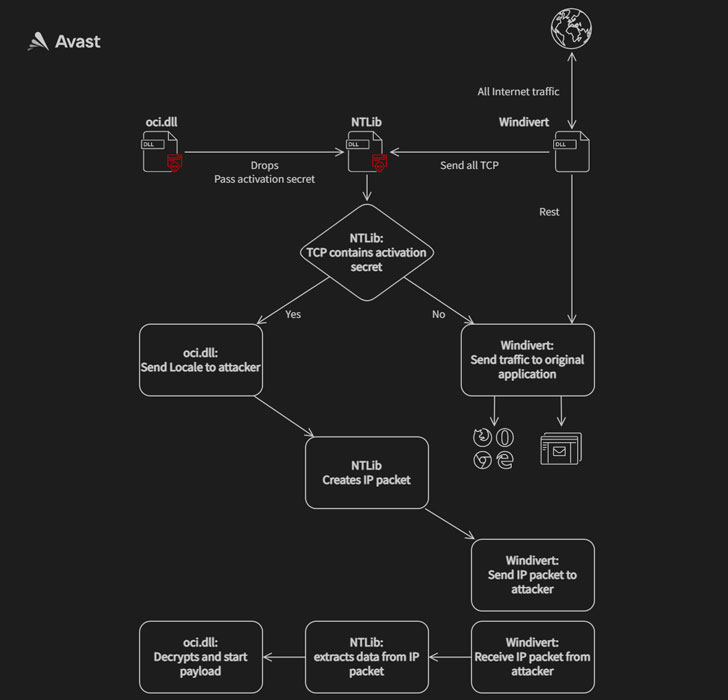
What’s known is that the attack was carried out in two stages to
deploy two malicious binaries that enabled the unidentified
adversary to intercept internet traffic and execute code of their
choosing, permitting the operators to take complete control over
the infected systems. It achieves this by abusing WinDivert[5], a legitimate packet
capturing utility for Windows.
Interestingly, not only both the samples masquerade as an Oracle
library named “oci.dll[6],” the second-stage
decryptor deployed during the attack was found to share
similarities with another executable detailed by Trend Micro
researchers in 2018, which delved into an information theft-driven
supply chain attack dubbed “Operation Red Signature[7]” aimed at organizations
in South Korea. The overlaps have led the Avast Threat Intelligence
Team to suspect that the attackers have had access to the source
code of the latter.
“It is reasonable to presume that some form of data gathering
and exfiltration of network traffic happened, but that is informed
speculation,” the researchers said. “That said, we have no way to
know for sure the size and scope of this attack beyond what we’ve
seen.”
References
- ^
said
(decoded.avast.io) - ^
Ars
Technica (arstechnica.com) - ^
The
Record (therecord.media) - ^
USCIRF
(www.uscirf.gov) - ^
WinDivert
(www.reqrypt.org) - ^
oci.dll
(docs.oracle.com) - ^
Operation Red Signature
(www.trendmicro.com)
Read more https://thehackernews.com/2021/12/experts-discover-backdoor-deployed-on.html