
Emotet is one of the most dangerous and widespread malware
threats active today.
Ever since its discovery in 2014—when Emotet was a standard
credential stealer and banking Trojan, the malware has evolved into
a modular, polymorphic platform for distributing other kinds of
computer viruses.
Being constantly under development, Emotet updates itself
regularly to improve stealthiness, persistence, and add new spying
capabilities.
This notorious Trojan is one of the most frequently malicious
programs found in the wild. Usually, it is a part of a phishing
attack, email spam that infects PCs with malware and spreads among
other computers in the network.
If you’d like to find out more about the malware, collect IOCs,
and get fresh samples, check the following article in the Malware trends
tracker[1], the service with
dynamic articles.
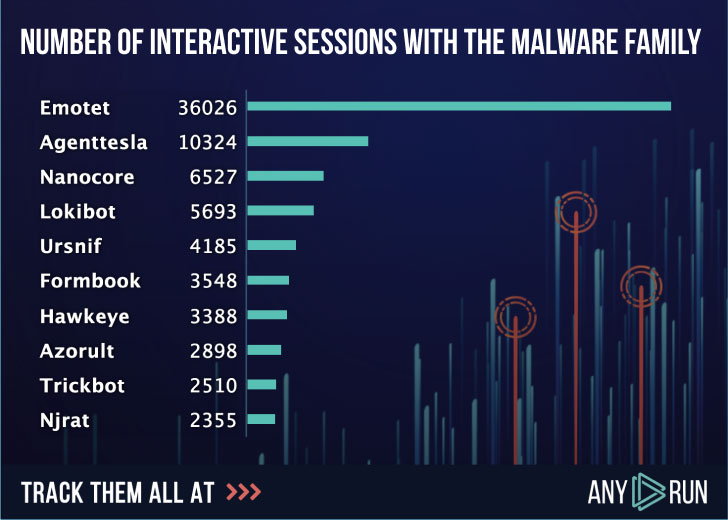
Emotet is the most uploaded malware throughout the past few
years. Here below is the rating of uploads to ANY.RUN
service[2] in 2019, where users ran
over 36000 interactive sessions of Emotet malware analysis
online.
The malware has changed a lot over time, and with every new
version, it gets more and more threatening for victims. Let’s have
a closer look at how it evolved.
When it was just like any other standard banking Trojan, the
malware’s main goal was to steal small companies’ credentials,
mainly in Germany and Austria. By faking invoices or other
financial documents, it made users click on the links and let the
malware in.
Later that year, it acquired a diverse modular architecture,
whose primary focuses were downloading a malware payload, spreading
onto as many machines as possible, and sending malicious emails to
infect other organizations.
In early 2015 after a little break, Emotet showed up again. The
public RSA key, new address lists, RC4 encryption were among the
new features of Trojan. From this point, the victims’ range started
to increase — Swiss banks joined it. And overall, evasion
techniques were improved a lot.
In recent versions, a significant change in the strategy has
happened. Emotet has turned into polymorphic malware, downloading
other malicious programs to the infected computer and the whole
network as well. It steals data, adapts to various detection
systems, rents the infected hosts to other cybercriminals as a
Malware-as-a-Service model.
Since Emotet uses stolen emails to gain victims’ trust, spam has
consistently remained the primary delivery method for Emotet—making
it convincing, highly successful, and dangerous.
For example, in 2018, the government system suffered an Emotet
infection in Allentown, a city in eastern Pennsylvania, which cost
them $1 million for recovery.
The whole city of Frankfurt had to shut down the network because
of Emotet in 2019. Different kinds of organizations, from the
government to small businesses, all public services were forced to
stop their work via IT.
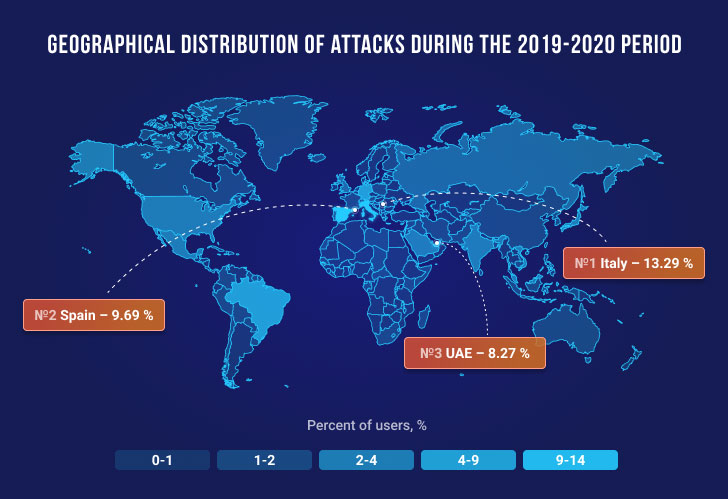
According to the latest research, Emotet is a worldwide threat
that affects all kinds of spheres. Just look at the following map,
Italy, Spain, and the United Arab Emirates are the top countries
with the most attacked users.
Recently France, Japan, and New Zealand’s cybersecurity
companies have announced a rise in Emotet attacks targeting their
countries.
Emotet then and now
According to a graph of the Emotet samples uploaded to ANY.RUN
service, you can see the behavior of the malware in 2019 and
2020.
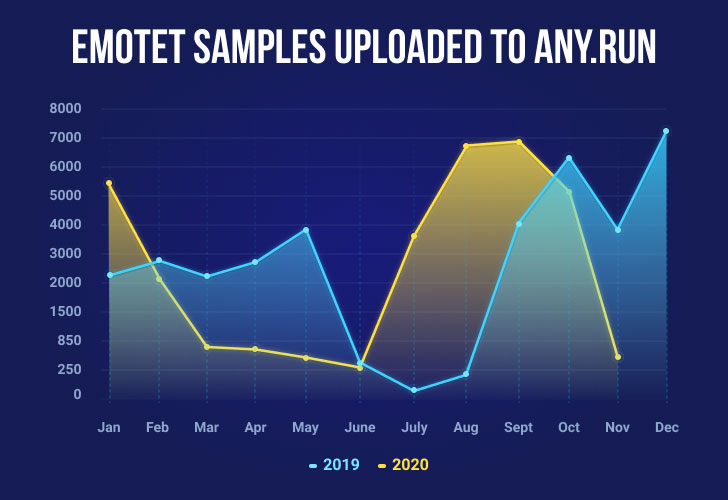
We can notice some similarities in its activity. For example, in
June, Emotet tends to be on the decline. However, it seems to show
an increasing trend from August till October. In 2019 the end of
the year was very active for this kind of attack, so we can expect
it to be on the rise this year as well.
Emotet has remained a threat for years as it changes
permanently. Early versions differ from the current one, even by
its intentions — Emotet has developed from the banking Trojan to
the loader. When it comes to execution evolution and document
templates, we will describe only versions that come after 2018.
There were changes even over these two years, but the only thing
that remains unchanged is delivery.
For distribution and user execution, Emotet is using malicious
spam and documents with VBA macros. After a target downloads the
attached malicious documents from an email and opens it, the Office
document tricks the user into enabling the macro. After that, the
embedded macro starts its execution, and subsequent scenarios may
vary. The most common variant over the past years is that macros
start a Base64 encoded Powershell script that later downloads an
executable. But at this point, Emotet brings a lot of different
executions.
Many variants come to its life when we talk about the initial
steps after a maldoc was opened. VBA macro in Office documents can
start cmd, Powershell, WScript, and, lately, for the first time,
Сertutil was used by the Emotet’s execution chain.
Other changes in the execution process happened in the chain
between malicious documents and dropped/downloaded executable
files.
Not only has the execution chain transformed over time, but also
the Emotet’s executable file itself — registry keys, files, and
child processes in the file system. For example, in the 2018-2019
years, Emotet dropped its executable at the folder under a
particular path and generated a filename and the name of a folder
using a particular algorithm.
It changed the file name generation algorithm, process tree, and
path generation algorithm for C2 communication.
Another big part that characterizes this malware family is the
maldocs’ templates it uses. They are continually changing, and most
of the time, Emotet uses its own ones. But between them can also be
found templates that previously were used to distribute other
malware families such as Valak and Icedid.
Emotet from the ANY.RUN’s perspective
Of course, the main challenge with Emotet is to find a way to
identify it and understand its behavior, so after that, you could
improve the weak points in security.
There is a tool that can give you a hand with that. ANY.RUN is
an interactive online sandbox that detects, analyzes, and monitors
cybersecurity threats, necessary if you deal with Emotet.
Moreover, ANY.RUN has a special tool — the research of public
submissions[3]. It’s a vast database
where users share their investigations. And quite often, Emotet
becomes the “hero” of the day: it has a leading position of the
most downloaded samples into ANY.RUN. That’s why ANY.RUN’s
experience with the malware is interesting.
The first step of protecting your infrastructure from Emotet
infection is — detecting the malware. ANY.RUN sandbox has
outstanding tools for Emotet detection and analysis.
The online service deals with Emotet regularly. So, let’s try
the interactive approach for Emotet detection and investigate one of the samples[4] together:
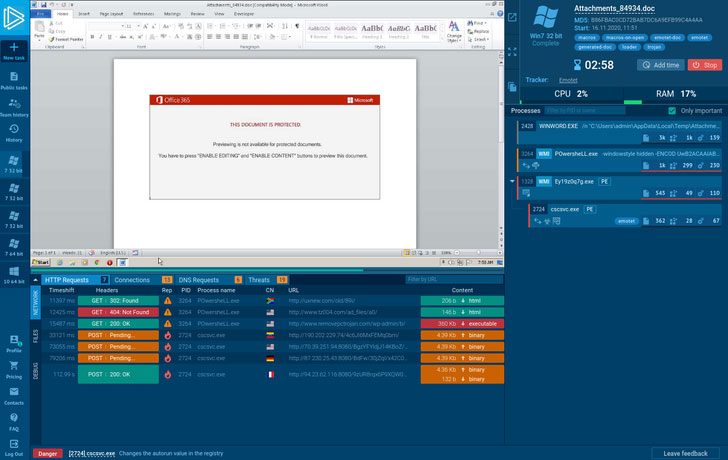
Here is a malicious attachment from the phishing email that we
uploaded to ANY.RUN and immediately get the first results. The
process tree on the right reflects all operations that were
made.
As shown, the first process starts to create new files in the
user directory. Then POwersheLL.exe connects to the network and
downloads executable files from the Internet. The last one,
winhttp.exe changes the autorun value in the registry and connects
to the command-and-control server, both to retrieve instructions
for subsequent malicious activities and exfiltrate stolen data.
And finally, Emotet was detected by network activity. Fresh
Suricata rulesets from premium providers such as Proofpoint
(Emerging Threats) and Positive Technologies are a big part of the
detection process.
In addition, ANY.RUN offers a useful Fake Net feature. When
turned on, it returns a 404 error that forces malware to reveal its
C2 links that help collect Emotet’s IOCs more efficiently. That
helps malware analysts optimize their time as there is no need to
deobfuscate it manually.
Interestingly, a set of malicious documents with the same
template can have embedded VBA macro, leading to creating different
execution chains. All of them have the main goal to trick a user
who opened this maldoc to enable VBA macro.

If you’d like to take a look at all of those templates, just
search by tag “emotet-doc” in ANY. RUN’s public submissions — these
maldocs are clustered by content similarity.
Conclusion
This kind of tendency proves that Emotet isn’t going to give up
or lose the ground. Its evolution showed that the malware develops
very quickly and adapts to everything.
If your enterprise is connected to the Internet, the risks may
be broader and deeper than you realize. That’s why it’s true that
combating sophisticated threats like Emotet requires a concerted
effort from both individuals and organizations.
Moreover, the goal of services like ANY.RUN is to be aware of
such potential threats and help companies recognize malware early
and avoid infections at any cost.
Analysis and detection with ANY.RUN is easy, and anyone can
analyze a bunch of fresh samples every day.
What’s more, the service is free to use and for downloading
samples, and there is no doubt you can make use of ANY.RUN[5] — just give it a
try!
References
- ^
Malware
trends tracker (any.run) - ^
ANY.RUN service
(app.any.run) - ^
public submissions
(app.any.run) - ^
investigate one of the samples
(app.any.run) - ^
ANY.RUN
(app.any.run)
Read more http://feedproxy.google.com/~r/TheHackersNews/~3/ZA5do8yQNVQ/anyrun-emotet-malware-analysis.html