The operators of the Ducktail information stealer have
demonstrated a “relentless willingness to persist” and continued to
update their malware as part of an ongoing financially driven
campaign.
“The malware is designed to steal browser cookies and take
advantage of authenticated Facebook sessions to steal information
from the victim’s Facebook account,” WithSecure researcher Mohammad
Kazem Hassan Nejad said[1]
in a new analysis.
“The operation ultimately hijacks Facebook Business accounts to
which the victim has sufficient access. The threat actor uses their
gained access to run ads for monetary gain.”
Attributed to a Vietnamese threat actor, the Ducktail campaign
is designed to target businesses in the digital marketing and
advertising sectors which are active on the Facebook Ads and
Business platform.
Also targeted are individuals within prospective companies that
are likely to have high-level access to Facebook Business accounts.
This includes marketing, media, and human resources personnel.
The malicious activity was first documented[2]
by the Finnish cybersecurity company in July 2022. The operation is
believed to be underway since the second half of 2021, although
evidence points to the threat actor being active as far back as
late 2018.
A subsequent analysis by Zscaler ThreatLabz last month uncovered
a PHP version[3]
of the malware distributed as installers for cracked software.
WithSecure, however, said the activity has no connection whatsoever
to the campaign it tracks under the Ducktail moniker.
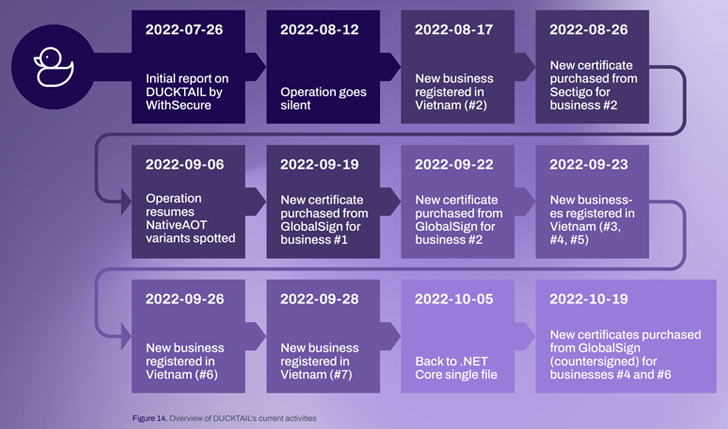
The latest iteration of the malware, which resurfaced on
September 6, 2022, after the threat actor was forced to halt its
operations on August 12 in response to public disclosure, comes
with a host of improvements incorporated to circumvent
detection.
Infection chains now commence with the delivery of archive files
containing spreadsheet documents hosted on Apple iCloud and Discord
through platforms like LinkedIn and WhatsApp, indicating
diversification of the threat actor’s spear-phishing tactics.
The Facebook Business account information collected by the
malware, which is signed using digital certificates obtained under
the guise of seven different non-existent businesses, is
exfiltrated using Telegram.
“An interesting shift that was observed with the latest campaign
is that [the Telegram command-and-control] channels now include
multiple administrator accounts, indicating that the adversary may
be running an affiliate program,” Nejad explained.
References
- ^
said
(labs.withsecure.com) - ^
first
documented (thehackernews.com) - ^
PHP
version (thehackernews.com)
Read more https://thehackernews.com/2022/11/ducktail-malware-operation-evolves-with.html