An analysis of off-the-shelf packages hosted on the NuGet
repository has revealed 51 unique software components to be
vulnerable to actively exploited, high-severity vulnerabilities,
once again underscoring the threat posed by third-party
dependencies to the software development process.
In light of the growing number of cyber incidents that target
the software supply chain, there is an urgent need to assess such
third-party modules for any security risks and minimize the attack
surface, ReversingLabs researcher Karlo Zanki said in a report
shared with The Hacker News.
NuGet[1]
is a Microsoft-supported mechanism for the .NET platform and
functions as a package manager designed to enable developers to
share reusable code. The framework maintains a central repository
of over 264,000 unique packages that have collectively produced
more than 109 billion package downloads.
“All identified precompiled software components in our research
were different versions of 7Zip, WinSCP and PuTTYgen, programs that
provide complex compression and network functionality,” Zanki
explained[2]. “They are continuously
updated to improve their functionality and to address known
security vulnerabilities. However, sometimes it happens that other
software packages get updated but still keep using several years
old dependencies containing known vulnerabilities.”
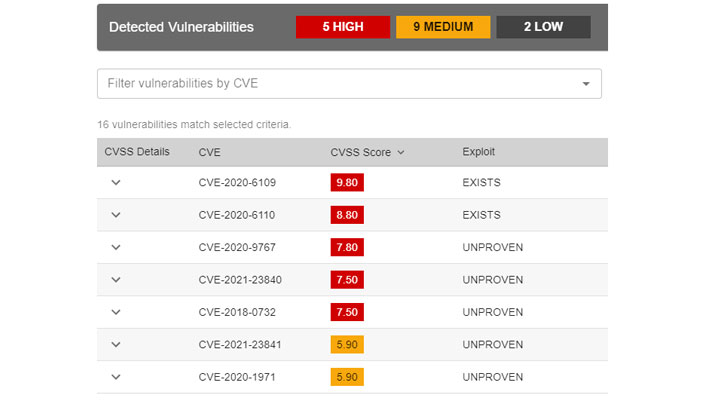
In one instance, it was found that “WinSCPHelper[3]” — a remote server file
management library and which has been downloaded more than 35,000
times — use an old and vulnerable WinSCP version 5.11.2, whereas
WinSCP version 5.17.10[4]
released earlier this January addresses a critical arbitrary
execution flaw (CVE-2021-3331[5]), thus exposing users of
the package to the vulnerability.
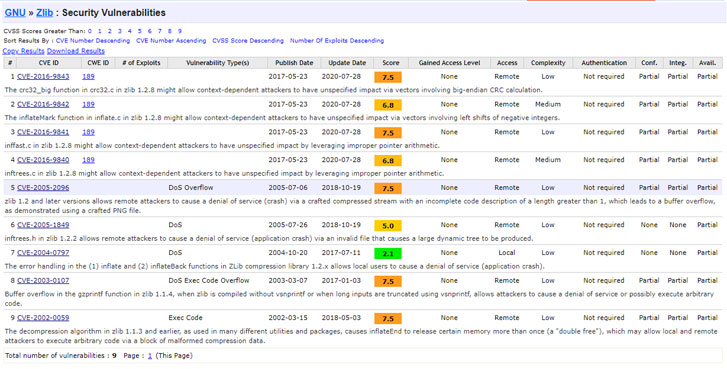
Furthermore, the researchers established that more than 50,000
software components extracted from NuGet packages were statically
linked to a vulnerable version of “zlib[6]” data compression
library, rendering them vulnerable to a number of known security
issues such as CVE-2016-9840[7], CVE-2016-9841[8], CVE-2016-9842[9], and CVE-2016-9843[10].
Some of the packages that were observed to have a zlib
vulnerability are “DicomObjects[11]” and “librdkafka.redist[12]“, each of which have
been downloaded no less than 50,000 and 18.2 million times. A
matter of more concern is that “librdkafka.redist” is listed as a
dependency for several other popular packages, counting Confluent’s
.NET Client for Apache Kafka (Confluent.Kafka[13]), which, in turn, has
been downloaded more than 17.6 million times to date.
“Companies developing software solutions need to become more
aware of such risks, and need to become more involved in their
handling,” Zanki said. “Both the inputs and final outputs of the
software development process need to be checked for tampering and
code quality issues. “Transparent software development is one of
the keystones needed to enable early detection and prevention of
software supply-chain attacks.”
References
- ^
NuGet
(docs.microsoft.com) - ^
explained
(blog.secure.software) - ^
WinSCPHelper
(www.nuget.org) - ^
WinSCP
version 5.17.10 (winscp.net) - ^
CVE-2021-3331
(nvd.nist.gov) - ^
zlib
(en.wikipedia.org) - ^
CVE-2016-9840
(nvd.nist.gov) - ^
CVE-2016-9841
(nvd.nist.gov) - ^
CVE-2016-9842
(nvd.nist.gov) - ^
CVE-2016-9843
(nvd.nist.gov) - ^
DicomObjects
(www.nuget.org) - ^
librdkafka.redist
(www.nuget.org) - ^
Confluent.Kafka
(www.nuget.org)