to implement a “comprehensive software security program” in order
to settle a Federal Trade Commission (FTC) lawsuit alleging that
the company didn’t take adequate steps to protect its consumers
from hackers.
Your wireless router is the first line of defense against
potential threats on the Internet.
However, sadly, most widely-used routers fail to offer necessary
security features and have often found vulnerable to serious
security flaws, eventually enabling remote attackers to
unauthorizedly access networks and compromise the security of other
devices connected to it.
In recent years, the security of wireless networks has been more of
a hot topic due to cyber attacks, as well as has gained headlines
after the discovery of critical vulnerabilities—such as authentication
bypass, remote code
execution, hard-coded login
credentials, and information disclosure—in routers manufactured
by various brands.
In 2017, the US Federal Trade Commission (FTC) filed a
lawsuit against D-Link[4], one of the more popular
router manufacturers, over the poor security of its wireless
routers, IP cameras, and other Internet-connected devices.
According to the FTC complaint, D-Link allegedly misrepresented
the security of its products to its customers, didn’t adequately
test its products for well-known and easy-to-fix security flaws,
and also failed to secure devices when security vulnerabilities
were reported by independent security researchers.
“Defendants D-Link repeatedly have failed to take reasonable
software testing and remediation measures to protect their routers
and IP cameras against well known and easily preventable software
security flaws,” the FTC complaint says. “In truth and in fact,
Defendants did not take reasonable steps to secure their products
from unauthorized access.”
keys on the Internet that could have allowed hackers to sign
their malware and evade detection.
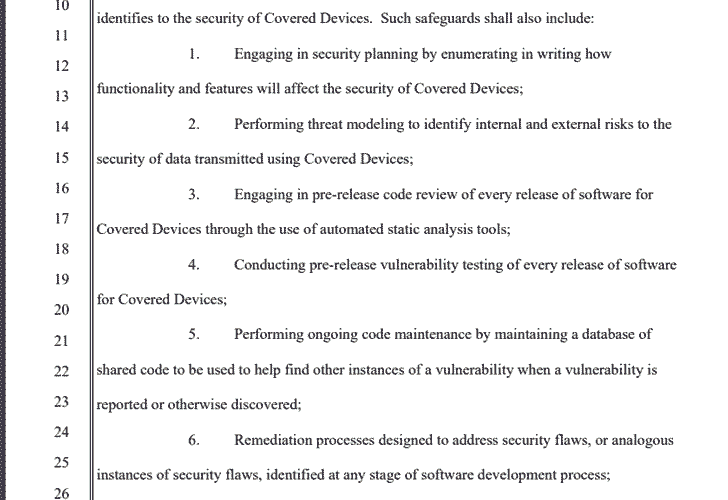
“amicable” settlement which says D-Link is required to follow
proper security planning, threat modeling, vulnerability testing,
and remediation before its routers and IP cameras hit the
market.
The deal also makes it mandatory for the company to monitor its
products for security flaws, automatically update firmware, and set
up a system to accept vulnerability reports from security
researchers.
Besides this, D-Link has also agreed to go through security
audits of its software security program every other year for the
next 10 years from a third-party, independent firm, an assessor
approved by the FTC.
In a press release, D-Link claims[7] the FTC has not found
the company liable for any alleged violations, but ironically the
company has reached an amicable resolution with the FTC, as
mentioned above.
The FTC settled similar charges
with ASUS[8] over the security of its
routers in 2016, when the company agreed to undergo independent
security audits every 2 years for the next 20 years.
References
- ^
authentication bypass
(thehackernews.com) - ^
remote code execution
(thehackernews.com) - ^
hard-coded login credentials
(thehackernews.com) - ^
filed a lawsuit against D-Link
(thehackernews.com) - ^
private code signing keys
(thehackernews.com) - ^
PDF
(www.ftc.gov) - ^
claims
(supportannouncement.us.dlink.com) - ^
similar charges with ASUS
(thehackernews.com)
Read more http://feedproxy.google.com/~r/TheHackersNews/~3/FYpC0YOaBZw/ftc-d-link-router-security.html