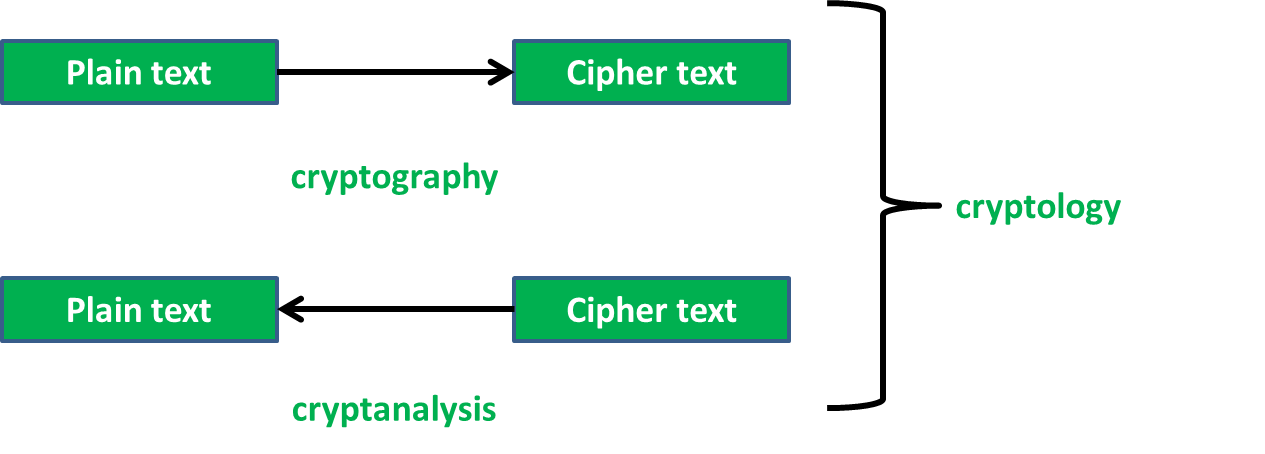
Cryptology is the study of codes, both creating and solving them. Cryptography is the art of creating codes. Cryptanalysis is the art of surreptitiously revealing the contents of coded messages, breaking codes, that were not intended for you as a recipient. Secondly, there are nomenclators and enciphers
Cryptanalysis is the study of analyzing information systems in order to study the hidden aspects of the systems. Cryptanalysis is used to breach cryptographic security systems and gain access to the contents of encrypted messages, even if the cryptographic key is unknown.
- Total break: deducing and obtaining a secret key.
- Global deduction: discovering an algorithm, which allows to decrypt many messages, without knowing the actual secret key.
- Local deduction: discovering an original plaintext of the specific given ciphertext.
An Overview of Cryptography
https://www.garykessler.net/library/crypto.html
3.1. Secret Key Cryptography
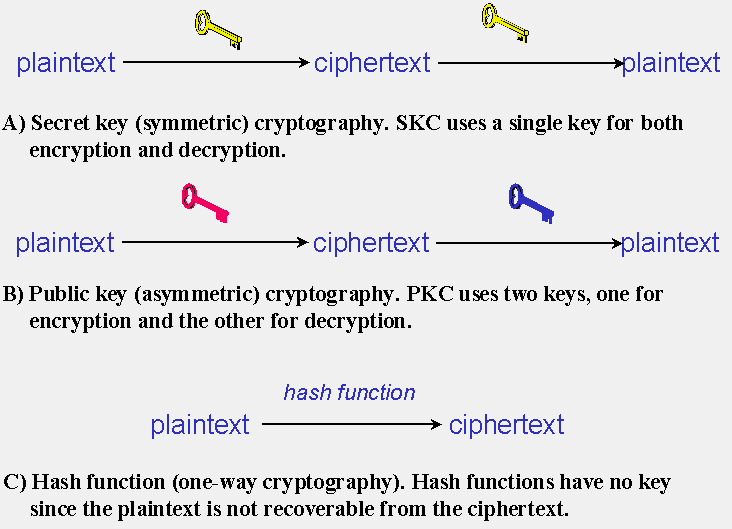
Secret key cryptography methods employ a single key for both encryption and decryption. As shown in Figure 1A, the sender uses the key to encrypt the plaintext and sends the ciphertext to the receiver. The receiver applies the same key to decrypt the message and recover the plaintext. Because a single key is used for both functions, secret key cryptography is also called symmetric encryption.
With this form of cryptography, it is obvious that the key must be known to both the sender and the receiver; that, in fact, is the secret. The biggest difficulty with this approach, of course, is the distribution of the key (more on that later in the discussion of public key cryptography).
Secret key cryptography schemes are generally categorized as being either stream ciphers or block ciphers.
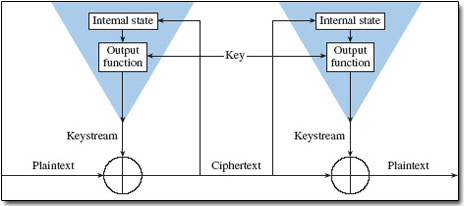 A) Self-synchronizing stream cipher. (From Schneier, 1996, Figure 9.8) A) Self-synchronizing stream cipher. (From Schneier, 1996, Figure 9.8)
FIGURE 2: Types of stream ciphers. |
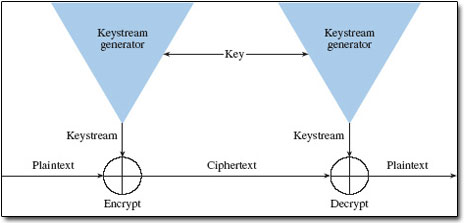 B) Synchronous stream cipher. (From Schneier, 1996, Figure 9.6)
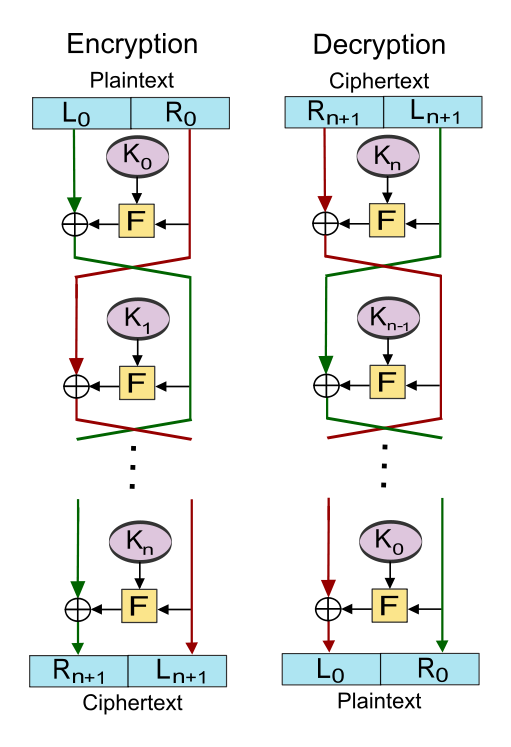 FIGURE 3: Feistel cipher. (Source: Wikimedia Commons) FIGURE 3: Feistel cipher. (Source: Wikimedia Commons) |
Block ciphers can operate in one of several modes; the following are the most important:
- Electronic Codebook (ECB) mode is the simplest, most obvious application: the secret key is used to encrypt the plaintext block to form a ciphertext block. Two identical plaintext blocks, then, will always generate the same ciphertext block. ECB is susceptible to a variety of brute-force attacks (because of the fact that the same plaintext block will always encrypt to the same ciphertext), as well as deletion and insertion attacks. In addition, a single bit error in the transmission of the ciphertext results in an error in the entire block of decrypted plaintext.
- Cipher Block Chaining (CBC) mode adds a feedback mechanism to the encryption scheme; the plaintext is exclusively-ORed (XORed) with the previous ciphertext block prior to encryption so that two identical plaintext blocks will encrypt differently. While CBC protects against many brute-force, deletion, and insertion attacks, a single bit error in the ciphertext yields an entire block error in the decrypted plaintext block and a bit error in the next decrypted plaintext block.
- Cipher Feedback (CFB) mode is a block cipher implementation as a self-synchronizing stream cipher. CFB mode allows data to be encrypted in units smaller than the block size, which might be useful in some applications such as encrypting interactive terminal input. If we were using one-byte CFB mode, for example, each incoming character is placed into a shift register the same size as the block, encrypted, and the block transmitted. At the receiving side, the ciphertext is decrypted and the extra bits in the block (i.e., everything above and beyond the one byte) are discarded. CFB mode generates a keystream based upon the previous ciphertext (the initial key comes from an Initialization Vector [IV]). In this mode, a single bit error in the ciphertext affects both this block and the following one.
- Output Feedback (OFB) mode is a block cipher implementation conceptually similar to a synchronous stream cipher. OFB prevents the same plaintext block from generating the same ciphertext block by using an internal feedback mechanism that generates the keystream independently of both the plaintext and ciphertext bitstreams. In OFB, a single bit error in ciphertext yields a single bit error in the decrypted plaintext.
- Counter (CTR) mode is a relatively modern addition to block ciphers. Like CFB and OFB, CTR mode operates on the blocks as in a stream cipher; like ECB, CTR mode operates on the blocks independently. Unlike ECB, however, CTR uses different key inputs to different blocks so that two identical blocks of plaintext will not result in the same ciphertext. Finally, each block of ciphertext has specific location within the encrypted message. CTR mode, then, allows blocks to be processed in parallel — thus offering performance advantages when parallel processing and multiple processors are available — but is not susceptible to ECB’s brute-force, deletion, and insertion attacks.
A good overview of these different modes can be found at CRYPTO-IT.
Secret key cryptography algorithms in use today — or, at least, important today even if not in use — include:
-
- Data Encryption Standard (DES): One of the most well-known and well-studied SKC schemes, DES was designed by IBM in the 1970s and adopted by the National Bureau of Standards (NBS) [now the National Institute of Standards and Technology (NIST)] in 1977 for commercial and unclassified government applications. DES is a Feistel block-cipher employing a 56-bit key that operates on 64-bit blocks. DES has a complex set of rules and transformations that were designed specifically to yield fast hardware implementations and slow software implementations, although this latter point is not significant today since the speed of computer processors is several orders of magnitude faster today than even twenty years ago. DES was based somewhat on an earlier cipher from Feistel called Lucifer which, some sources report, had a 112-bit key. This was rejected, partially in order to fit the algorithm onto a single chip and partially because of the National Security Agency (NSA). The NSA also proposed a number of tweaks to DES that many thought were introduced in order to weaken the cipher; analysis in the 1990s, however, showed that the NSA suggestions actually strengthened DES, including the removal of a mathematical back door by a change to the design of the S-box (see “The Legacy of DES” by Bruce Schneier [2004]).
DES was defined in American National Standard X3.92 and three Federal Information Processing Standards (FIPS), all withdrawn in 2005:
- FIPS PUB 46-3: DES (Archived file)
- FIPS PUB 74: Guidelines for Implementing and Using the NBS Data Encryption Standard
- FIPS PUB 81: DES Modes of Operation
Information about vulnerabilities of DES can be obtained from the Electronic Frontier Foundation.
Two important variants that strengthen DES are:
- Triple-DES (3DES): A variant of DES that employs up to three 56-bit keys and makes three encryption/decryption passes over the block; 3DES is also described in FIPS PUB 46-3 and was an interim replacement to DES in the late-1990s and early-2000s.
- DESX: A variant devised by Ron Rivest. By combining 64 additional key bits to the plaintext prior to encryption, effectively increases the keylength to 120 bits.
More detail about DES, 3DES, and DESX can be found below in Section 5.4.
- Advanced Encryption Standard (AES): In 1997, NIST initiated a very public, 4-1/2 year process to develop a new secure cryptosystem for U.S. government applications (as opposed to the very closed process in the adoption of DES 25 years earlier). The result, the Advanced Encryption Standard, became the official successor to DES in December 2001. AES uses an SKC scheme called Rijndael, a block cipher designed by Belgian cryptographers Joan Daemen and Vincent Rijmen. The algorithm can use a variable block length and key length; the latest specification allowed any combination of keys lengths of 128, 192, or 256 bits and blocks of length 128, 192, or 256 bits. NIST initially selected Rijndael in October 2000 and formal adoption as the AES standard came in December 2001. FIPS PUB 197 describes a 128-bit block cipher employing a 128-, 192-, or 256-bit key. AES is also part of the NESSIE approved suite of protocols. (See also the entries for CRYPTEC and NESSIE Projects in Table 3.)
The AES process and Rijndael algorithm are described in more detail below in Section 5.9.
- CAST-128/256: CAST-128 (aka CAST5), described in Request for Comments (RFC) 2144, is a DES-like substitution-permutation crypto algorithm, employing a 128-bit key operating on a 64-bit block. CAST-256 (aka CAST6), described in RFC 2612, is an extension of CAST-128, using a 128-bit block size and a variable length (128, 160, 192, 224, or 256 bit) key. CAST is named for its developers, Carlisle Adams and Stafford Tavares, and is available internationally. CAST-256 was one of the Round 1 algorithms in the AES process.
- International Data Encryption Algorithm (IDEA): Secret-key cryptosystem written by Xuejia Lai and James Massey, in 1992 and patented by Ascom; a 64-bit SKC block cipher using a 128-bit key.
- Rivest Ciphers (aka Ron’s Code): Named for Ron Rivest, a series of SKC algorithms.
- RC1: Designed on paper but never implemented.
- RC2: A 64-bit block cipher using variable-sized keys designed to replace DES. It’s code has not been made public although many companies have licensed RC2 for use in their products. Described in RFC 2268.
- RC3: Found to be breakable during development.
- RC4: A stream cipher using variable-sized keys; it is widely used in commercial cryptography products. An update to RC4, called Spritz (see also this article), was designed by Rivest and Jacob Schuldt. More detail about RC4 (and a little about Spritz) can be found below in Section 5.13.
- RC5: A block-cipher supporting a variety of block sizes (32, 64, or 128 bits), key sizes, and number of encryption passes over the data. Described in RFC 2040.
- RC6: A 128-bit block cipher based upon, and an improvement over, RC5; RC6 was one of the AES Round 2 algorithms.
- Blowfish: A symmetric 64-bit block cipher invented by Bruce Schneier; optimized for 32-bit processors with large data caches, it is significantly faster than DES on a Pentium/PowerPC-class machine. Key lengths can vary from 32 to 448 bits in length. Blowfish, available freely and intended as a substitute for DES or IDEA, is in use in a large number of products.
- Twofish: A 128-bit block cipher using 128-, 192-, or 256-bit keys. Designed to be highly secure and highly flexible, well-suited for large microprocessors, 8-bit smart card microprocessors, and dedicated hardware. Designed by a team led by Bruce Schneier and was one of the Round 2 algorithms in the AES process.
- Threefish: A large block cipher, supporting 256-, 512-, and 1024-bit blocks and a key size that matches the block size; by design, the block/key size can grow in increments of 128 bits. Threefish only uses XOR operations, addition, and rotations of 64-bit words; the design philosophy is that an algorithm employing many computationally simple rounds is more secure than one employing highly complex — albeit fewer — rounds. The specification for Threefish is part of the Skein Hash Function Family documentation.
- Anubis: Anubis is a block cipher, co-designed by Vincent Rijmen who was one of the designers of Rijndael. Anubis is a block cipher, performing substitution-permutation operations on 128-bit blocks and employing keys of length 128 to 3200 bits (in 32-bit increments). Anubis works very much like Rijndael. Although submitted to the NESSIE project, it did not make the final cut for inclusion.
- ARIA: A 128-bit block cipher employing 128-, 192-, and 256-bit keys to encrypt 128-bit blocks in 12, 14, and 16 rounds, depending on the key size. Developed by large group of researchers from academic institutions, research institutes, and federal agencies in South Korea in 2003, and subsequently named a national standard. Described in RFC 5794.
- Camellia: A secret-key, block-cipher crypto algorithm developed jointly by Nippon Telegraph and Telephone (NTT) Corp. and Mitsubishi Electric Corporation (MEC) in 2000. Camellia has some characteristics in common with AES: a 128-bit block size, support for 128-, 192-, and 256-bit key lengths, and suitability for both software and hardware implementations on common 32-bit processors as well as 8-bit processors (e.g., smart cards, cryptographic hardware, and embedded systems). Also described in RFC 3713. Camellia’s application in IPsec is described in RFC 4312 and application in OpenPGP in RFC 5581. Camellia is part of the NESSIE suite of protocols.
- CLEFIA: Described in RFC 6114, CLEFIA is a 128-bit block cipher employing key lengths of 128, 192, and 256 bits (which is compatible with AES). The CLEFIA algorithm was first published in 2007 by Sony Corporation. CLEFIA is one of the new-generation lightweight blockcipher algorithms designed after AES, offering high performance in software and hardware as well as a lightweight implementation in hardware.
- FFX-A2 and FFX-A10: FFX (Format-preserving, Feistel-based encryption) is a type of Format Preserving Encryption (FPE) scheme that is designed so that the ciphertext has the same format as the plaintext. FPE schemes are used for such purposes as encrypting social security numbers, credit card numbers, limited size protocol traffic, etc.; this means that an encrypted social security number, for example, would still be a nine-digit string. FFX can theoretically encrypt strings of arbitrary length, although it is intended for message sizes smaller than that of AES-128 (2128 points). The FFX version 1.1 specification describes FFX-A2 and FFX-A10, which are intended for 8-128 bit binary strings or 4-36 digit decimal strings.
- GSM (Global System for Mobile Communications, originally Groupe Spécial Mobile) encryption: GSM mobile phone systems use several stream ciphers for over-the-air communication privacy. A5/1 was developed in 1987 for use in Europe and the U.S. A5/2, developed in 1989, is a weaker algorithm and intended for use outside of Europe and the U.S. Significant flaws were found in both ciphers after the “secret” specifications were leaked in 1994, however, and A5/2 has been withdrawn from use. The newest version, A5/3, employs the KASUMI block cipher. NOTE: Unfortunately, although A5/1 has been repeatedly “broken” (e.g., see “Secret code protecting cellphone calls set loose” [2009] and “Cellphone snooping now easier and cheaper than ever” [2011]), this encryption scheme remains in widespread use, even in 3G and 4G mobile phone networks. Use of this scheme is reportedly one of the reasons that the National Security Agency (NSA) can easily decode voice and data calls over mobile phone networks.
- GPRS (General Packet Radio Service) encryption: GSM mobile phone systems use GPRS for data applications, and GPRS uses a number of encryption methods, offering different levels of data protection. GEA/0 offers no encryption at all. GEA/1 and GEA/2 are proprietary stream ciphers, employing a 64-bit key and a 96-bit or 128-bit state, respectively. GEA/1 and GEA/2 are most widely used by network service providers today although both have been reportedly broken. GEA/3 is a 128-bit block cipher employing a 64-bit key that is used by some carriers; GEA/4 is a 128-bit clock cipher with a 128-bit key, but is not yet deployed.
- KASUMI: A block cipher using a 128-bit key that is part of the Third-Generation Partnership Project (3gpp), formerly known as the Universal Mobile Telecommunications System (UMTS). KASUMI is the intended confidentiality and integrity algorithm for both message content and signaling data for emerging mobile communications systems.
- KCipher-2: Described in RFC 7008, KCipher-2 is a stream cipher with a 128-bit key and a 128-bit initialization vector. Using simple arithmetic operations, the algorithms offers fast encryption and decryption by use of efficient implementations. KCipher-2 has been used for industrial applications, especially for mobile health monitoring and diagnostic services in Japan.
- KHAZAD: KHAZAD is a so-called legacy block cipher, operating on 64-bit blocks à la older block ciphers such as DES and IDEA. KHAZAD uses eight rounds of substitution and permutation, with a 128-bit key.
- KLEIN: Designed in 2011, KLEIN is a lightweight, 64-bit block cipher supporting 64-, 80- and 96-bit keys. KLEIN is designed for highly resource constrained devices such as wireless sensors and RFID tags.
- Light Encryption Device (LED): Designed in 2011, LED is a lightweight, 64-bit block cipher supporting 64- and 128-bit keys. LED is designed for RFID tags, sensor networks, and other applications with devices constrained by memory or compute power.
- MARS: MARS is a block cipher developed by IBM and was one of the five finalists in the AES development process. MARS employs 128-bit blocks and a variable key length from 128 to 448 bits. The MARS document stresses the ability of the algorithm’s design for high speed, high security, and the ability to efficiently and effectively implement the scheme on a wide range of computing devices.
- MISTY1: Developed at Mitsubishi Electric Corp., a block cipher using a 128-bit key and 64-bit blocks, and a variable number of rounds. Designed for hardware and software implementations, and is resistant to differential and linear cryptanalysis. Described in RFC 2994, MISTY1 is part of the NESSIE suite.
- Salsa and ChaCha: Salsa20 is a stream cipher proposed for the eSTREAM project by Daniel Bernstein. Salsa20 uses a pseudorandom function based on 32-bit (whole word) addition, bitwise addition (XOR), and rotation operations, aka add-rotate-xor (ARX) operations. Salsa20 uses a 256-bit key although a 128-bit key variant also exists. In 2008, Bernstein published ChaCha, a new family of ciphers related to Salsa20. ChaCha20, originally defined in RFC 7539 (now obsoleted), is employed (with the Poly1305 authenticator) in Internet Engineering Task Force (IETF) protocols, most notably for IPsec and Internet Key Exchange (IKE), per RFC 7634, and Transaction Layer Security (TLS), per RFC 7905. In 2014, Google adopted ChaCha20/Poly1305 for use in OpenSSL, and they are also a part of OpenSSH. RFC 8439 replaces RFC 7539, and provides an implementation guide for both the ChaCha20 cipher and Poly1305 message authentication code, as well as the combined CHACHA20-POLY1305 Authenticated-Encryption with Associated-Data (AEAD) algorithm.
- Secure and Fast Encryption Routine (SAFER): A series of block ciphers designed by James Massey for implementation in software and employing a 64-bit block. SAFER K-64, published in 1993, used a 64-bit key and SAFER K-128, published in 1994, employed a 128-bit key. After weaknesses were found, new versions were released called SAFER SK-40, SK-64, and SK-128, using 40-, 64-, and 128-bit keys, respectively. SAFER+ (1998) used a 128-bit block and was an unsuccessful candidate for the AES project; SAFER++ (2000) was submitted to the NESSIE project.
- SEED: A block cipher using 128-bit blocks and 128-bit keys. Developed by the Korea Information Security Agency (KISA) and adopted as a national standard encryption algorithm in South Korea. Also described in RFC 4269.
- Serpent: Serpent is another of the AES finalist algorithms. Serpent supports 128-, 192-, or 256-bit keys and a block size of 128 bits, and is a 32-round substitution–permutation network operating on a block of four 32-bit words. The Serpent developers opted for a high security margin in the design of the algorithm; they determined that 16 rounds would be sufficient against known attacks but require 32 rounds in an attempt to future-proof the algorithm.
- SHACAL: SHACAL is a pair of block ciphers based upon the Secure Hash Algorithm (SHA) and the fact that SHA is, at heart, a compression algorithm. As a hash function, SHA repeatedly calls on a compression scheme to alter the state of the data blocks. While SHA (like other hash functions) is irreversible, the compression function can be used for encryption by maintaining appropriate state information. SHACAL-1 is based upon SHA-1 and uses a 160-bit block size while SHACAL-2 is based upon SHA-256 and employs a 256-bit block size; both support key sizes from 128 to 512 bits. SHACAL-2 is one of the NESSIE block ciphers.
- Simon and Speck: Simon and Speck are a pair of lightweight block ciphers proposed by the NSA in 2013, designed for highly constrained software or hardware environments. (E.g., per the specification, AES requires 2400 gate equivalents and these ciphers require less than 2000.) While both cipher families perform well in both hardware and software, Simon has been optimized for high performance on hardware devices and Speck for performance in software. Both are Feistel ciphers and support ten combinations of block and key size:
- Skipjack: SKC scheme proposed, along with the Clipper chip, as part of the never-implemented Capstone project. Although the details of the algorithm were never made public, Skipjack was a block cipher using an 80-bit key and 32 iteration cycles per 64-bit block. Capstone, proposed by NIST and the NSA as a standard for public and government use, met with great resistance by the crypto community largely because the design of Skipjack was classified (coupled with the key escrow requirement of the Clipper chip).
- SM4: Formerly called SMS4, SM4 is a 128-bit block cipher using 128-bit keys and 32 rounds to process a block. Declassified in 2006, SM4 is used in the Chinese National Standard for Wireless Local Area Network (LAN) Authentication and Privacy Infrastructure (WAPI). SM4 had been a proposed cipher for the Institute of Electrical and Electronics Engineers (IEEE) 802.11i standard on security mechanisms for wireless LANs, but has yet to be accepted by the IEEE or International Organization for Standardization (ISO). SM4 is described in SMS4 Encryption Algorithm for Wireless Networks (translated by Whitfield Diffie and George Ledin, 2008) and at the SM4 (cipher) page. SM4 is issued by the Chinese State Cryptographic Authority as GM/T 0002-2012: SM4 (2012).
- Tiny Encryption Algorithm (TEA): A family of block ciphers developed by Roger Needham and David Wheeler. TEA was originally developed in 1994, and employed a 128-bit key, 64-bit block, and 64 rounds of operation. To correct certain weaknesses in TEA, eXtended TEA (XTEA), aka Block TEA, was released in 1997. To correct weaknesses in XTEA and add versatility, Corrected Block TEA (XXTEA) was published in 1998. XXTEA also uses a 128-bit key, but block size can be any multiple of 32-bit words (with a minimum block size of 64 bits, or two words) and the number of rounds is a function of the block size (~52+6*words), as shown in Table 1.
- Data Encryption Standard (DES): One of the most well-known and well-studied SKC schemes, DES was designed by IBM in the 1970s and adopted by the National Bureau of Standards (NBS) [now the National Institute of Standards and Technology (NIST)] in 1977 for commercial and unclassified government applications. DES is a Feistel block-cipher employing a 56-bit key that operates on 64-bit blocks. DES has a complex set of rules and transformations that were designed specifically to yield fast hardware implementations and slow software implementations, although this latter point is not significant today since the speed of computer processors is several orders of magnitude faster today than even twenty years ago. DES was based somewhat on an earlier cipher from Feistel called Lucifer which, some sources report, had a 112-bit key. This was rejected, partially in order to fit the algorithm onto a single chip and partially because of the National Security Agency (NSA). The NSA also proposed a number of tweaks to DES that many thought were introduced in order to weaken the cipher; analysis in the 1990s, however, showed that the NSA suggestions actually strengthened DES, including the removal of a mathematical back door by a change to the design of the S-box (see “The Legacy of DES” by Bruce Schneier [2004]).
| Block Size 2n |
Key Size mn |
Word Size n |
Key Words m |
Rounds T |
|---|---|---|---|---|
| 32 | 64 | 16 | 4 | 32 |
| 48 | 72 96 |
24 | 3 4 |
36 36 |
| 64 | 96 128 |
32 | 3 4 |
42 44 |
| 96 | 96 144 |
48 | 2 3 |
52 54 |
| 128 | 128 192 256 |
64 | 2 3 4 |
68 69 72 |
-
- TWINE: Designed by engineers at NEC in 2011, TWINE is a lightweight, 64-bit block cipher supporting 80- and 128-bit keys. TWINE’s design goals included maintaining a small footprint in a hardware implementation (i.e., fewer than 2,000 gate equivalents) and small memory consumption in a software implementation.
Although not an SKC scheme, check out Section 5.17 about Shamir’s Secret Sharing (SSS).
There are several other references that describe interesting algorithms and even SKC codes dating back decades. Two that leap to mind are the Crypto Museum’s Crypto List and John J.G. Savard’s (albeit old) A Cryptographic Compendium page.
3.2. Public Key Cryptography
Public key cryptography has been said to be the most significant new development in cryptography in the last 300-400 years. Modern PKC was first described publicly by Stanford University professor Martin Hellman and graduate student Whitfield Diffie in 1976. Their paper described a two-key crypto system in which two parties could engage in a secure communication over a non-secure communications channel without having to share a secret key.
PKC depends upon the existence of so-called one-way functions, or mathematical functions that are easy to compute whereas their inverse function is relatively difficult to compute. Let me give you two simple examples:
- Multiplication vs. factorization: Suppose you have two prime numbers, 3 and 7, and you need to calculate the product; it should take almost no time to calculate that value, which is 21. Now suppose, instead, that you have a number that is a product of two primes, 21, and you need to determine those prime factors. You will eventually come up with the solution but whereas calculating the product took milliseconds, factoring will take longer. The problem becomes much harder if we start with primes that have, say, 400 digits or so, because the product will have ~800 digits.
- Exponentiation vs. logarithms: Suppose you take the number 3 to the 6th power; again, it is relatively easy to calculate 36 = 729. But if you start with the number 729 and need to determine the two integers, x and y so that logx 729 = y, it will take longer to find the two values.
While the examples above are trivial, they do represent two of the functional pairs that are used with PKC; namely, the ease of multiplication and exponentiation versus the relative difficulty of factoring and calculating logarithms, respectively. The mathematical “trick” in PKC is to find a trap door in the one-way function so that the inverse calculation becomes easy given knowledge of some item of information.
Generic PKC employs two keys that are mathematically related although knowledge of one key does not allow someone to easily determine the other key. One key is used to encrypt the plaintext and the other key is used to decrypt the ciphertext. The important point here is that it does not matter which key is applied first, but that both keys are required for the process to work (Figure 1B). Because a pair of keys are required, this approach is also called asymmetric cryptography.
In PKC, one of the keys is designated the public key and may be advertised as widely as the owner wants. The other key is designated the private key and is never revealed to another party. It is straight-forward to send messages under this scheme. Suppose Alice wants to send Bob a message. Alice encrypts some information using Bob’s public key; Bob decrypts the ciphertext using his private key. This method could be also used to prove who sent a message; Alice, for example, could encrypt some plaintext with her private key; when Bob decrypts using Alice’s public key, he knows that Alice sent the message (authentication) and Alice cannot deny having sent the message (non-repudiation).
Public key cryptography algorithms that are in use today for key exchange or digital signatures include:
- RSA: The first, and still most common, PKC implementation, named for the three MIT mathematicians who developed it — Ronald Rivest, Adi Shamir, and Leonard Adleman. RSA today is used in hundreds of software products and can be used for key exchange, digital signatures, or encryption of small blocks of data. RSA uses a variable size encryption block and a variable size key. The key-pair is derived from a very large number, n, that is the product of two prime numbers chosen according to special rules; these primes may be 100 or more digits in length each, yielding an n with roughly twice as many digits as the prime factors. The public key information includes n and a derivative of one of the factors of n; an attacker cannot determine the prime factors of n (and, therefore, the private key) from this information alone and that is what makes the RSA algorithm so secure. (Some descriptions of PKC erroneously state that RSA’s safety is due to the difficulty in factoring large prime numbers. In fact, large prime numbers, like small prime numbers, only have two factors!) The ability for computers to factor large numbers, and therefore attack schemes such as RSA, is rapidly improving and systems today can find the prime factors of numbers with more than 200 digits. Nevertheless, if a large number is created from two prime factors that are roughly the same size, there is no known factorization algorithm that will solve the problem in a reasonable amount of time; a 2005 test to factor a 200-digit number took 1.5 years and over 50 years of compute time. In 2009, Kleinjung et al. reported that factoring a 768-bit (232-digit) RSA-768 modulus utilizing hundreds of systems took two years and they estimated that a 1024-bit RSA modulus would take about a thousand times as long. Even so, they suggested that 1024-bit RSA be phased out by 2013. (See the Wikipedia article on integer factorization.) Regardless, one presumed protection of RSA is that users can easily increase the key size to always stay ahead of the computer processing curve. As an aside, the patent for RSA expired in September 2000 which does not appear to have affected RSA’s popularity one way or the other. A detailed example of RSA is presented below in Section 5.3.
- Diffie-Hellman: After the RSA algorithm was published, Diffie and Hellman came up with their own algorithm. Diffie-Hellman is used for secret-key key exchange only, and not for authentication or digital signatures. More detail about Diffie-Hellman can be found below in Section 5.2.
- Digital Signature Algorithm (DSA): The algorithm specified in NIST’s Digital Signature Standard (DSS), provides digital signature capability for the authentication of messages. Described in FIPS PUB 186-4.
- ElGamal: Designed by Taher Elgamal, ElGamal is a PKC system similar to Diffie-Hellman and used for key exchange. ElGamal is used in some later version of Pretty Good Privacy (PGP) as well as GNU Privacy Guard (GPG) and other cryptosystems.
- Elliptic Curve Cryptography (ECC): A PKC algorithm based upon elliptic curves. ECC can offer levels of security with small keys comparable to RSA and other PKC methods. It was designed for devices with limited compute power and/or memory, such as smartcards and PDAs. More detail about ECC can be found below in Section 5.8. Other references include the Elliptic Curve Cryptography page and the Online ECC Tutorial page, both from Certicom. See also RFC 6090 for a review of fundamental ECC algorithms and The Elliptic Curve Digital Signature Algorithm (ECDSA) for details about the use of ECC for digital signatures.
- Identity-Based Encryption (IBE): IBE is a novel scheme first proposed by Adi Shamir in 1984. It is a PKC-based key authentication system where the public key can be derived from some unique information based upon the user’s identity, allowing two users to exchange encrypted messages without having an a priori relationship. In 2001, Dan Boneh (Stanford) and Matt Franklin (U.C., Davis) developed a practical implementation of IBE based on elliptic curves and a mathematical construct called the Weil Pairing. In that year, Clifford Cocks (GCHQ) also described another IBE solution based on quadratic residues in composite groups. RFC 5091: Identity-Based Cryptography Standard (IBCS) #1 describes an implementation of IBE using Boneh-Franklin (BF) and Boneh-Boyen (BB1) Identity-based Encryption. More detail about Identity-Based Encryption can be found below in Section 5.16.
- Public Key Cryptography Standards (PKCS): A set of interoperable standards and guidelines for public key cryptography, designed by RSA Data Security Inc. (These documents are no longer easily available; all links in this section are from archive.org.)
- PKCS #1: RSA Cryptography Standard (Also RFC 8017)
- PKCS #2: Incorporated into PKCS #1.
- PKCS #3: Diffie-Hellman Key-Agreement Standard
- PKCS #4: Incorporated into PKCS #1.
- PKCS #5: Password-Based Cryptography Standard (PKCS #5 V2.1 is also RFC 8018)
- PKCS #6: Extended-Certificate Syntax Standard (being phased out in favor of X.509v3)
- PKCS #7: Cryptographic Message Syntax Standard (Also RFC 2315)
- PKCS #8: Private-Key Information Syntax Standard (Also RFC 5958)
- PKCS #9: Selected Attribute Types (Also RFC 2985)
- PKCS #10: Certification Request Syntax Standard (Also RFC 2986)
- PKCS #11: Cryptographic Token Interface Standard
- PKCS #12: Personal Information Exchange Syntax Standard (Also RFC 7292)
- PKCS #13: Elliptic Curve Cryptography Standard
- PKCS #14: Pseudorandom Number Generation Standard is no longer available
- PKCS #15: Cryptographic Token Information Format Standard
- Cramer-Shoup: A public key cryptosystem proposed by R. Cramer and V. Shoup of IBM in 1998.
- Key Exchange Algorithm (KEA): A variation on Diffie-Hellman; proposed as the key exchange method for the NIST/NSA Capstone project.
- LUC: A public key cryptosystem designed by P.J. Smith and based on Lucas sequences. Can be used for encryption and signatures, using integer factoring.
- McEliece: A public key cryptosystem based on algebraic coding theory.
For additional information on PKC algorithms, see “Public Key Encryption” (Chapter 8) in Handbook of Applied Cryptography, by A. Menezes, P. van Oorschot, and S. Vanstone (CRC Press, 1996).
A digression: Who invented PKC? I tried to be careful in the first paragraph of this section to state that Diffie and Hellman “first described publicly” a PKC scheme. Although I have categorized PKC as a two-key system, that has been merely for convenience; the real criteria for a PKC scheme is that it allows two parties to exchange a secret even though the communication with the shared secret might be overheard. There seems to be no question that Diffie and Hellman were first to publish; their method is described in the classic paper, “New Directions in Cryptography,” published in the November 1976 issue of IEEE Transactions on Information Theory (IT-22(6), 644-654). As shown in Section 5.2, Diffie-Hellman uses the idea that finding logarithms is relatively harder than performing exponentiation. And, indeed, it is the precursor to modern PKC which does employ two keys. Rivest, Shamir, and Adleman described an implementation that extended this idea in their paper, “A Method for Obtaining Digital Signatures and Public Key Cryptosystems,” published in the February 1978 issue of the Communications of the ACM (CACM), (21(2), 120-126). Their method, of course, is based upon the relative ease of finding the product of two large prime numbers compared to finding the prime factors of a large number.
Diffie and Hellman (and other sources) credit Ralph Merkle with first describing a public key distribution system that allows two parties to share a secret, although it was not a two-key system, per se. A Merkle Puzzle works where Alice creates a large number of encrypted keys, sends them all to Bob so that Bob chooses one at random and then lets Alice know which he has selected. An eavesdropper (Eve) will see all of the keys but can’t learn which key Bob has selected (because he has encrypted the response with the chosen key). In this case, Eve’s effort to break in is the square of the effort of Bob to choose a key. While this difference may be small it is often sufficient. Merkle apparently took a computer science course at UC Berkeley in 1974 and described his method, but had difficulty making people understand it; frustrated, he dropped the course. Meanwhile, he submitted the paper “Secure Communication Over Insecure Channels,” which was published in the CACM in April 1978; Rivest et al.’s paper even makes reference to it. Merkle’s method certainly wasn’t published first, but he is often credited to have had the idea first.
An interesting question, maybe, but who really knows? For some time, it was a quiet secret that a team at the UK’s Government Communications Headquarters (GCHQ) had first developed PKC in the early 1970s. Because of the nature of the work, GCHQ kept the original memos classified. In 1997, however, the GCHQ changed their posture when they realized that there was nothing to gain by continued silence. Documents show that a GCHQ mathematician named James Ellis started research into the key distribution problem in 1969 and that by 1975, James Ellis, Clifford Cocks, and Malcolm Williamson had worked out all of the fundamental details of PKC, yet couldn’t talk about their work. (They were, of course, barred from challenging the RSA patent!) By 1999, Ellis, Cocks, and Williamson began to get their due credit in a break-through article in WIRED Magazine. And the National Security Agency (NSA) claims to have knowledge of this type of algorithm as early as 1966. For some additional insight on who knew what when, see Steve Bellovin’s “The Prehistory of Public Key Cryptography.”
3.3. Hash Functions
Hash functions, also called message digests and one-way encryption, are algorithms that, in essence, use no key (Figure 1C). Instead, a fixed-length hash value is computed based upon the plaintext that makes it impossible for either the contents or length of the plaintext to be recovered. Hash algorithms are typically used to provide a digital fingerprint of a file’s contents, often used to ensure that the file has not been altered by an intruder or virus. Hash functions are also commonly employed by many operating systems to encrypt passwords. Hash functions, then, provide a mechanism to ensure the integrity of a file.
Hash functions are also designed so that small changes in the input produce significant differences in the hash value, for example:
Hash string 1: The quick brown fox jumps over the lazy dog
Hash string 2: The quick brown fox jumps over the lazy dog.MD5 [hash string 1] = 37c4b87edffc5d198ff5a185cee7ee09
MD5 [hash string 2] = 0d7006cd055e94cf614587e1d2ae0c8eSHA1 [hash string 1] = be417768b5c3c5c1d9bcb2e7c119196dd76b5570
SHA1 [hash string 2] = 9c04cd6372077e9b11f70ca111c9807dc7137e4bRIPEMD160 [hash string 1] = ee061f0400729d0095695da9e2c95168326610ff
RIPEMD160 [hash string 2] = 99b90925a0116c302984211dbe25b5343be9059e
Let me reiterate that hashes are one-way encryption. You cannot take a hash and “decrypt” it to find the original string that created it, despite the many web sites that claim or suggest otherwise, such as CrackStation, Hashes.com, MD5 Online, md5thiscracker, OnlineHashCrack, and RainbowCrack.
Note that these sites search databases and/or use rainbow tables to find a suitable string that produces the hash in question but one can’t definitively guarantee what string originally produced the hash. This is an important distinction. Suppose that you want to crack someone’s password, where the hash of the password is stored on the server. Indeed, all you then need is a string that produces the correct hash and you’re in! However, you cannot prove that you have discovered the user’s password, only a “duplicate key.”
Hash algorithms in common use today include:
- Message Digest (MD) algorithms: A series of byte-oriented algorithms that produce a 128-bit hash value from an arbitrary-length message.
- MD2 (RFC 1319): Designed for systems with limited memory, such as smart cards. (MD2 has been relegated to historical status, per RFC 6149.)
- MD4 (RFC 1320): Developed by Rivest, similar to MD2 but designed specifically for fast processing in software. (MD4 has been relegated to historical status, per RFC 6150.)
- MD5 (RFC 1321): Also developed by Rivest after potential weaknesses were reported in MD4; this scheme is similar to MD4 but is slower because more manipulation is made to the original data. MD5 has been implemented in a large number of products although several weaknesses in the algorithm were demonstrated by German cryptographer Hans Dobbertin in 1996 (“Cryptanalysis of MD5 Compress”). (Updated security considerations for MD5 can be found in RFC 6151.)
- Secure Hash Algorithm (SHA): Algorithm for NIST’s Secure Hash Standard (SHS), described in FIPS PUB 180-4 The status of NIST hash algorithms can be found on their “Policy on Hash Functions” page.
- SHA-1 produces a 160-bit hash value and was originally published as FIPS PUB 180-1 and RFC 3174. SHA-1 was deprecated by NIST as of the end of 2013 although it is still widely used.
- SHA-2, originally described in FIPS PUB 180-2 and eventually replaced by FIPS PUB 180-3 (and FIPS PUB 180-4), comprises five algorithms in the SHS: SHA-1 plus SHA-224, SHA-256, SHA-384, and SHA-512 which can produce hash values that are 224, 256, 384, or 512 bits in length, respectively. SHA-2 recommends use of SHA-1, SHA-224, and SHA-256 for messages less than 264 bits in length, and employs a 512 bit block size; SHA-384 and SHA-512 are recommended for messages less than 2128 bits in length, and employs a 1,024 bit block size. FIPS PUB 180-4 also introduces the concept of a truncated hash in SHA-512/t, a generic name referring to a hash value based upon the SHA-512 algorithm that has been truncated to t bits; SHA-512/224 and SHA-512/256 are specifically described. SHA-224, -256, -384, and -512 are also described in RFC 4634.
- SHA-3 is the current SHS algorithm. Although there had not been any successful attacks on SHA-2, NIST decided that having an alternative to SHA-2 using a different algorithm would be prudent. In 2007, they launched a SHA-3 Competition to find that alternative; a list of submissions can be found at The SHA-3 Zoo. In 2012, NIST announced that after reviewing 64 submissions, the winner was Keccak (pronounced “catch-ack”), a family of hash algorithms based on sponge functions. The NIST version can support hash output sizes of 256 and 512 bits.
- RIPEMD: A series of message digests that initially came from the RIPE (RACE Integrity Primitives Evaluation) project. RIPEMD-160 was designed by Hans Dobbertin, Antoon Bosselaers, and Bart Preneel, and optimized for 32-bit processors to replace the then-current 128-bit hash functions. Other versions include RIPEMD-256, RIPEMD-320, and RIPEMD-128.
- eD2k: Named for the EDonkey2000 Network (eD2K), the eD2k hash is a root hash of an MD4 hash list of a given file. A root hash is used on peer-to-peer file transfer networks, where a file is broken into chunks; each chunk has its own MD4 hash associated with it and the server maintains a file that contains the hash list of all of the chunks. The root hash is the hash of the hash list file.
- HAVAL (HAsh of VAriable Length): Designed by Y. Zheng, J. Pieprzyk and J. Seberry, a hash algorithm with many levels of security. HAVAL can create hash values that are 128, 160, 192, 224, or 256 bits in length. More details can be found in “HAVAL – A one-way hashing algorithm with variable length output” by Zheng, Pieprzyk, and Seberry (AUSCRYPT ’92).
- The Skein Hash Function Family: The Skein Hash Function Family was proposed to NIST in their 2010 hash function competition. Skein is fast due to using just a few simple computational primitives, secure, and very flexible — per the specification, it can be used as a straight-forward hash, MAC, HMAC, digital signature hash, key derivation mechanism, stream cipher, or pseuo-random number generator. Skein supports internal state sizes of 256, 512 and 1024 bits, and arbitrary output lengths.
- SM3: SM3 is a 256-bit hash function operating on 512-bit input blocks. Part of a Chinese National Standard, SM3 is issued by the Chinese State Cryptographic Authority as GM/T 0004-2012: SM3 cryptographic hash algorithm (2012) and GB/T 32905-2016: Information security techniques—SM3 cryptographic hash algorithm (2016). More information can also be found at the SM3 (hash function) page.
- Tiger: Designed by Ross Anderson and Eli Biham, Tiger is designed to be secure, run efficiently on 64-bit processors, and easily replace MD4, MD5, SHA and SHA-1 in other applications. Tiger/192 produces a 192-bit output and is compatible with 64-bit architectures; Tiger/128 and Tiger/160 produce a hash of length 128 and 160 bits, respectively, to provide compatibility with the other hash functions mentioned above.
- Whirlpool: Designed by V. Rijmen (co-inventor of Rijndael) and P.S.L.M. Barreto, Whirlpool is one of two hash functions endorsed by the NESSIE competition (the other being SHA). Whirlpool operates on messages less than 2256 bits in length and produces a message digest of 512 bits. The design of this hash function is very different than that of MD5 and SHA-1, making it immune to the types of attacks that succeeded on those hashes.
Readers might be interested in HashCalc, a Windows-based program that calculates hash values using a dozen algorithms, including MD5, SHA-1 and several variants, RIPEMD-160, and Tiger. Command line utilities that calculate hash values include sha_verify by Dan Mares (Windows; supports MD5, SHA-1, SHA-2) and md5deep (cross-platform; supports MD5, SHA-1, SHA-256, Tiger, and Whirlpool).