
vulnerability in the LIVE555 streaming media library—which is being
used by popular media players, along with a number of embedded
devices capable of streaming media.
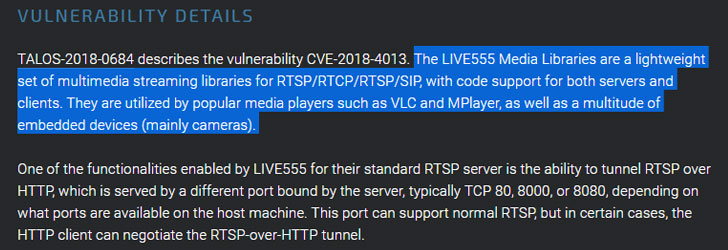
LIVE555 streaming media, developed and maintained by Live Networks, is a set of C++ libraries
companies and application developers use to stream multimedia over
open standard protocols like RTP/RTCP, RTSP or SIP.
[1]
The LIVE555 streaming media libraries support streaming, receiving,
and processing of various video formats such as MPEG, H.265, H.264,
H.263+, VP8, DV, and JPEG video, and several audio codecs such as
MPEG, AAC, AMR, AC-3, and Vorbis.
UPDATE: LIVE555 streaming media library supports both
server and client, and is internally being used by many well-known
media software such as VLC and MPlayer, security researchers at
Talos mentioned in the advisory.
(a server-side library) is being used by the popular VLC player,
team at VLC today contacted THN and clarified that their media
player application is using LIVE555 streaming media at the
client-side only.
The code execution vulnerability, tracked as CVE-2018-4013 and
discovered by researcher Lilith Wyatt of Cisco Talos Intelligence
Group, resides in the HTTP packet-parsing functionality of the
LIVE555 RTSP, which parses HTTP headers for tunneling RTSP over
HTTP.
“A specially crafted packet can cause a stack-based buffer
overflow, resulting in code execution,” Cisco Talos’ security
advisory[2] says. “An attacker can
send a packet to trigger this vulnerability.”
create and send “a packet containing multiple ‘Accept:’ or
‘x-sessioncookie’ strings” to the vulnerable application, which
will trigger a stack buffer overflow in the ‘lookForHeader’
function, leading to arbitrary code execution.
Cisco Talos team confirmed the vulnerability in Live Networks
LIVE555 Media Server version 0.92, but the team believes the
security issue may also be present in the earlier version of the
product.
Cisco Talos responsibly reported the vulnerability to Live
Networks on October 10 and publicly disclosed the security issue on
October 18 after the vendor released security patches[3] on October 17.
References
- ^
Live Networks
(www.live555.com) - ^
security advisory
(blog.talosintelligence.com) - ^
released security patches
(www.live555.com)
Read more http://feedproxy.google.com/~r/TheHackersNews/~3/ZLUcHy_GeDQ/critical-flaw-found-in-streaming.html