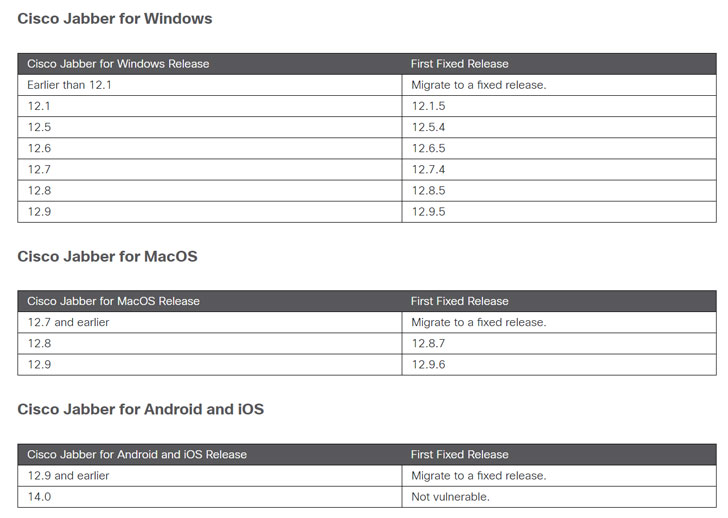
Cisco on Wednesday released software updates to address multiple
vulnerabilities affecting its Jabber messaging clients across
Windows, macOS, Android, and iOS.
Successful exploitation of the flaws could permit an “attacker
to execute arbitrary programs on the underlying operating system
with elevated privileges, access sensitive information, intercept
protected network traffic, or cause a denial of service (DoS)
condition,” the networking major said[1]
in an advisory.
The issues concern a total of five security vulnerabilities,
three of which (CVE-2021-1411, CVE-2021-1417, and CVE-2021-1418)
were reported to the company by Olav Sortland Thoresen of Watchcom,
with two others (CVE-2021-1469 and CVE-2021-1471) uncovered during
internal security testing.
Cisco notes that the flaws are not dependent on one another, and
that exploitation of any one of the vulnerabilities doesn’t hinge
on the exploitation of another. But in order to do this, an
attacker needs to be authenticated to an Extensible Messaging and
Presence Protocol (XMPP) server running the vulnerable software, as
well as be able to send XMPP messages.
CVE-2021-1411, which concerns an arbitrary
program execution vulnerability in its Windows app, is also the
most critical, with a CVSS score of 9.9 out of a maximum of 10.
According to Cisco, the flaw is due to improper validation of
message content, thus making it possible for an attacker to send
specially-crafted XMPP messages to the vulnerable client and
execute arbitrary code with the same privileges as that of the user
account running the software.
Besides CVE-2021-1411, four other Jabber flaws have also been
fixed by Cisco, counting —
- CVE-2021-1469 (Windows) – An issue with
improper validation of message content that could result in
arbitrary code execution. - CVE-2021-1417 (Windows) – A failure to
validate message content that could be leveraged to leak sensitive
information, which can then fuel further attacks. - CVE-2021-1471 (Windows, macOS, Android, iOS) –
A certificate validation vulnerability that could be abused to
intercept network requests and even modify connections between the
Jabber client and a server - CVE-2021-1418 (Windows, macOS, Android, iOS) –
An issue arising from improper validation of message content that
could be exploited by sending crafted XMPP messages to cause a
denial-of-service (DoS) condition.
This is far from the first time Norwegian cybersecurity firm
Watchcom has uncovered flaws in Jabber clients. In September 2020,
Cisco resolved four flaws[2]
in its Windows app that could permit an authenticated, remote
attacker to execute arbitrary code. But after three of the four
vulnerabilities were not “sufficiently mitigated,” the company
ended up releasing the second round of patches[3]
in December.
In addition to the fix for Jabber, Cisco has also published
37 other advisories[4]
that go into detail about security updates for a number of medium
and high severity security issues affecting various Cisco
products.
References
- ^
said
(tools.cisco.com) - ^
resolved
four flaws (thehackernews.com) - ^
second
round of patches (thehackernews.com) - ^
37 other
advisories (tools.cisco.com)