systems and IP cameras, recently patched three of the four critical
flaws impacting its card and fingerprint scanners that could’ve
potentially allowed attackers to intercept network traffic and
stage man-in-the-middle attacks.
In a report shared exclusively with The Hacker News, enterprise
security firm Acronis said it discovered the vulnerabilities last
year following a routine security audit of a Singapore-based major
retailer.
“Malicious attackers can establish persistence on the network
and spy on internal users, steal data — without ever getting
detected,” Acronis said.
“They can reuse your fingerprint data to enter your home and/or
personal devices, and photos can be easily reused by malicious
actors to perpetrate identity theft based on biometric data.”
[1]
In all, the flaws affect at least 6 device families, with over
2,500 vulnerable devices discovered online across Brazil, US,
Germany, Taiwan, and Japan, aside from thousands of other devices
capable of being remotely compromised.
The first issue concerns a previously undocumented root password
that permits an attacker backdoor access to a device by simply
using the default password (“admin”) and remotely log in to the
vulnerable device (e.g., https://ip.of.the.device/isshd.htm).
A second flaw involves the use of hardcoded shared cryptographic
private keys when authenticating via SSH, while a third
vulnerability makes it possible to access system logs on the device
(e.g., at https://ip.of.the.device/messages.txt and at
https://ip.of.the.device/messages.old.txt) without any
authentication.
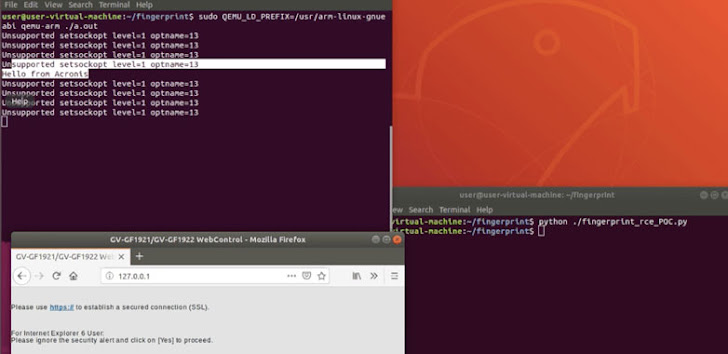
Lastly, there exists a buffer overflow
vulnerability in the firmware impacting GeoVision’s fingerprint
readers that allows attackers to run unauthorized code on the
devices. It requires no prior authentication. Even more
troublingly, it has a CVSS rating of 10, making it a critical flaw.
Acronis said it initially approached GeoVision last August,
subsequently twice in September and December, in addition to
contacting SingCERT with their findings. But it wasn’t until early
this month that GeoVision issued fixes for three of the flaws
(version 1.22) while leaving the buffer overflow vulnerability
unpatched.
The flaws were also acknowledged by Taiwan’s Computer Emergency
Response Team (TWCERT), which published advisories for the three
bugs — CVE-2020-3928,
CVE-2020-3929, and
CVE-2020-3930 —
confirming the firmware fixes and the availability of the new
version.
[3][4][5]
Besides this, without disclosing technical information on the
fourth critical remote code execution flaw that the company left
unpatched, we can mention that it could let attackers leverage a
vulnerable parameter to overwrite memory structures responsible for
memory management.
The flaw eventually overwrites the pointers in particular
structures, allowing attackers to redirect the program’s execution
flow to their own malicious code and perform different
commands.
We have reached out to GeoVision to ask for their comment on the
disclosures, but we did not receive a response before this
article’s publication.
“Once the attacker gets full control over the device, he/she is
free to install their own malicious firmware — after which it will
be almost impossible to evict them from the network,” Acronis CISO
CISO Kevin Reed and Security Researcher Alex Koshelev said.
“It’s quite surreal seeing some vendors not rushing to fix
critical vulnerabilities — in addition to the low quality of the
initial source code, the presence of back doors is concerning. It
shows that IoT security is flawed, and each company must understand
that using such devices can leave them exposed to prolonged
unmitigated risks.”
References
- ^
Acronis
(www.acronis.com) - ^
buffer overflow vulnerability
(owasp.org) - ^
CVE-2020-3928
(www.twcert.org.tw) - ^
CVE-2020-3929
(www.twcert.org.tw) - ^
CVE-2020-3930
(www.twcert.org.tw)
Read more http://feedproxy.google.com/~r/TheHackersNews/~3/pEaEvtxl_Vw/geovision-scanner-vulnerabilities.html